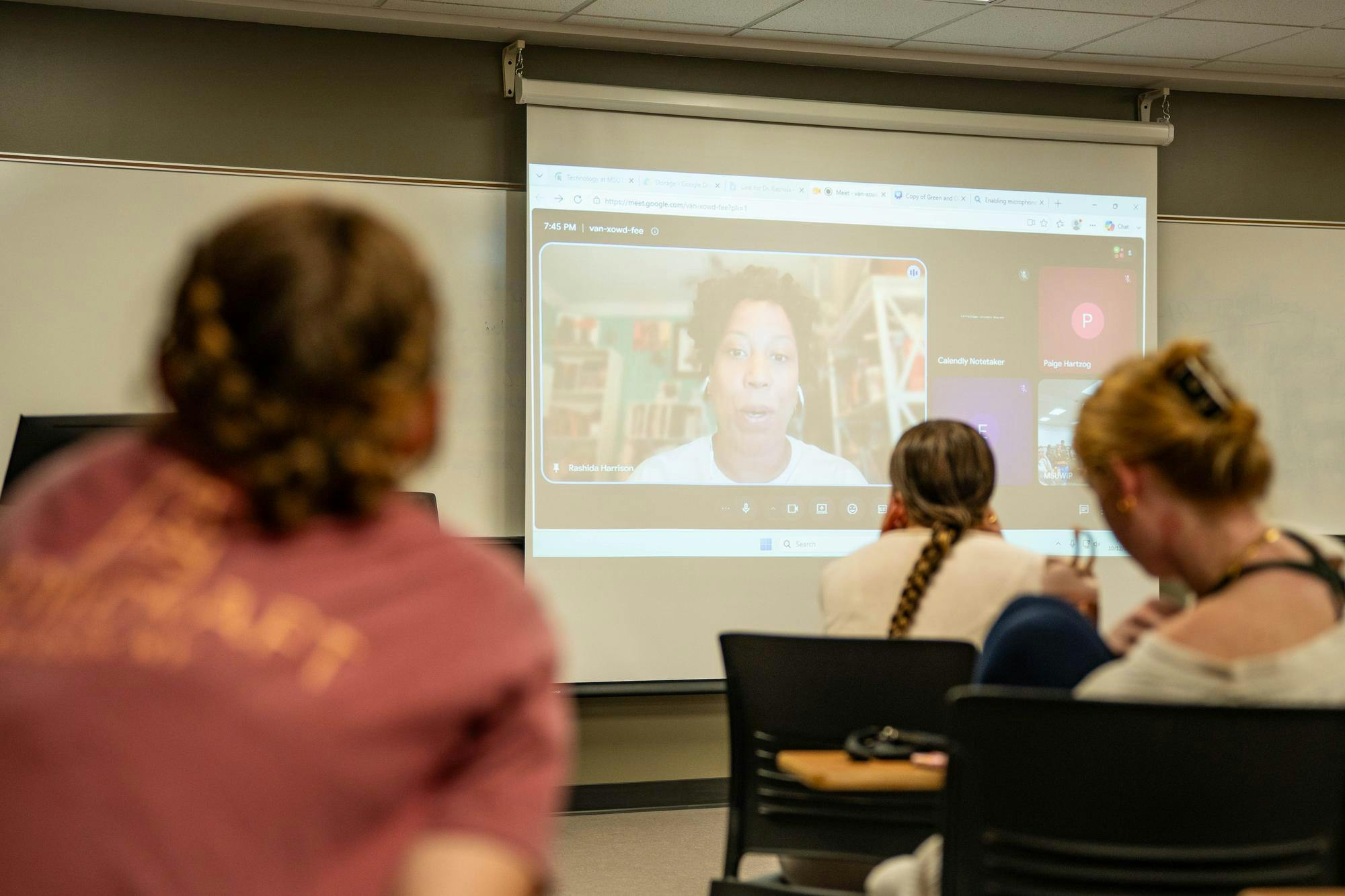
When Dr. Rashida Harrison bested three male competitors in her bid to become Michigan's 28th state senate district Democratic nominee, she got a phone call.
A "man in politics" alluded that her victory was from being the “coolest” or “prettiest thing" on the ballot, Harrison told the Women in Policy and United Madison Multicultural Association Monday night.
He gave Harrison the advice to “not lose” herself, spurring her commitment to develop future political spaces for women.
Harrison, a former assistant Social Relations and Policy professor in James Madison College, grew up co-parenting her siblings in the South Bronx of New York City after her working-class family was hit hard by the crack epidemic of the 1980s. She attended Cornell University as a first generation student, before pursuing her Ph.D in African American and African Studies at Michigan State University.
“Much of my life and how I’ve seen the world has been through the lens of knowing that if people have more resources, things could get done, and striving to get into places where I could facilitate more resources,” Harrison said.
Harrison “jumped in” to politics, running for state senate not as a career politician, but as someone who wants change. If Harrison is elected, the Democratic Senate caucus will have more women than men. It will also be the largest Black senate in Michigan’s history.
This doesn’t come without its challenges.
“The ways in which the political infrastructure exists was never made for women,” Harrison said. “I learned more and more how it wasn't made for us, and that made me want it more.”
Harrison was the only woman in her primary, up against three men who were older with more experience: Mark Polsdofer, Robert Pena and Ted Kilvington.
All women in politics need to "embrace deep down" that nothing comes easy, Harrison said.
Showing up and being a mother and a career woman at the same time is part of the struggle. Harrison, mother to an eight-year-old herself, spoke of the difficulty of being both all of the time, and the standards set in place that make it that way.
“In this hetero-patriarchal space, women are home, taking care of the children, even if they have a job,” Harrison said. “They still do the second shift.”
This responsibility follows women outside of motherhood as well as they often become the caretakers of communities.
Having community is not a negative, however. Harrison emphasized the importance of women having a mentor, or allies in a certain space.
“Part of my role is me continuing to be a mentor and to pay it forward, as well as being a symbol so that people can see me and be like, ‘Oh shoot,’” Harrison said.
Field organizer Sammy Leggett, a junior majoring in political theory and constitutional democracy and social relations and policy, said Harrison has become a mentor for him.
“Just seeing someone like Dr. Harrison and knowing that they can easily go to her … I think that will be really helpful for young women," Leggett said.
Having a “cohort of people breaking through this glass" in MSU students comforts Harrison that she is not alone, saying that its hard to build anything "sustainable" without help.
“You have me here, so it will be easier. I am definitely gonna help,” Harrison said. “I’d love to encourage more women in the field, we need your voices, we need your experiences.”
Support student media!
Please consider donating to The State News and help fund the future of journalism.
Discussion
Share and discuss “State Senate candidate Rashida Harrison encourages women to pursue political careers” on social media.