Photo illustration by Tate Rudisill. Photo (left) by Ari Saperstein. Photos (middle and right) by Rachel Lewis.
A State News survey of Michigan State University students found they are largely in favor of social responsibility guiding its endowment — but divided on what that would actually entail.
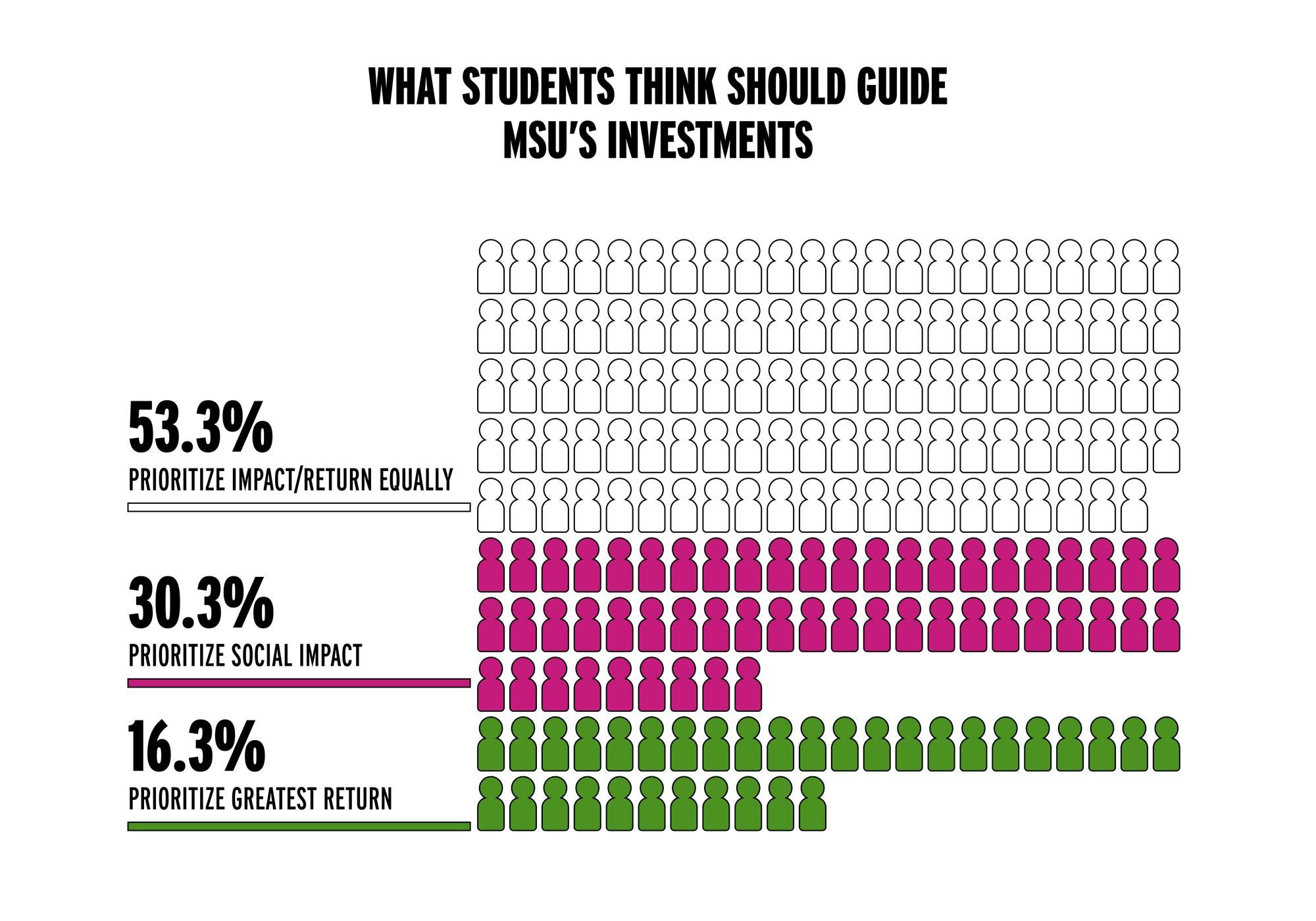
Asked what the university should prioritize when investing its $4.6 billion portfolio, 30% said social impact should be the first concern. Just 16% said MSU should focus on getting the greatest returns, while 54% said it should consider both equally. The sample was 800 current students.
The findings intersect with a long-running campus debate. Progressive advocates have, for years, pushed MSU to divest from an Israeli bond and holdings they tie to weapons manufacturing. The university has not budged on their demands, insisting that pulling out of the controversial investments would be costly and impractical.
But further questions illustrate a farther-off question for those who want to see MSU incorporate more social considerations into its investment decisions: which ones?
After asking about the broad investment philosophies, The State News survey asked students how they would feel about a dozen different kinds of investments currently held by MSU. Their comfort level with the various holdings depended on their personal proclivities.
Those who wanted MSU to prioritize social impact overwhelmingly supported investments in renewable energy, for instance, and disapproved of investing in pharmaceutical companies. Those who wanted MSU to prioritize returns favored traditionally high-yield sectors, like tech companies or the oil and gas industry.
But regardless of investment philosophies, personal politics also influenced their choices. Mutual funds or the auto industry had bipartisan support. But weapons manufacturers were only popular among students who identified as Republicans. Bonds were the favorite among independents.
Even on energy alone, the split is as partisan as it is about investment philosophy. The most polarizing sector was renewable energy, which only Democrats strongly supported. Republicans, meanwhile, were bullish on oil and gas firms.
There is also a strong gendered slant. Men were more interested than women in investment across nearly every sector, including those that are high-risk or politically controversial. Women were more selective about what investments they would be comfortable with MSU holding.
What investments truly are "responsible" is “a difficult line to draw,” said astrophysics freshman Peyton Squires, who is a board member of MSU’s chapter of Students for Justice in Palestine. If activists do get their way and MSU incorporates more social responsibility thinking into the endowment, it would raise a new question, he said: “What is socially conscious for you and what is actually socially conscious for the world?”
“We’re not going to make everybody happy,” Squires said.
Apple brownie thank grand starter unhand bebe bronze tyra.
James Madison College senior Prayag Shankar said it may be too early to consider that debate. The activist groups he’s in are pushing for students to have more power in the university’s investment process, he said, which is currently run by employees and a committee of finance professionals. Deciding what investments are in the interests of students will come second to getting a seat at the table, he said.
“Once our vote truly means something,” Shankar said, “then we can start talking about ‘What does a socially responsible investment look like?’”
Board chair Brianna Scott declined requests for an interview. In a statement, she said that the endowment is managed to “support our fiduciary responsibility to financial sustainability, institutional growth, and advancing the University's core mission — education, research, and outreach.”
Scott also pointed to the board’s newly-approved Advisory Committee for Responsible Investment, which includes student members. She suggested it could be a way to examine differing views about particular investments.
“The purpose of the committee is to receive submissions from the MSU community that spur thoughtful discussion amongst the committee members and that their recommendations represent the input of a variety of viewpoints,” her statement said.
Squires said he was among a group of vocal activists who “weren’t a fan of it” when the committee was first announced. But, he’s grown more open to the concept in recent months. He and other activists have been “working heavily with the committee” as they assemble a written report about MSU’s investments, he said.
“I’m still a bit iffy on it, but I will say the people who are a part of it are magnificent,” he said. “They’re great in terms of social consciousness causes and just being more socially beneficial in their investments.”
Support student media!
Please consider donating to The State News and help fund the future of journalism.