Photo illustration by Tate Rudisill. State News file photos.
Amid worries about a particularly gruesome job market, Michigan State University students largely believe that their degrees are worth the investment, according to a State News survey.
A sample of 800 current students was asked if they agreed with the following statement: “The education I am receiving at MSU is worth the financial investment.” On average, they either somewhat or strongly agreed. Only 5% strongly disagreed.
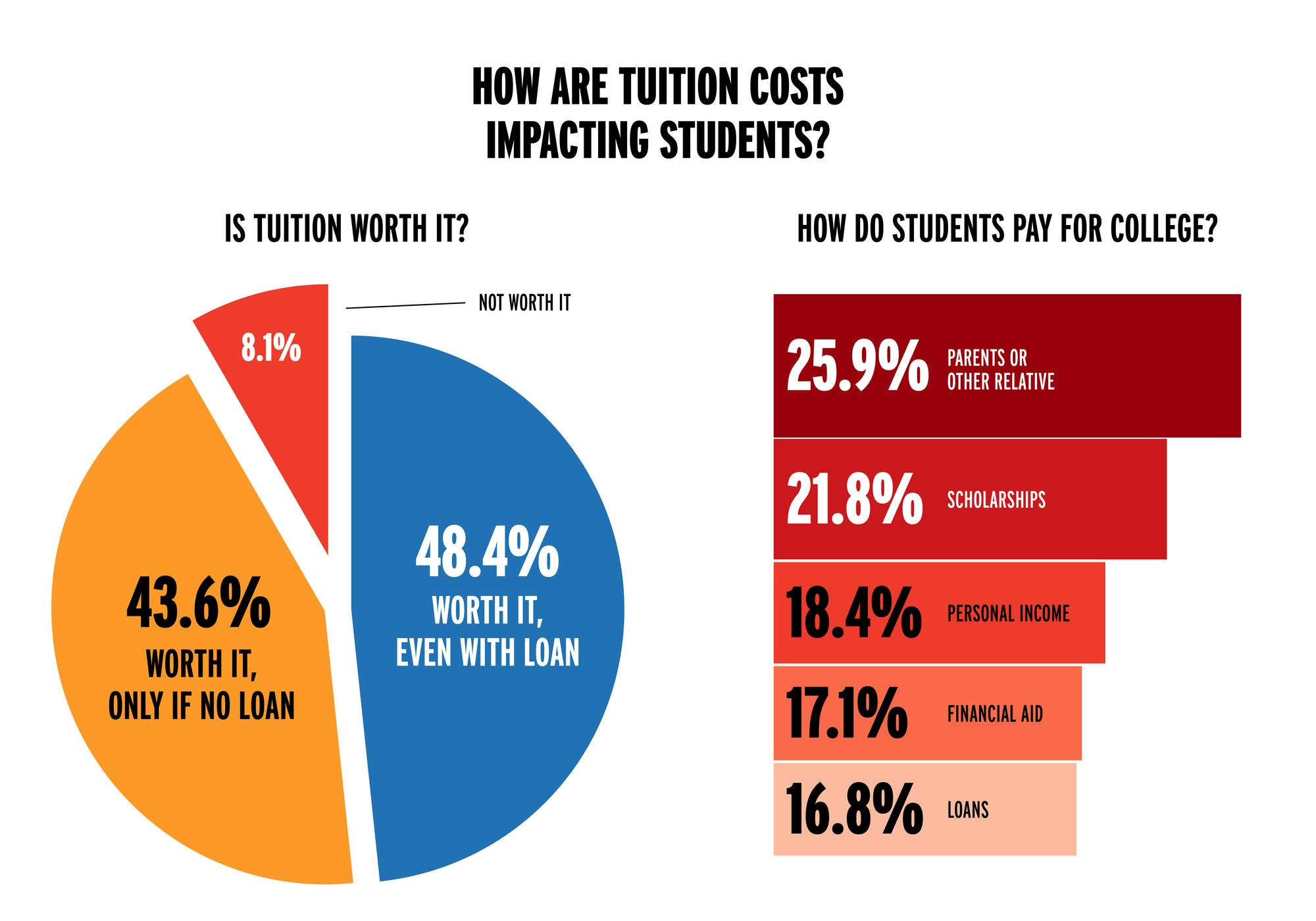
The survey also asked them to consider the worth of their degrees in relation to hypothetical student loans. About 44% of students said a degree is worth it, even with loans; 46% said it would only be worth it without loans; and 10% said it was not worth it, no matter what.
Overall, the MSU students in the State News’ sample were far less skeptical about the worth of college than the average American adult, according to a comparison with a recent Pew Research survey that asked some of the same questions.
The MSU students' opinions are somewhat correlated with how they finance their own education. Those who said it would only be worth it without loans were more likely to rely heavily on parents and other relatives to pay their tuition. Those who said it was not worth it no matter what, had, on average, fewer financial pathways to pay for their education. They were less likely to access money from family or scholarships, for instance.
The data should be interpreted with caution, said Phillip Levine, an economics professor at Wellesley College who studies the cost of college. People naturally want to believe they make smart decisions, he said, so college students saying college is worth it may tell more about “human nature” than the actual value of education.
Still, he said, there is broadly strong evidence that a college degree is ultimately worthwhile for most people. There are outliers, he said, but “for the average student, college is worth it. Period.”
The way he sees it, college is ultimately a question of return on investment. For most people, the cost will be in the tens of thousands of dollars, and the return will be hundreds of thousands of dollars in increased earnings over a lifetime. But, Levine said, most people focus solely on the cost and don’t think about the return.
Many Americans don’t approach decisions about college in a way that is "economically rational,” said Jeff Strohl, director of the Center on Education and the Workforce at Georgetown University.
“They do it when they buy a house,” he said. “So, why don’t they do it when they get an education? I think they used to, because cost became such a dominant part of the conversation.”
Even if you accept that cost will be the focus, Levine said those conversations often involve the wrong number. People look at the “sticker-price” — the full listed cost of tuition — without considering how many students actually pay it, he said.
At MSU, only about half of students actually pay the full price of tuition, according to the university’s most recent public data. That’s in line for large public universities with R1 research status, Levine said.
The State News survey shows how the ways students pay for an MSU degree also shift over the course of their education. Freshmen were most likely to have family funding their education, with about 84% reporting that they relied on parents or other relatives to pay tuition. Only about 73% of Seniors, by contrast, reported relying on family. They were instead more likely to use personal incomes or loans to pay tuition.
There is also a demographic split, where students of color reported a heavier reliance on loans than white students, who relied more on their parents and personal income.
Race and class year were not meaningful predictors of how students perceived the worth of their degree. But gender was.
Women were consistently more positive about the value of a college education than men. They were more likely to say that a degree is worth the investment and more skeptical about the job prospects of someone without one.
Strohl said that is true nationally, and even manifests in enrollment. Though MSU’s student body is currently split about evenly, college enrollment overall today skews towards women. Today’s women “have been enculturated to understand differently than men the value of education,” Strohl said, because college has created economic independence for many women in recent history.
The survey also asked students to consider how someone would fare in today’s job market without a degree. They were moderately confident, with about 60% saying a “good job” is either “somewhat,” “very,” or “extremely” likely for someone without a college degree. Still, the responses were more skeptical than those from a recent Pew survey of American adults overall.
Support student media!
Please consider donating to The State News and help fund the future of journalism.