President Kevin Guskiewicz's decision to stay at Michigan State University comes with a newly extended contract extending his presidency through 2031, a $1.5 million salary and added benefits such as private jet travel, as he seeks to rebuild trust with faculty and the broader campus community.
On Monday, Guskiewicz rescinded his May announcement that he would be taking the top job at Clemson University, saying he would remain MSU's president following a “period of deep personal reflection.”
In a community letter sent the same day, Guskiewicz said he was “sincerely sorry” for any uncertainty he created.
Guskiewicz also acknowledged that there may be a renewed sense of distrust over his commitment to the university.
"I recognize that some members of our community may have questions about my commitment," Guskiewicz wrote. "That is understandable. Our university has experienced more than its share of change in recent years, and I regret that my decision-making over the past several weeks added to that uncertainty."
‘Level of distrust’
Following the announcement of Guskiewicz staying, the Faculty Steering Committee has asked the school’s Academic Congress to vote on two resolutions — one being whether faculty have “confidence and trust” in the president to "effectively" lead MSU and if they have “confidence and trust” in the ability of the Board of Trustees to “effectively oversee” MSU.
The voting will close on Tuesday, July 14, 2026, and the results will be shared with all members of the Academic Congress, the President, the Board of Trustees and members of the public, according to a press release.
Local 1855 Union, formerly known as the Union for Non-Tenure Faculty, President Victor Rodriguez-Pereira said faculty's sense of distrust is nothing new for this administration.
"I think a lot of faculty already had a level of distrust from this administration, stemming back from the budget cuts that were rolled out about a year or so ago," Rodriguez-Pereira said. "There has been a healthy level of distrust even before his departure, for both him and the Board of Trustees."
Rodriguez-Pereira said Guskiewicz's reversal has only compounded those concerns.
"His departure and return adds to a level of distrust that was already there," he said.
The uncertainty around some of Guskiewicz’s initiatives has only increased this feeling, Rodriguez-Pereira said, including the athletics-driven nonprofit Spartan Ventures.
Guskiewicz spearheaded Spartan Ventures to bring in money for name, image and likeness for student-athletes, revamp infrastructure and give MSU Athletics a monetary advantage over other institutions. The entity launched on July 1 after the Board of Trustees approved the creation of the non-profit in late 2025, but not much has been made public.
“Spartan Ventures might end up being a good thing or not, but the fact that we know so very little about it, it seems that there is a lot more of an effort to put resources in athletics than in education, which is concerning for faculty right now,” Rodriguez-Pereira said.
While Rodriguez-Pereira described Guskiewicz as "very personable" and "always open and receptive to hear us out," he said rebuilding confidence among faculty will require more than public outreach.
"There's been so much talking in the last year," Rodriguez-Pereira said. "I think it will all come down to actions and what they do in the next year."
Other faculty members viewed Guskiewicz’s return differently.
Over 40 MSU endowed chairs and distinguished professors sent a letter to Guskiewicz asking him to stay at MSU on June 19 — 13 days after Guskiewicz announced he would be leaving for Clemson.
“You have demonstrated yourself as impatient with the status quo and looking towards the horizon," the letter read. "Please stay and continue guiding us there.”
Support student media!
Please consider donating to The State News and help fund the future of journalism.
MSU Foundation Professor Joey Huston, one faculty member who signed the letter, said sending the letter was a “Hail Mary.”
"We were pessimistic about working," Huston said. "Having him stay is great for the university on so many levels. It allows him to continue the program of progress that he has planned."
Huston said another presidential search would have disrupted the university's momentum.
"A presidential transition is, by definition, an interruption," Huston said. "I think this makes MSU stronger, just having President Guskiewicz continue."
Jeff Freymueller, the Chair of the Department of Earth and Environmental Sciences, who also signed the letter, said that part of his reaction to Guskiewicz's departure was, "Here we go again. How many presidents have there been since I got here in 2018? I've lost count.”
“I think we would be worse off if he had just left,” Freymueller said. “I think we’re better off with him coming back than if he had just left.”
Freymueller said rebuilding trust, for those who feel it has been damaged, will require consistency from Guskiewicz and the Board of Trustees.
“If somebody is feeling a little bit of mistrust, what they need to see is that he’s being committed and showing the commitment, and that it’s sustained over time,” Freymueller said. “There’s no way it just magically comes back instantly. You just have to build that over time.”
Some of the trust issues stem from how Guskiewicz initially left the university.
In his departure letter sent May 27, Guskiewicz pointed to trustees on the board for creating an “unsustainable situation” at MSU.
The Association of Governing Boards of Universities and Colleges conducted a review of the MSU board in late April of 2026. The board ranked low in leadership, shared governance and board experience, according to public records The Detroit News obtained.
In a statement to The State News, the AGB shared that “after public conflicts, boards and presidents can rebuild confidence by reaffirming governance norms, engaging in candid but constructive dialogue, and demonstrating that disagreements will be handled through appropriate board processes rather than public division or personal agendas.”
“This is critically important to long-term institutional health because governance instability, blurred roles, leaks, public infighting, and lack of trust can make it significantly harder for universities to recruit and retain strong presidents,” the statement continued.
Freymueller said future conflicts between Guskiewicz and the board could further erode confidence among faculty, unless the two demonstrate they are able to work together.
“If there’s further vacillation from the president, that’s a big negative,” Freymueller said. “If there’s further issues with the board and squirrely behavior and other issues showing up, that’ll be seen as a negative.”
With his return, Guskiewicz said in a Monday interview with The State News that he has worked with the board to find ways to move forward.
“We had productive conversations about how the board can operate more strategically, more effectively, and that really means functioning as a whole board and trying to get us sort of rowing together in the same direction," Guskiewicz said.
New contract
As Guskiewicz no longer has to order the moving trucks, he will now get private jet access atop a higher salary at MSU.
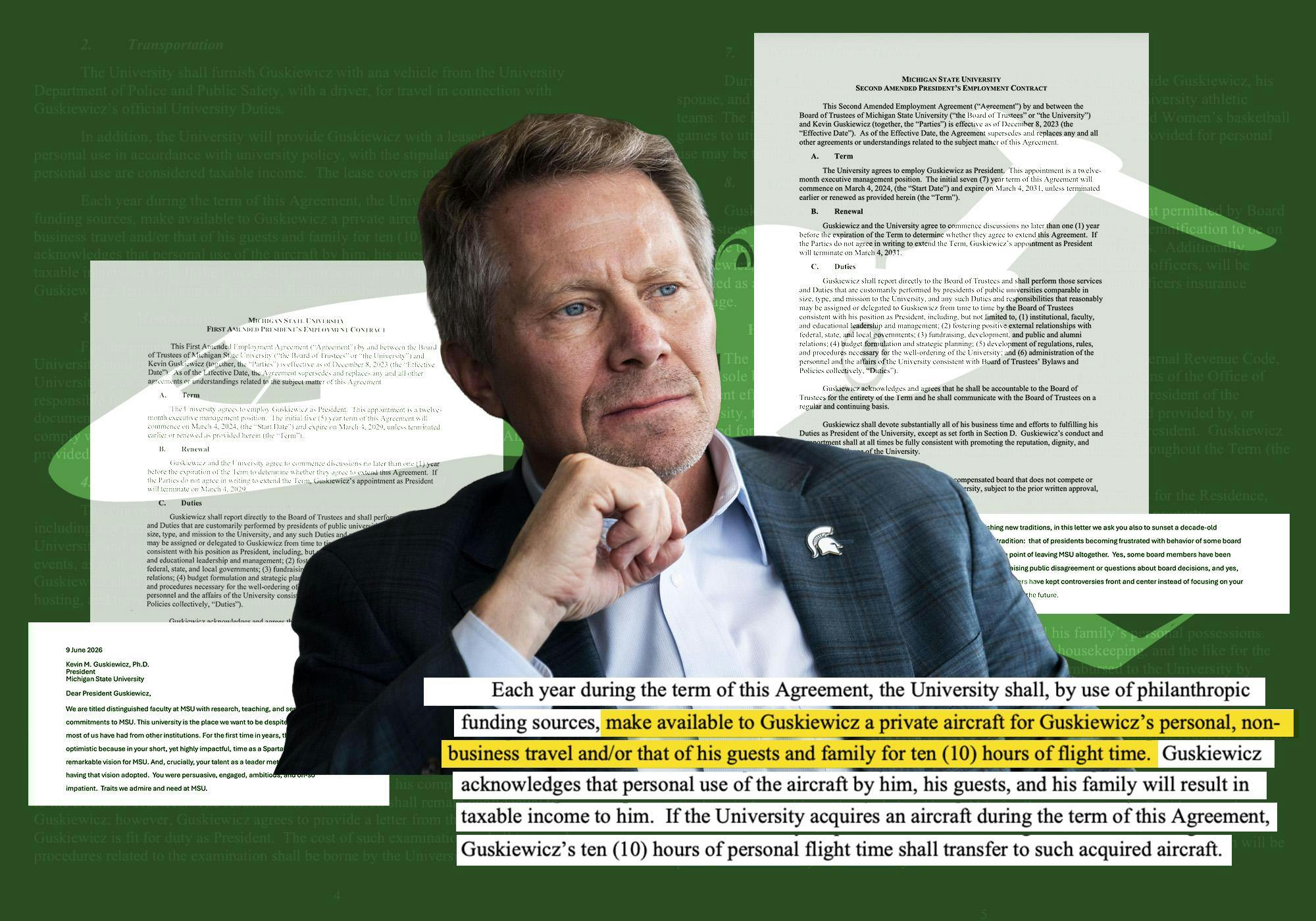
In his revised contract, Guskiewicz's term was extended through 2031 and his base salary was bumped from $1,029,210 to $1,500,000. His annual deferred compensation awards rose from $200,000 to $250,000. This raise will be funded by “non-university resources,” according to a press release sent Monday.
Judith Wilde, a research professor specializing in university presidential compensation at George Mason University, pointed out that Guskiewicz hasn’t publicly called for an increase in salary.
“He has never once mentioned salary. The fact that they gave him this much of a raise leads to a great deal of financial need in the future," Wilde said. "I don't think the board really thought about how much they were adding to his salary."
Beyond MSU, the raise fits a national pattern. Seven-figure base salaries are increasingly common among public university presidents, said James Finkelstein, a George Mason University professor emeritus who studies college leadership.
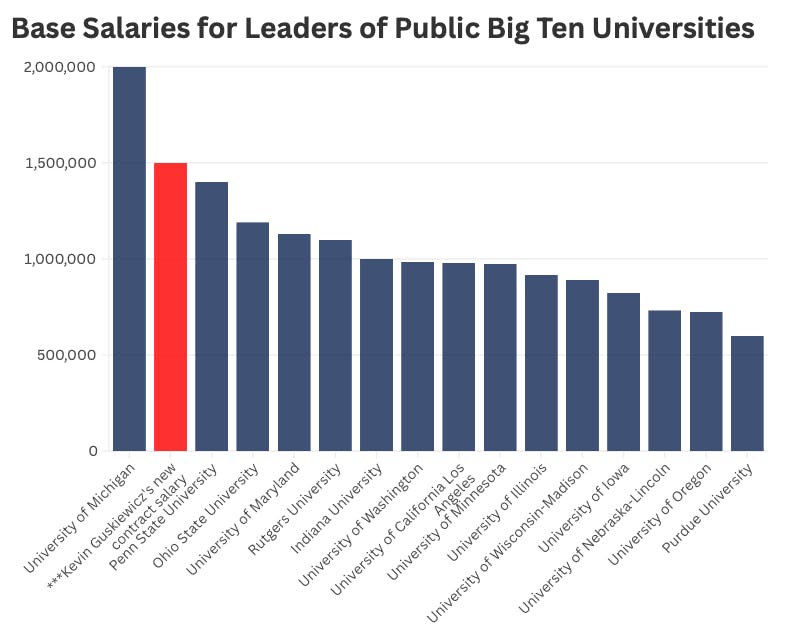
MSU was ready to pay Guskiewicz $2 million in efforts to retain him before his Clemson announcement. The only other public Big Ten university to offer a similar presidential salary is the University of Michigan, which offered its then-incoming president $2 million before he stepped down due to a cancer diagnosis.
Now, Guskiewicz will be the second-highest-paid public Big Ten university president. Behind MSU is Penn State University’s president, who earns $1.4 million annually.
Guskiewicz's new contract also offers up to 10 hours of private aircraft flight time for personal use for guests and family.
"The first thing that's really unusual is the bit about being able to use an aircraft," Wilde said. Private jet access shows up "very occasionally" in these agreements, but almost always tethered to official business.
"This one has no restrictions whatsoever and specifically says he can use it for anything — for himself, his family and his guests," Wilde said. "We've never seen that in a contract before."
10 hours of flight time may sound modest, but on a chartered jet, the costs add up fast, Finkelstein said.
"10 hours of a luxury private jet could run into six figures pretty quickly," Finkelstein said.
The only comparable case both Finkelstein and Wilde could recall was Gordon Gee's arrangement at Ohio State University, which they said involved official travel rather than personal vacations.
"You would think if he (Guskiewicz) wanted to go on vacation and fly first class, he would be able to afford it," Finkelstein said. Instead, he said, "Guskiewicz can take 10 of his best friends on a corporate jet and the donors at the university would have to pick up the charge."
Discussion
Share and discuss “MSU rewards Guskiewicz for staying as faculty remain split” on social media.