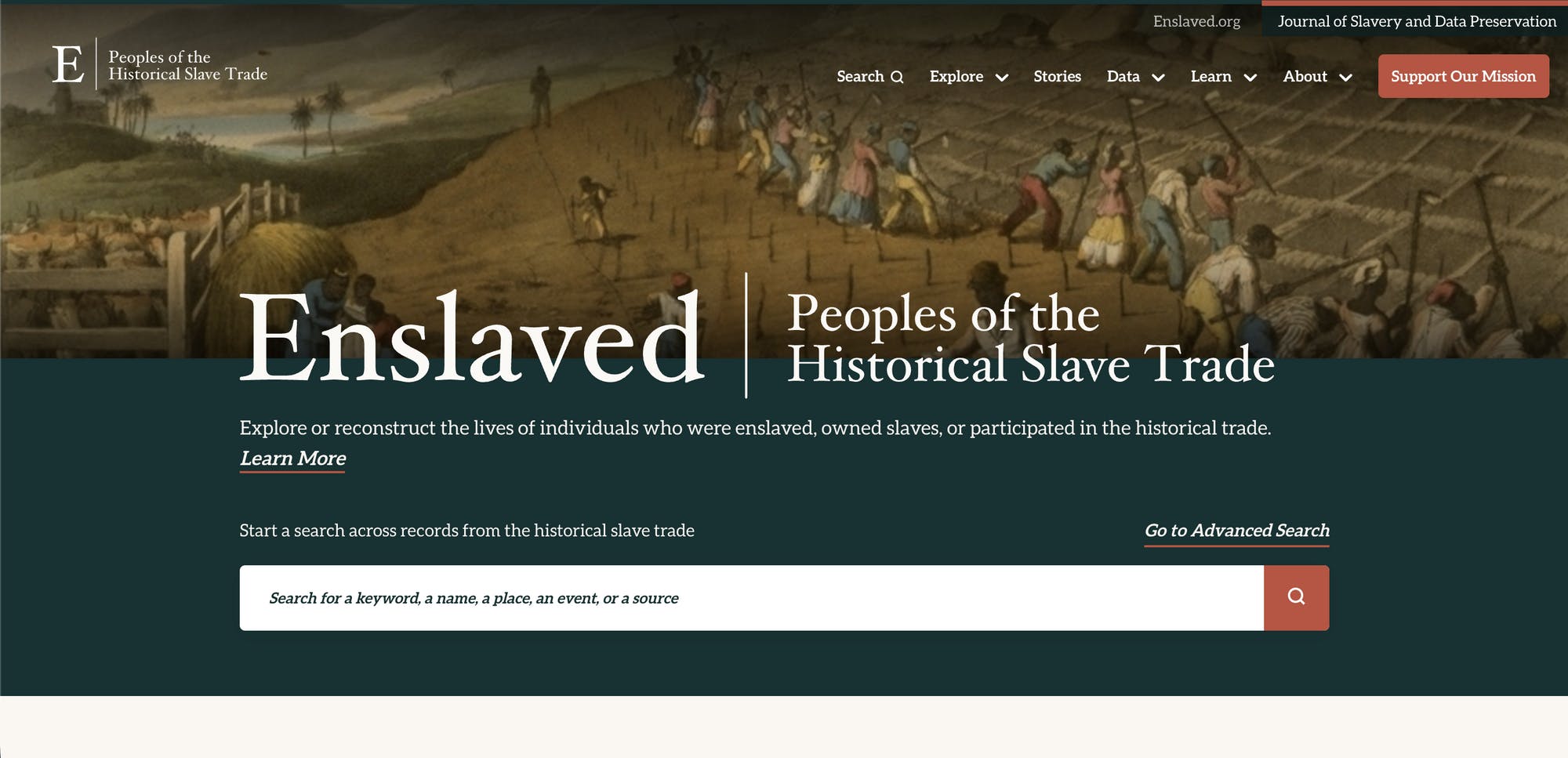
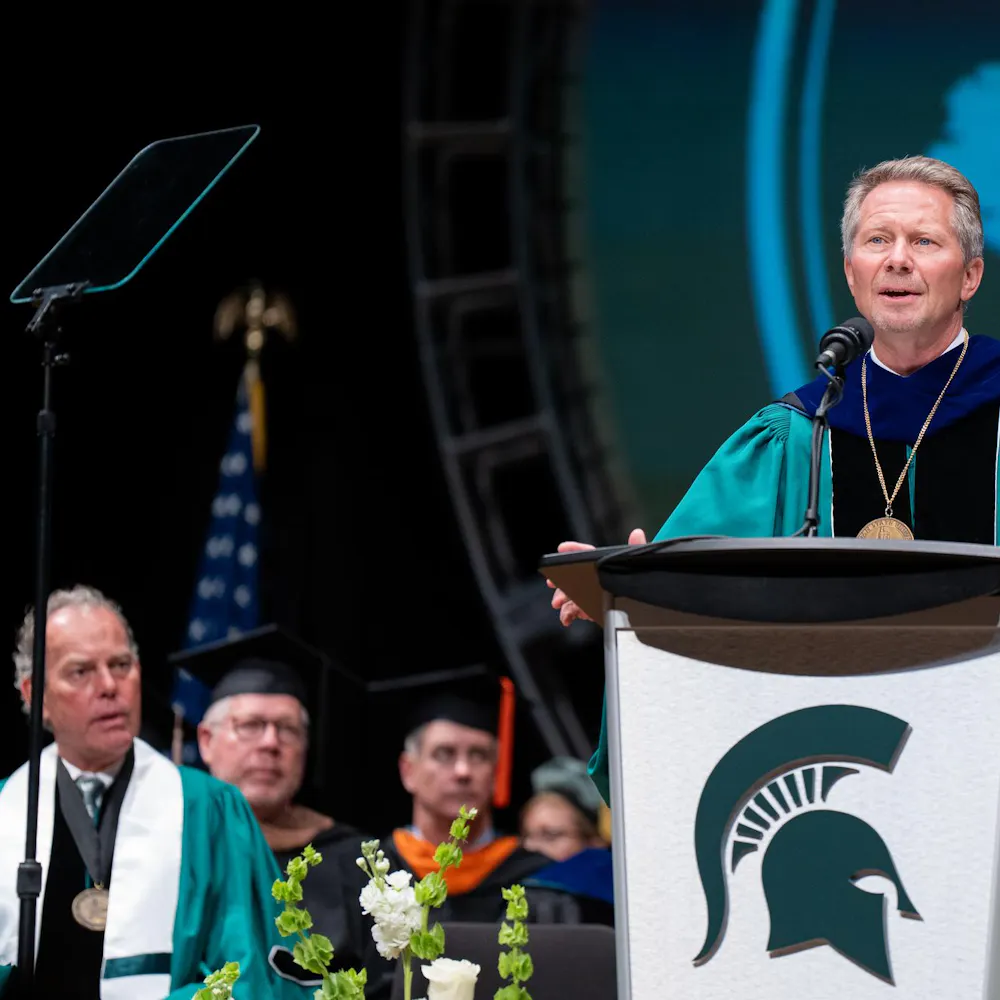
“Michigan State University really offered an ideal place to have a project, any digital project, but particularly a project about enslaved people,” Hawthorne said.
MSU has a digital humanities and social science center with a team of experts, system administrators, programmers, project managers and scholars of slavery and the Atlantic slave trade. Hawthorne said that without the College of Social Science’s support for Matrix and the broad support MSU provides, this project could never have taken place.
The Mellon Foundation, a foundation that funds cultural heritage projects, became interested and gave a series of grants totaling $4 million to create the project that is now called Enslaved.org. Enslaved.org builds on the previous project, Slave Biographies.
Most funding for Enslaved.org comes from the NEH and the Mellon Foundation. However, they have pursued external grants to launch the project and keep it going.
“That funding from Michigan State University and the Jenison Fund was really crucial last year,” Hawthorne said.
The Department of Justice, in coordination with the Department of Government Efficiency, cut a variety of grants classified as Diversity, Equity and Inclusion. Enslaved.org was one of the projects affected. Through the Jenison Fund, MSU offered funding that the National Endowment for the Humanities had terminated.
The website’s significance lies in documenting named enslaved individuals whose stories have never been told because their information is fragmented and scattered across archives in many parts of the U.S. The website’s purpose is to move the historical lens of analysis away from enslavers to named enslaved individuals whose stories have never been told before.
Black Americans face the 1870 Brick Wall where, due to enslaved individuals being considered property, they were not being named in the U.S. Census any year prior to 1870. As a result, the website uses sources other than the U.S. Census.
Dean Rehberger, an American historian and co-director of Enslaved.org, helped get the project started with co-directors Daryle Williams and Hawthorne. Rehberger’s role in the project focuses on technical infrastructure.
The idea that it’s more difficult to obtain information about individual slaves is, according to Rehberger, partially true. Because of chattel slavery, there are different types of records available, like wills, marriage, baptismal, property, plantation, probate, sales and escaped enslaved people records.
“That sounds doable, but they tend to be spread all over the world,” Rehberger said.
Contributors visit archives, libraries, historical sites and primary source materials and make the information that’s handwritten machine-readable. Enslaved.org puts all that information together into spreadsheets, publishes them, and if information pops up in other records, links them together to begin forming a biography.
“We do some of this ourselves, but we really rely on contributors,” Hawthorne said.
Rehberger said that people can think of Enslaved.org as bits of information strung together, just like how his grandmother used to make ornaments for their family's Christmas tree by threading little pieces of colored paper into a thread and tying them together.
The website partners with scholars across the country and around the world to collect data and expand its dataset for Enslaved.org.
“We are getting people, you know, who are highly credible; they’re giving their data to us. We’re publishing that data and then putting it into our pool of data,” Rehberger said.
Information about two million enslaved individuals is contained on the website.
“It’s quite a remarkable accomplishment over six years, and we continue to grow,” Hawthorne said.
Support student media!
Please consider donating to The State News and help fund the future of journalism.
When records have the same name, one thing the project never does is say the records are of the same person. Instead, users are told there’s a certain percentage likelihood that it’s the same person. Once a person reaches the record, they decide if they’re related.
“That’s what historians do," Hawthorne said. "We just try to get you to the record."
Although the website isn’t a genealogical site, most users, since its launch, have been from genealogical societies and individuals interested in their own family histories. The website is free of charge, unlike many genealogical websites that have paywalls or subscription services. Users don’t have to identify themselves either.
“Anybody in the world can access the site,” Hawthorne said.
Over the past 12 months, the website has been visited by over 80,000 unique users, according to Hawthorne.
“I can assure you that the majority of those are not academics; the majority of those people are members of the general public,” he said.
Hawthorne said many people, especially Black Americans, have emailed, reached out and attended talks to share how important the website is for them in helping them trace their own family history.
Meghan Wilson, an assistant professor of political science at MSU, happened upon her ancestor, Hannah Johnson, by coincidence. Wilson was part of the Spelman Independent Scholars Oral History Project.
She said she was always interested in having conversations with older members of her community. So when Wilson drove from Detroit to Pennsylvania with her grandmother, more doors opened.
“We were talking, and she was like: ‘Oh, yeah, my great-grandmother was a slave.’ I was like: ‘Wait, what are you talking about? Like there’s no way.”
As a black woman in America, Wilson said she never felt far from slavery. When she came to MSU, her grandmother had brought up the conversation about Hannah Johnson again.
Wilson said her grandmother told her Hannah Johnson was sold on the Johnson plantation. After she was freed from slavery, she owned a store in New Orleans where she sold goods and was a God-fearing woman. Because of the trauma associated with slavery, that was the story Wilson’s grandmother was able to share with her.
At a faculty meeting, someone mentioned to Wilson that they had a data set that was among the most complete in New Orleans.
“I’ve been thinking about it for a long time. It was in me, and then I actually had the opportunity to research it because MSU had the resource. It was this point of: you know this thing deep down in you, but you have no real sense of how it manifested in the world," she said.
Wilson obtained a record of Hannah Johnson’s name, location, birthday and history. Before the record, Wilson said she only had the oral history of who Hannah Johnson was as a person.
“For a lot of Black Americans, when you go far enough back, your ancestors don’t have a name. Families were ripped apart,” she said. “This gave me at least a sense of proof ... I don’t have much story outside of that she owned a store, and now I have the paperwork to show that she has a history."
“The same grandmother who told me that she knew a slave and then we found her is the same grandmother ... It was really hard for her to get a real ID because, again, she was born in New Orleans, and they didn’t give birth certificates to black folks then," Wilson said.
After slavery ended, years of Jim Crow laws and then mass incarceration followed. Rehberger said the project is “more important now than it’s ever been.”
“That history keeps haunting us, so I think that one of the wonderful things about learning history is it’s about both – yes, the terrible things and tragic things that happened, but also the wonderful ways that people have survived,” he said. “Unless you learn their stories, unless you see them as people, then those things can kinda keep going on.”
The website has been helpful for other members of Wilson’s family as well. Her cousin homeschools her children and used it to find her ancestry.
“She really got into the data around it, and she downloaded a lot more stuff than I did," Wilson said. "It was really helpful for just helping students and helping young people have access to family that they might not have had previously."
Rehberger said, “A lot of people are like ‘Oh, we should forget that and not talk about that,’ but I think it makes us stronger. It makes us better and makes us understand where we came from and where we still need to go.”
Discussion
Share and discuss “MSU project helps connect Black Americans to their ancestors” on social media.