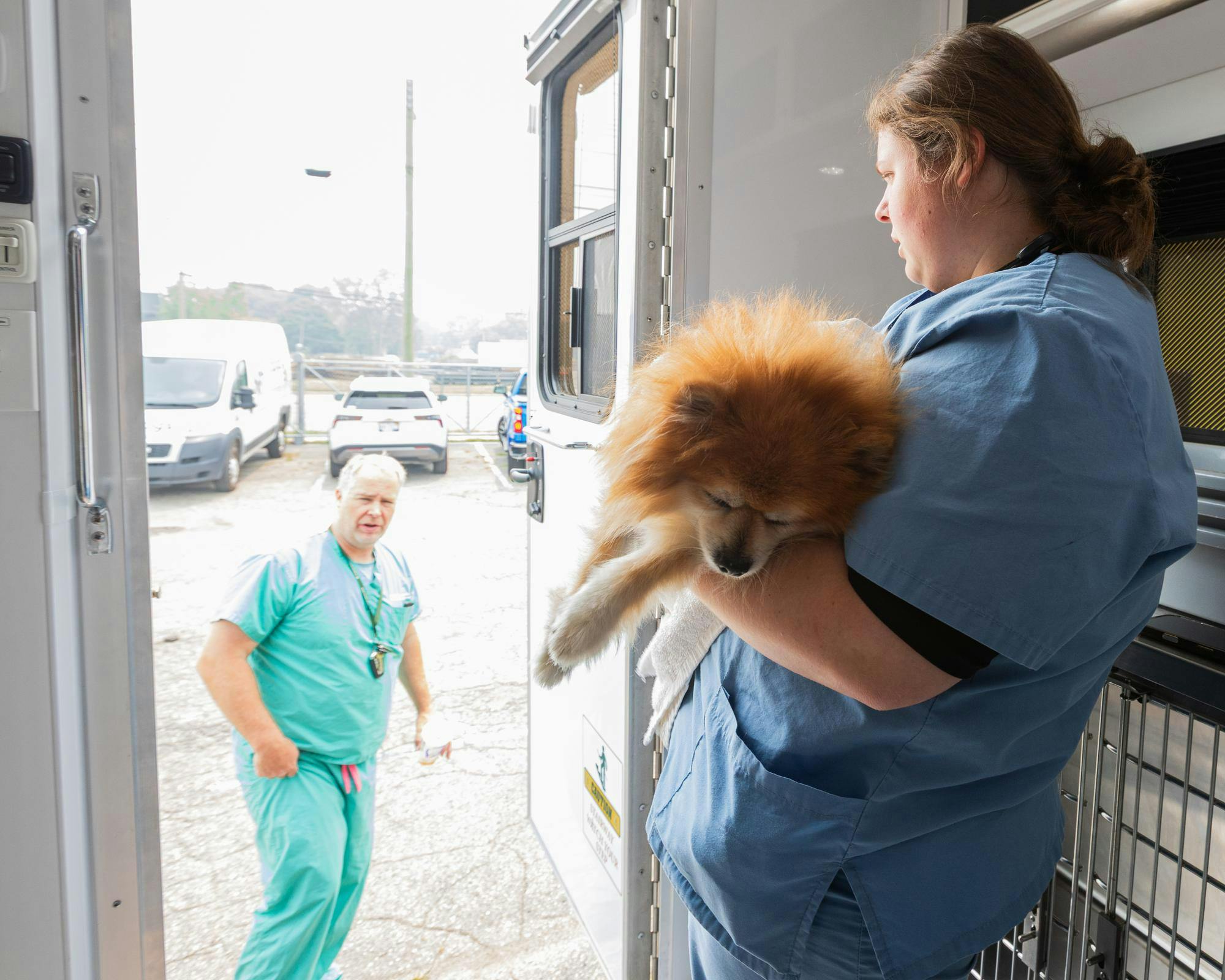
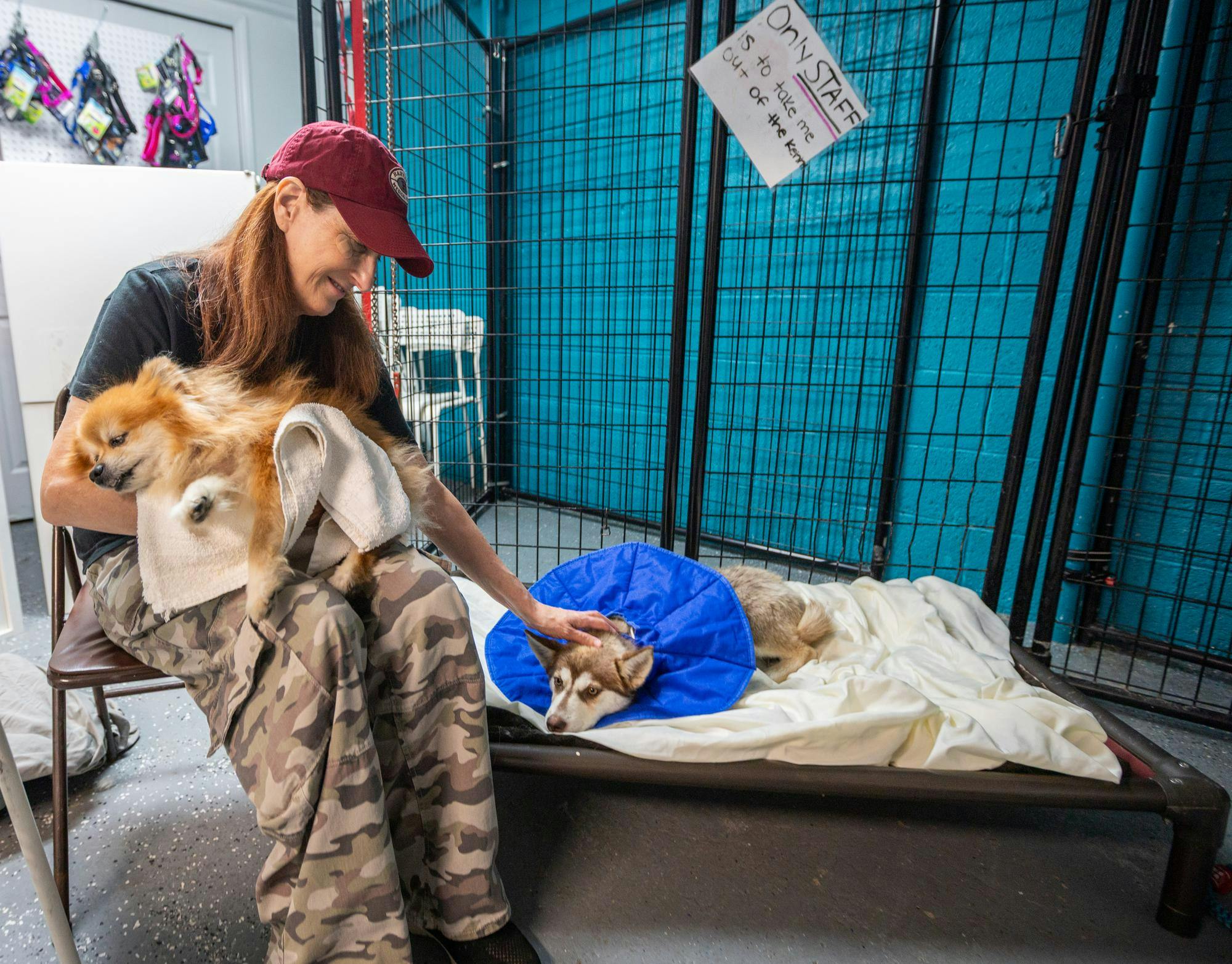
Katlyn Cunningham carries Courage, a dog they just neutered, out of the MSU Veterinary Mobile Unit while waiting for him to wake up in Warren, Mich., on July 16, 2026.
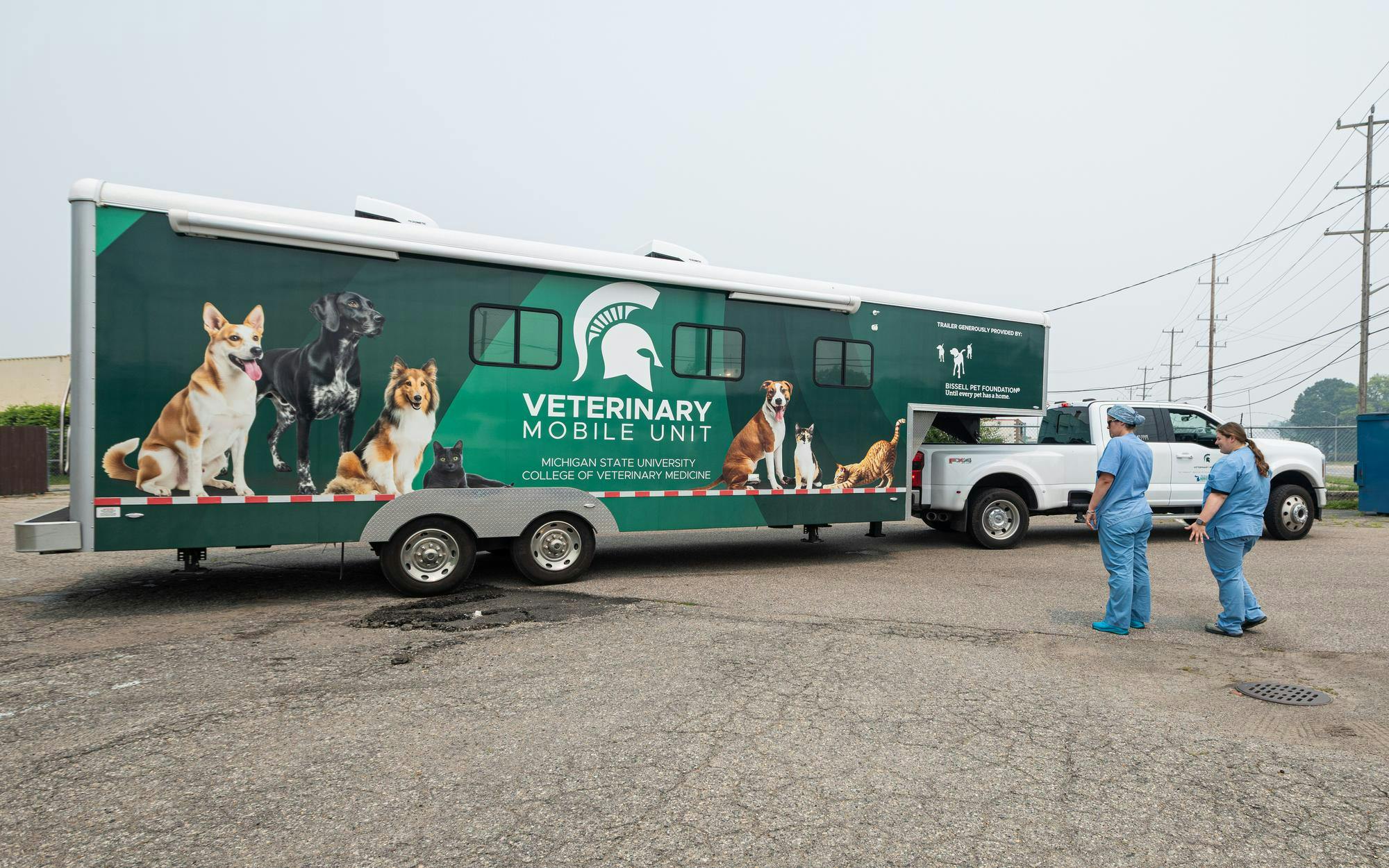
The Michigan State University College of Veterinary Medicine launched the Community Medicine Program and a mobile surgical unit last month, offering spay-and-neuter services to shelters that struggle to access veterinary care.
In Michigan, most shelters don’t have access to a veterinarian, which can be difficult because animals need to be spayed or neutered before they’re adopted.
Dr. David Emery, an assistant professor in the Community Medicine Program at MSU, wanted to create a program to address parvo, a virus that affects canines, and other infectious diseases originating from different areas of Detroit. Before returning to MSU, Emery was a facility medical director at the Michigan Humane Society. His goal was to get out into the community and make an impact.
Kelley Meyers, the executive director of the MSU Veterinary Medical Center, knew about Emery’s passion and got inspiration from Kansas State University’s mobile vet clinic. They received a grant from the Michigan Department of Agriculture and Rural Development (MDARD) and the BISSELL Pet Foundation to create the program.
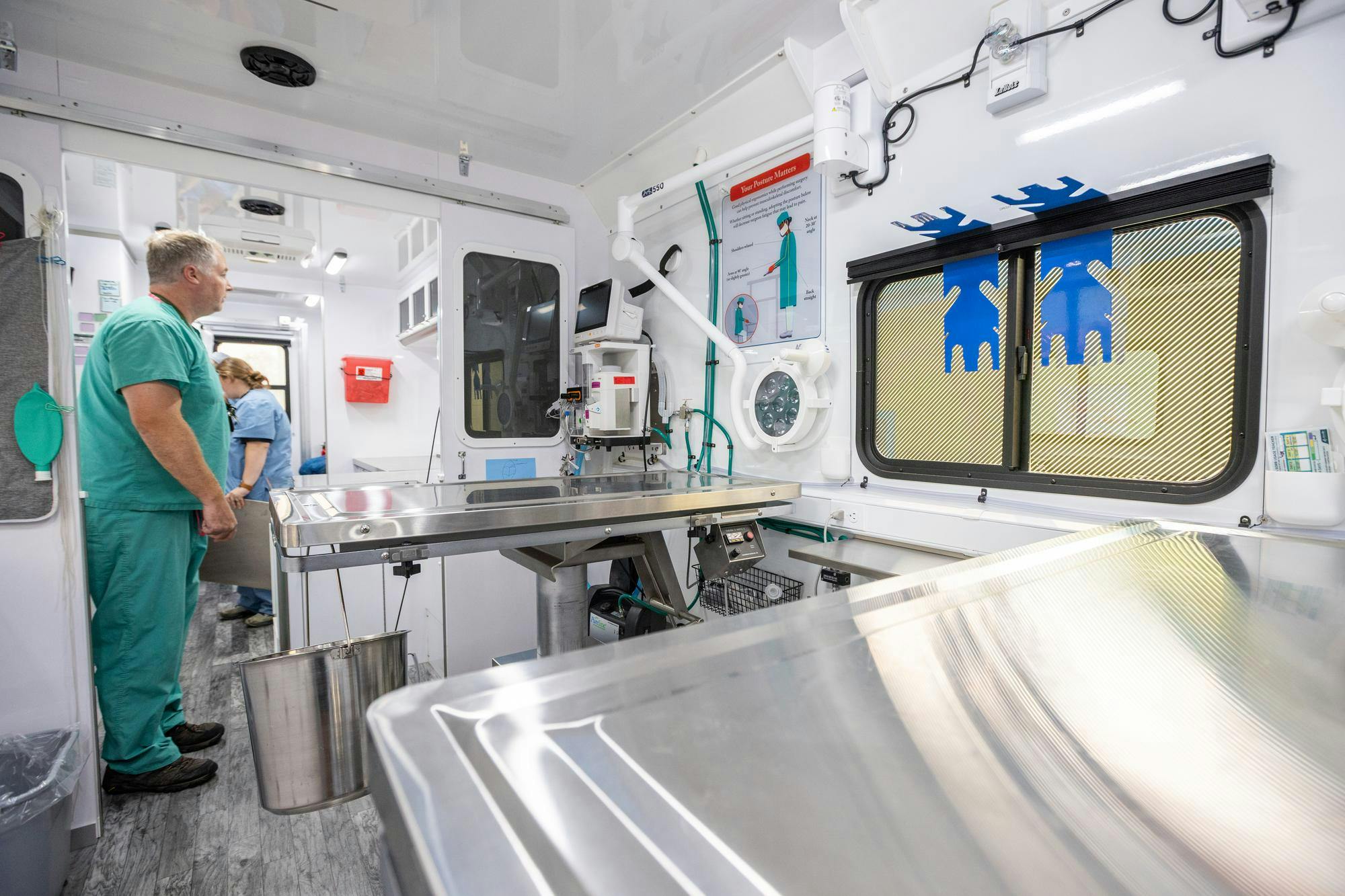
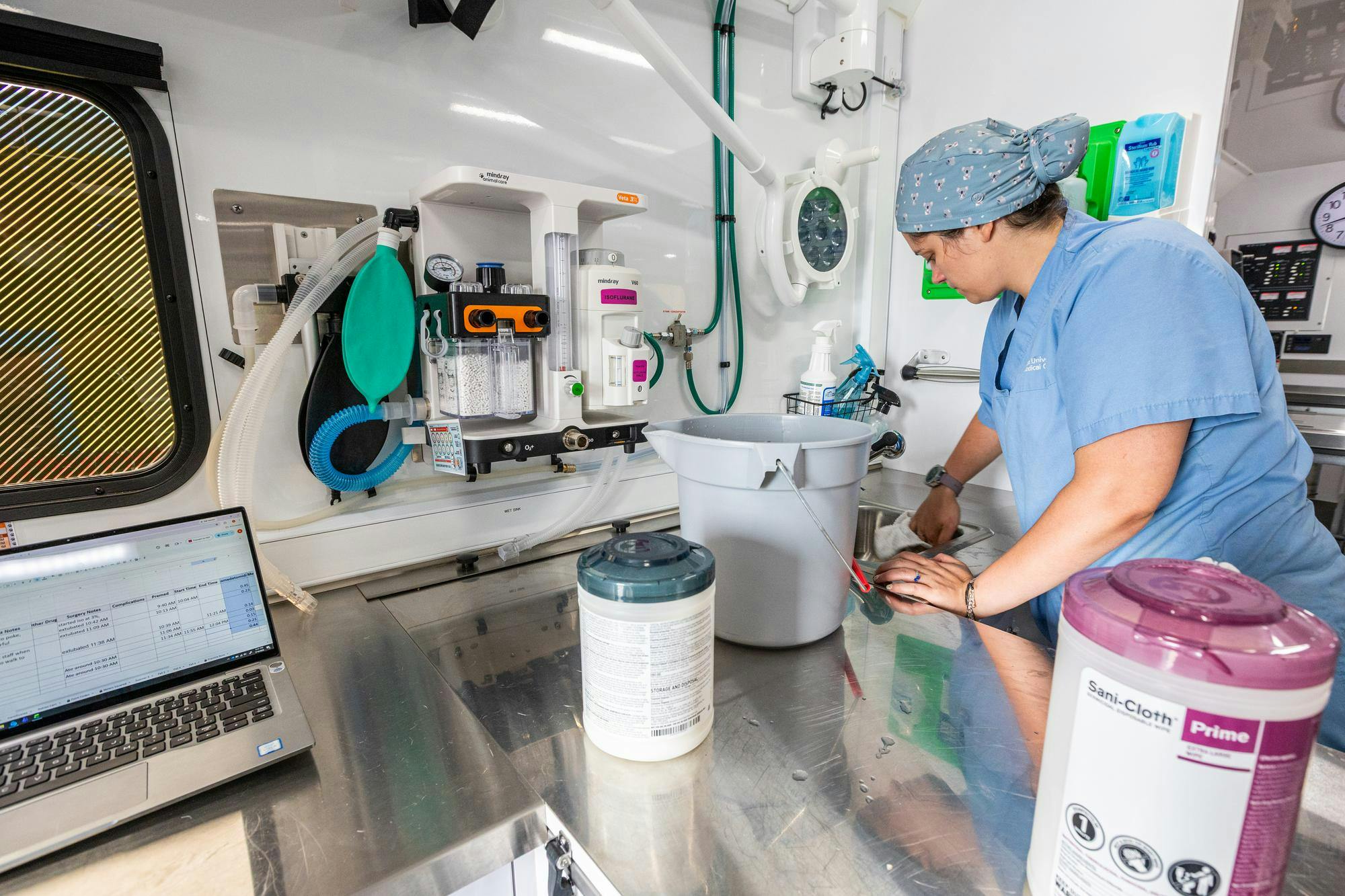
The 32-foot mobile unit is equipped with three ceiling fans, a storage space, a sink, a prep table, two heated surgical tables, two oxygen concentrators and anesthesia monitoring equipment. The program assists shelters within a two-hour radius of campus.
While visiting other vet schools with mobile clinics to draw inspiration for MSU's, Emery would visit, talk on the phone, or meet with every person who had built their own mobile clinic to find out what they liked about it and what they had done, which allowed him to learn from their successes and mistakes.
He conducted a trial run before the first rotation by practicing on different shelters, so the shelters had an idea of what to expect when the mobile clinic arrived.
Dianne Reeves, the executive director at I Heart Dogs, a nonprofit shelter in Warren, said the service provided by the mobile clinic parallels and exceeds that typically received at veterinary offices. The only cost Reeves’ shelter had to pay was for a high-voltage line to connect the mobile clinic to an electricity grid.
While Reeves said veterinary offices are great, the shelter faces restrictions due to the need to drive long distances, local clinics taking only one or two animals at a time and high costs.
According to Emery, the cost of dog spays can range from $300 to $800, adding that the places the mobile clinic is helping don't get discounts anymore; they have to pay normal vet prices.
“Our vet bills have more than doubled in the past five years, so we spend about $275,000 a year just on vet bills, and the majority of that is wellness, like spaying and neutering,” Reeves said. “There’s a shortage of veterinary care across the United States, and then there is also an issue with investment firms buying the smaller, individually owned offices. And when that happens, their prices tend to increase, making it really cost-prohibitive for us to continue with some clinics.”
The mobile clinic has special disinfectants called rescue and standard operating procedures to prevent the spread of diseases such as upper respiratory infections in cats, canine respiratory infections and parvo, which Emery said is the "real killer."
“When I graduated from vet school at Michigan State in 2010, I kinda feel like shelter medicine was looked at as the ugly stepchild of veterinary medicine,” Emery said.
Emery said that, at the time, there was a stigma that people in shelter medicine were euthanizing animals all the time, were unable to help the animals and didn’t make enough money to pay off student debt. When he came back to MSU in 2021, he wanted to change that perspective and thinks shelter medicine is becoming more desirable for students.
Erin Ridenour, a senior veterinary student, said she heard rumors going around the MSU vet school that there would be a mobile clinic. It wasn’t until her junior surgery classes with Emery that he announced it would officially happen and asked people to spread the word.
Ridenour grew up in a rural area in Southwest Michigan where access to low-cost veterinary care is not prominent.
“I’ve always wanted to kind of give back to the community as well, so that’s kind of what drew me into it: being able to kind of give back to the same areas that raised me essentially,” she said.
Ridenour was part of the first rotation of the mobile clinic, which lasts three weeks, and one of the counties she went to was Berrien County.
Support student media!
Please consider donating to The State News and help fund the future of journalism.
“It was really nice to go down there, be in home territory and really help out some of those shelters down there,” she said.
Ridenour said the shelters were open and receptive to the students, good at communicating the animals' personalities and used walkie-talkies as the students were undergoing surgeries.
“When we were done, they were always so grateful for us being there,” she said. “Overall, I think it’s really a great opportunity for veterinary students, especially, you know, getting those hands-on skills that they might not really get in their core rotations.”
“It makes me feel good, and I know the shelters absolutely love it."
The MSU vet school offers one solo surgery to students before they enter a clinic. Most of the time, students in vet school get to perform a couple of surgeries, especially spays and neuters, which are the most common in animal medicine, before they graduate, according to Ridenour.
The program pairs the students’ need for experience and surgical experience with shelters’ need for animal care. The mobile clinic recently finished its first rotation with two student vets. The students came into the program having completed one dog spay, one cat spay and one dog neuter.
“Just in my three weeks alone, I completed 67 spays and neuters on cats and dogs, and that hands-on experience is very valuable,” Ridenour said. “Having those technical skills is very, very helpful.”
Ridenour said the experience helped her realize the differences among surgeries and how to perform them, and it offered her a more in-depth experience than she would see in other clinical rotations.
“MSU’s goal for us is to be day-one-ready vets, and I think this mobile clinic really helps set that up for students,” she said.
Ridenour describes her experience in the mobile clinic as fast-paced, where she learned as she went. Some areas she went to were Trap-Neuter-Release (TNR) Programs. She observed how shelters handled feral cat colonies and population control and described the experience as eye-opening.
Working closely with her professor and nurse on the trailer helped build relationships that Ridenour said she wouldn’t get working with eight nurses in a rotation. Her favorite memory was of Emery giving her a fist bump because she knew it was a good day.
“I would tell him it wasn’t a good day if I didn’t get my fist bump,” she said.
The mobile clinic has been beneficial to I Heart Dogs through its convenience, the volume of animals to be spayed, students' eagerness to learn and Emery’s knowledge and bedside manner, according to Reeves. She said the mobile clinic has been very sympathetic to the animals, ensured the process is comfortable for them, has been attentive to the shelter's needs and has been eager to help them.
Practice owners in the Grand Rapids area raised concerns that the mobile clinic's free service would steer potential customers away from their businesses and financially harm them. The mobile clinic took those concerns into consideration and, as a result of an agreement, restricted its service to certain shelters. As part of the agreement, the mobile clinic may operate only on unowned animals during its first three years. The mobile clinic targets areas with the least access to care and prioritizes high-need communities.
The mobile clinic currently has two student vets working with Emery; in future rotations, there will be three to four. He also hopes to expand their services and travel to the Upper Peninsula. Currently, the clinic is constrained by travel, with the team waking up at 7 a.m. to leave and returning at 4:30 p.m.
The mobile unit provides temporary relief for shelters, so there's less of a financial burden on shelters to provide wellness care for their animals. Ideally, the shelters would eventually become self-sufficient and not rely heavily on the mobile clinic.
“The goal is to make it so the shelters don’t actually need us,” Emery said. “I think we’re struggling a little bit with that.”
The mobile clinic is partnered with 14 shelters across the state. The clinic faces a trade-off: either help fewer shelters more often to make a larger impact or choose more partners and have a smaller impact. As of now, the solution has been to help the shelters once every six weeks, which Emery said is a drop in the bucket compared to the shelters' needs.
“But I think we’re spreading the love, or at least trying to, across many of the different counties instead of just helping a few more frequently,” he said.
Reeves said that once there’s consistency built into the clinic, it will help their shelter by providing foresight for planning how many animals to save from euthanasia shelters, taking in strays and working with animal control.
Discussion
Share and discuss “MSU mobile vet clinic assists shelters struggling to obtain veterinary care” on social media.