In just one week, recent Michigan State graduates Asher Printzen and Jullia Gross-Turkey will attend the 2026 Professional Women’s Hockey League Draft with hopes of hearing their names called.
Growing up, that was never a plausible dream.
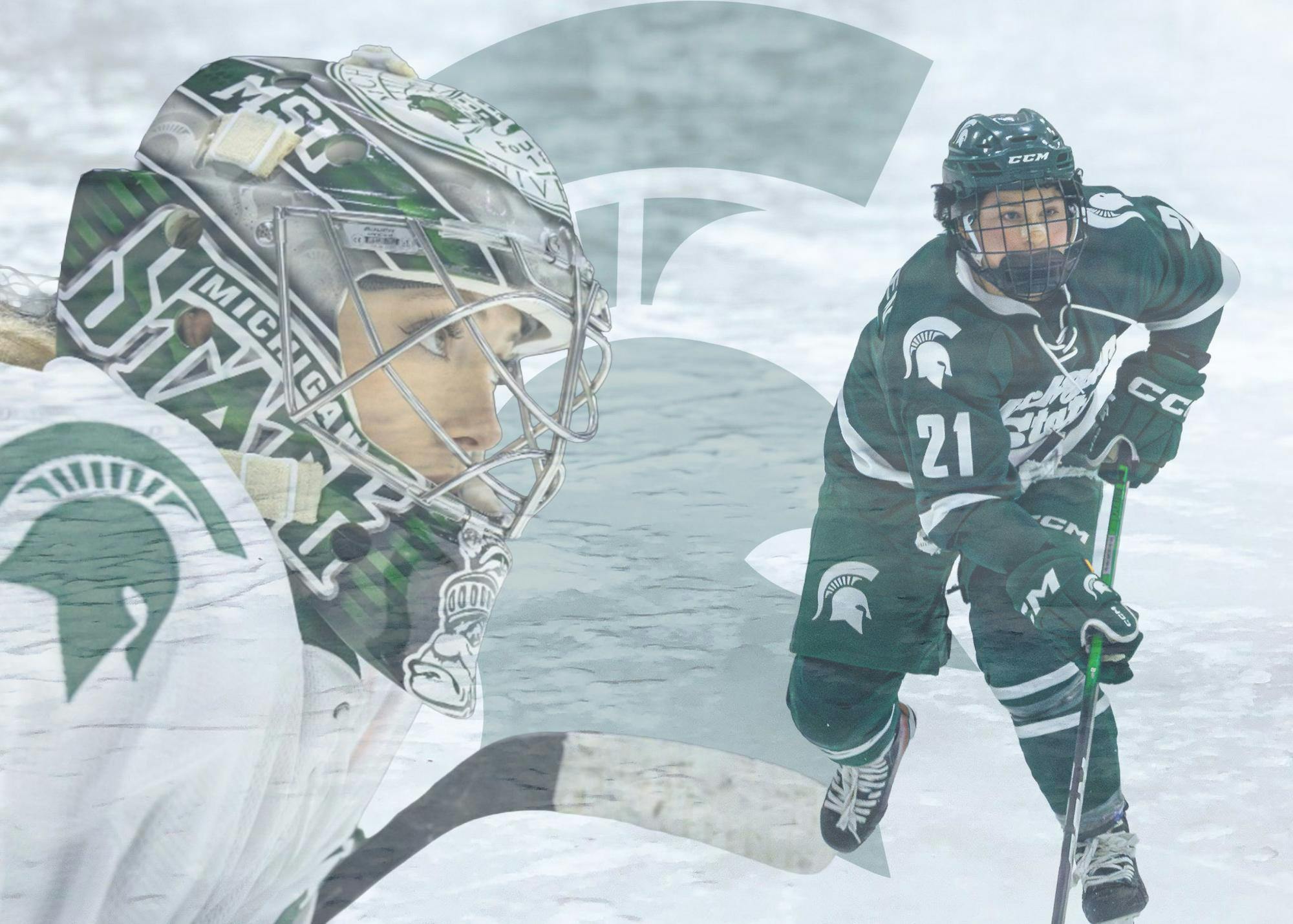
In just one week, recent Michigan State graduates Asher Printzen and Jullia Gross-Turkey will attend the 2026 Professional Women’s Hockey League Draft with hopes of hearing their names called.
Growing up, that was never a plausible dream.
Printzen, a forward from Las Vegas, and Gross-Turkey, a goaltender from Hamilton, Ontario, only watched competitive women’s hockey once every four years during the Winter Olympics broadcast. Their game was modeled after NHL players like Tuukka Rask and Shea Theodore.
“I did not ever think that I would be declaring for the PWHL draft,” Printzen said. “I didn't even think this would be possible growing up. I think delusionally growing up, we all have dreams, and growing up, I was like I'm definitely going to be in the NHL or something. I didn't know better.”
The NHL has been the only long-standing professional hockey league, and while there’s no rule barring women from competing, the only woman to have ever played in an NHL exhibition game is Manon Rhéaume, a former goaltender. No woman has ever competed in a regular-season or playoff game.
Rhéaume was recently named General Manager of the PWHL’s Detroit team, one of four expansion teams for the upcoming 2026-27 season. Detroit will host the draft at the Fox Theatre at 5 p.m. on Wednesday, June 17.
Both Prinzten (16 points in 18 games) and Gross-Turkey (.916 SV%, 2.57 GAA) hold solid statistics. Printzen even competed in Spain (6 points, 7 games) for CHH Necso Txuri Urdin to round off last season.
But the strength of statistics is influenced by how competitive a league is. Lower statistics can mean more if they are against stronger competition, and vice versa. It’s hard to compare Prinzten and Gross-Turkey to other candidates because they’ve been competing in a different league.
The pool of 236 prospects includes 23 recent Olympians and five gold medalists from the 2026 U.S. Olympic team. Printzen and Gross-Turkey are two of just four club hockey players in the mix.
Only 48 players will be drafted, but more spots may become available. Players with expiring contracts may not be re-signed, resulting in an open position. Current players may be dismissed and expansion teams need to fill a complete 23-woman roster, requiring more than just the six draft picks allotted.
“There's going to be just so much movement that I feel like truly no one knows what the numbers are and what teams need,” Gross-Turkey said.
Gross-Turkey is one of 40 goaltenders and Prinzten is one of 128 forwards. Printzen isn’t getting her hopes up and doesn’t have an agent. Gross-Turkey has signed with the Gladiator agency.
Publicity comes more naturally for Olympians and NCAA players with team media. Over half the prospect pool competed in the NCAA, but MSU doesn’t have an NCAA team. Printzen and Gross-Turkey competed in the American Collegiate Hockey Association (ACHA), a collegiate club hockey league.
The difference in league will impact how teams view both players, but it has also led to the misconception that MSU does not have a competitive women’s hockey team. MSU actually has two ACHA teams; it just lacks one that’s university-funded.
“There's obviously still that limitation within the funding, and the overall getting our name out there, because we're deemed club,” Gross-Turkey said. “It wouldn't be a super negative thing, it just shows that there needs to be more growth and awareness around us.”
The weight room is off limits, ice time must be paid for and lugging hockey bags around Munn Ice Arena is part of the practice routine. The lack of resources is nothing new, but it has remained unchanged.
Members of the team regularly email to advocate for more resources, but Printzen and Gross-Turkey said they have to pick their battles. Every conversation must be meaningful and respectful in order to maintain the access they do have.
“You want it to be taken very seriously, because that's where you are mentally,” Printzen said. “I definitely wish the school cared about it a little bit more. You can't expect something to be so great if you don't put any resources into it, or money, or time or care.”
The lack of an NCAA DI team is seen as the glaring problem for those who want women’s hockey to rise. But the lack of support for the team that already exists highlights why progress has been slow.
The growth of the PWHL and Detroit expansion has the potential to encourage an NCAA DI team in the state of Michigan.
Support student media! Please consider donating to The State News and help fund the future of journalism.
“With Detroit getting a team now these girls get to grow up dreaming about playing for their hometown,” Printzen said. “That's just going to be great for the development. There's nothing that drives a person more than knowing that you can make your dream one day.”
“I've already seen it in girls that are a little bit younger than I am. The skill development nowadays is just insane. Those resources that they're starting to have finally, like, there's just so much talent, and especially the state of Michigan.”
For Printzen, Gross-Turkey and others, the ACHA was one of those resources — more time to develop.
Hockey differs from other sports in that many players don’t attend college right after high school. Many players spend one to three years in developmental leagues prior to college, often starting in those leagues during high school. There are considerably more leagues for men.
Almost every MSU hockey player has competed in the NAHL, USHL or now CHL before their NCAA debut. Several MSU commits have signed CHL contracts for the upcoming season to further develop.
Women’s hockey players don’t have the same opportunities, and the ACHA allows them to keep competing. While the NCAA is seen as the standard, ACHA can be viewed as a stepping stone, just like the USHL or CHL is for men’s players.
“There is more to the college hockey world than just NCAA,” Gross-Turkey said. “I feel like really good ACHA DI schools can beat other DI NCAA schools, it's just all about people trying to not have such tunnel vision on the NCAA, and try and broaden, their perspective, because as you can see, me and Asher (Printzen) are club hockey players, but we're in this pool with all this talent, and we are good enough to play at that level.”
Gross-Turkey started skating when she was nine and became a goaltender when she was 12, much later than her Canadian peers, who started closer to three and four. Printzen started ice hockey at age 12, although she learned to roller skate when she was four.
At 13, Printzen left Nevada to pursue hockey on her own, staying with billet families (who host young, out-of-town hockey players during the season). She lived in Dallas, Shelbourne, Ontario and later Michigan, playing for Honey Baked Ham and Meijer teams.
Printzen’s journey mirrored that of standouts like Porter Martone and Isaac Howard from MSU’s NCAA men’s team. Nearly every player left home as a teenager to advance their hockey career.
That experience shaped Printzen’s independence, just as hockey shaped her and Gross-Turkey’s lives.
“It's shaped me into being an energetic person and a hard-working person, and wanting to constantly get stuff done,” Printzen said. “When we were younger, we had to play with guys, and you're not really seen. You're in a full locker room with guys, you're trying to make a name for yourself, and I think it puts fight in you.”
Gross-Turkey said hockey has taught her to get back up when adversity comes on and off the ice. It’s also been a source of outreach and community for her as she represents her Native American heritage. Gross-Turkey is from the Six Nations of the Grand River and wears it on her goalie mask.
“It's helped me be myself a little bit more,” Gross-Turkey said. “It's also built this toughness around me, to stand up for myself in different ways, but then also use sports as a tool to connect with other people and try and build representation in meaningful ways, in impactful ways off the ice.”
Gross-Turkey and Printzen are unsure of their plans if they go undrafted on June 17, but still want to continue hockey. Gross-Turkey just started law school and will either get drafted and earn an online degree or try to compete at her university. Printzen is open to developing more in Europe as she did last season, but also wants to be realistic.
“There's not many teams, like if a guy doesn't make the NHL or if he goes undrafted, there's so many leagues he can go and develop in, and he doesn't have to give up hockey,” said Printzen. “That's just not the same picture for us. … At the end of the day I can't just sit around like ‘Oh maybe I'll get drafted next year,’ like now I have to find a job.”