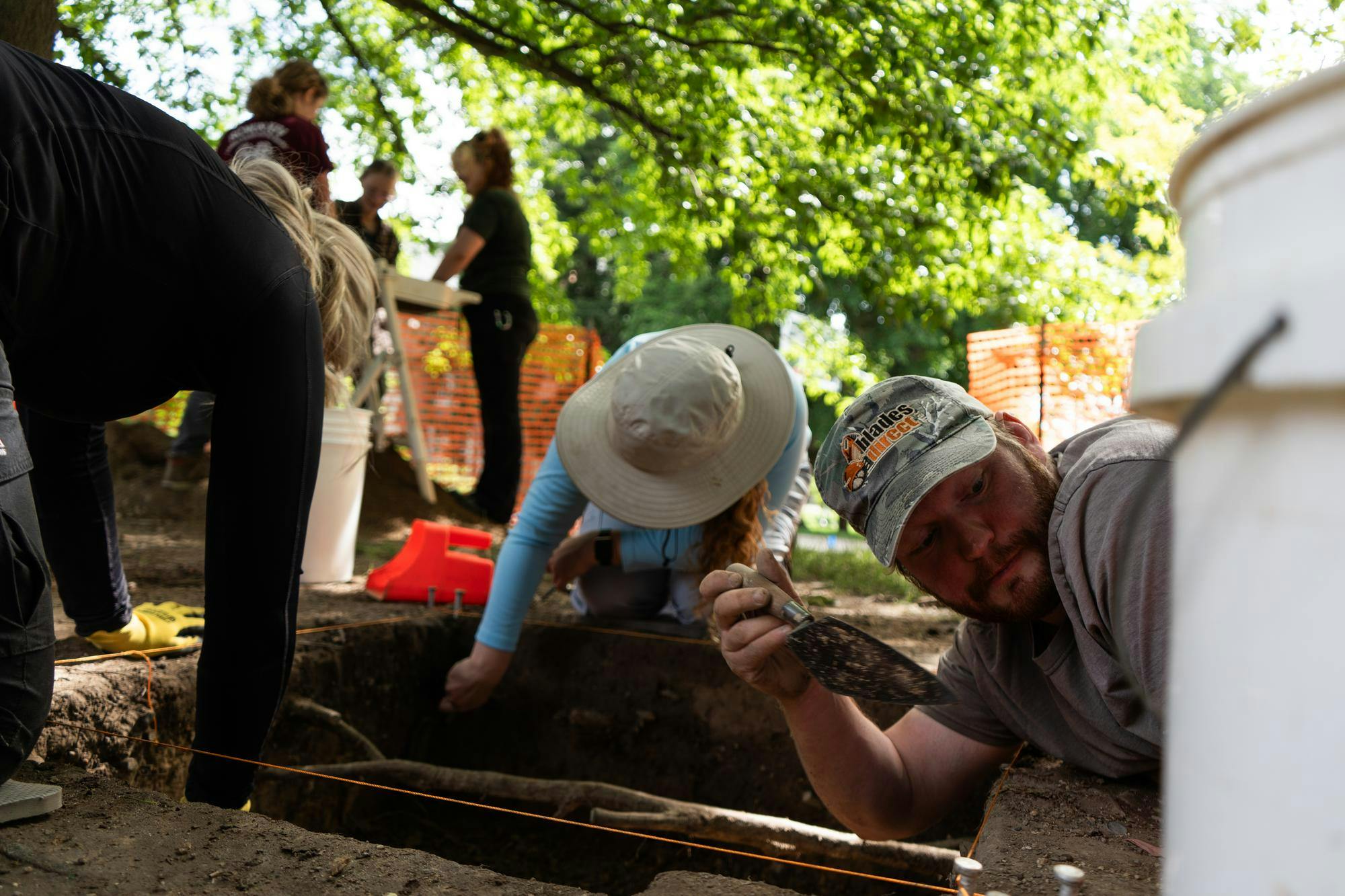
Andrew Kracinski (right) and other members of the Campus Archaeology Program work on excavating the old observatory site in East Lansing, Mich., on June 15, 2026.
As thousands of students leave campus each summer, Michigan State University enters its busiest season of construction, where campus archaeologists work to ensure the university’s history isn’t buried beneath its future.
In 2023, the Campus Archaeology Program (CAP) at MSU made a groundbreaking discovery: the foundation of the original, 145-year-old campus observatory that was demolished in the 1920s.
Now, the team is back at the excavation site hoping to uncover more information about the history of the building and the people who once utilized it.
Recent MSU graduate and current volunteer for CAP, Max Levinduski, was part of the program when they made the discovery. She recalled how exciting it was for the project to make national news and how it helped her figure out her path in archaeology.
“Today, we’re trying to figure out where a pipe went that we discovered in my unit two years ago,” Levinduski said. “So, it's kind of closure in a way, a little symbolic. As I'm finishing my time here at MSU, we're finishing out this site. And later on, we're going to do shovel tests to find a privy (outhouse) that I remember learning about when we started.”
Levinduski participated in the CAP 2024 undergraduate field school where they found much more of the building foundation, the original telescope podium foundation and a lead pipe that went through it.
MSU PhD student, Gabrielle Moran O’Dell is the campus archaeologist overseeing the project for this field season.
“We are out here this year trying to follow that pipeline to see if it leads to the (telescope) podium or where it goes to, to try and determine whether that pipe was put in during the construction of the observatory in 1880 or if it was put in after demolition or after that,” Moran-O’Dell said. “We do know that Will's House at one time here was the weather bureau, so it may be associated with that, or it may be associated with whatever technology was used for the telescope itself.”
The CAP was founded by Dr. Lynne Goldstien in 2005, becoming the world’s first university-run archaeology program.
Their team works with MSU’s Infrastructure Planning and Facilities (IPF) department to ensure that below-ground artifacts and archaeology sites are preserved when found during campus construction projects.
The program uniquely gives students, alumni and the surrounding community access to work on archaeology projects directly on campus, whereas many must travel for that opportunity.
In addition, the CAP team regularly handles the preservation of indigenous artifacts and communicates with tribes, which is also unique to MSU as the nation’s first land-grant university.
Levinduski reflected that they believe it’s significant to engage with the “rich history” that MSU offers and to see how previous students existed on campus.
“I think it's really important for students to know the history of the institution they were a part of, and know how it went before and really appreciate what things look like now, especially as a woman here at MSU,” Levinduski said. “As we looked more into the observatory, especially old photographs, there was a singular woman who was a part of the astronomy courses. So, getting to be like, ‘look at how far we come.’ Now, I'm in a very female dominated field working here and kind of uncovering this.”
Goldstien originally pitched the idea of excavating the university’s first dormitory which burned down, Saint’s Rest, to President Lou Anna K. Simon, which began the idea for starting the program. The dig revealed thousands of artifacts that sparked curiosity about the building across campus and propelled the CAP university funding forward.
Since then, CAP employs students each year to do various work on campus archaeology projects. Students work directly with construction staff, excavate sites, catalog artifacts in labs, develop outreach projects and even engage in academic research if desired.
Sometimes, CAP fellows do research on campus construction projects years ahead of time to get a scope for the work they need to do each year.
However, for last-minute projects or repairs, construction crews are mandated to contact the current CAP director, Stacey Camp, if they find anything that may be historic when digging.
“We ask that if they find something, they stop until we can come out, which we usually can say the same day,” Camp said. “We also are following federal, state and tribal guidelines that if they hit something that's indigenous, everything stops.”
Support student media!
Please consider donating to The State News and help fund the future of journalism.
In 2023, IPF was installing hammock poles in various outdoor locations across campus when they hit a concrete pad near the old observatory site in present-day North neighborhood.
Normally, the CAP team is used to seeing similar cases where IPF runs into remnants of old construction materials. Especially because the site had so much infrastructure surrounding it, they didn’t expect to find anything.
The CAP team did research on the site and realized that it was in the same location as MSU’s old observatory, which sat behind the original faculty row houses, and took students out to do ground tests.
Their team dug small holes, called burr holes, across the landscape to see if there was any archaeology in the area. They also use ground penetrating radars for these tests that essentially give them an x-ray of the ground.
“And funny enough, this is what happens in archaeology, the last hole that they opened up, which had nothing to do with the concrete pad and the reason we got contacted, was the foundation of the observatory,” Camp said.
Camp also explained that there’s a privy, or outhouse, they’re hoping to find that was associated with the old observatory and buildings near faculty row.
These sites are of interest to archaeologists because of the surprising number of artifacts they usually contain. This is because, when indoor plumbing was invented, many people would throw their trash in their outhouses and then demolish them. In some cases, archaeologists can learn more about a site from its privy than from the main building.
“Gabrielle was part of that discovery (the old observatory), we were like gung-ho about finding the outhouse from the professor who was teaching classes in there,” Camp said. “So maybe that will be the next exciting discovery. But those kinds of discoveries are really rare.”
Only one privy has been uncovered on MSU’s campus so far at Saint’s Rest.
“We have found really cool things in privies and landfills. It can tell us so much about who was on campus during that time,” Moran-O’Dell said. “You think about campus, and you think about college students, but back then, faculty and families were living on campus. So, it's really cool to see that through the archaeology.”
From May to mid-July, the CAP team will have excavation sites on campus.
Next, the team hopes to return to the Saint’s Rest dormitory or to another documented landfill near the admin lawn, which was owned by the first groundskeeper at MSU.
Discussion
Share and discuss “Campus archaeology team heads back to 1880 MSU observatory site” on social media.