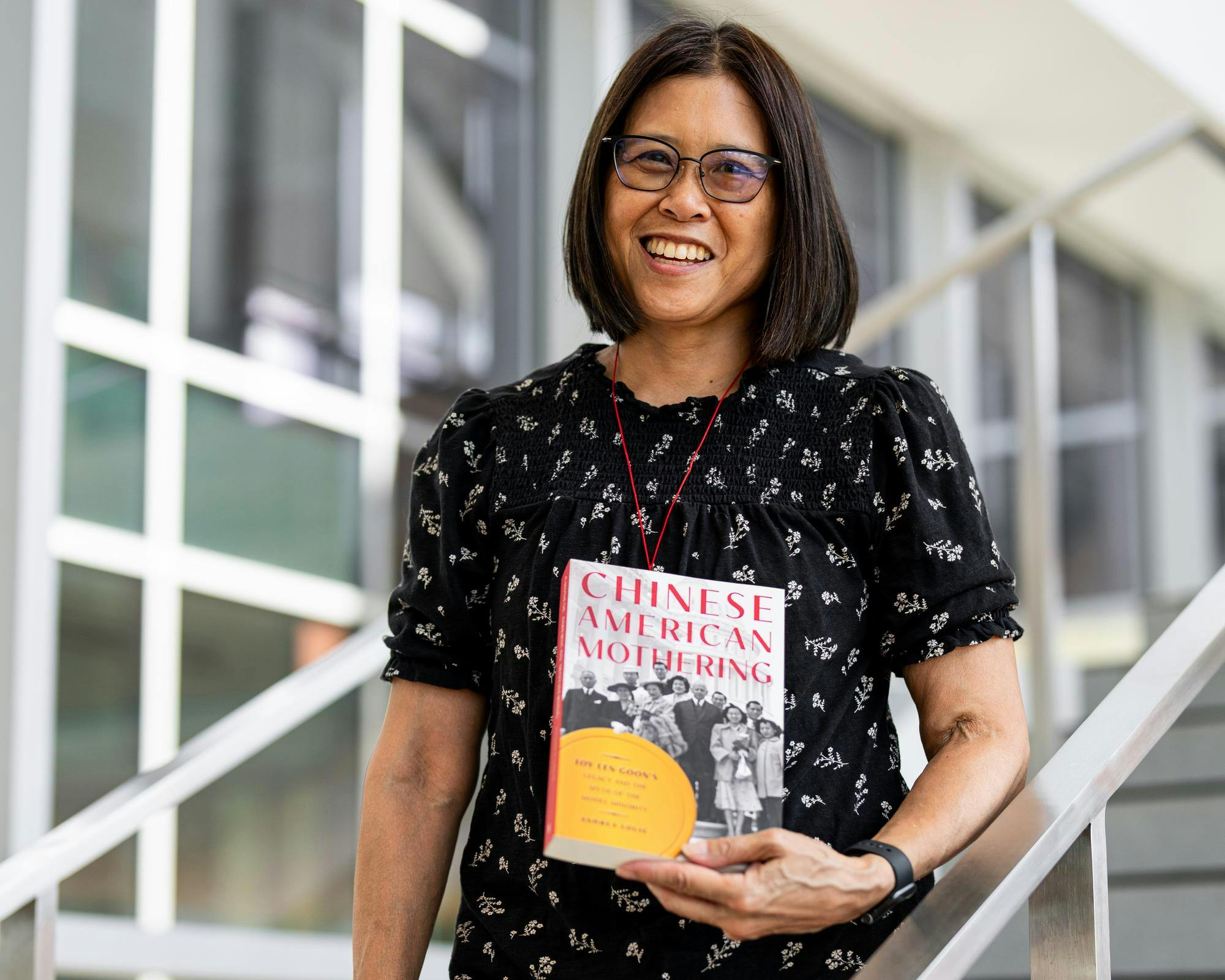
Andrea Louie and her cousins grew up knowing that their grandmother was named U.S. Mother of the Year in 1952. But she never thought about what that term meant, except for a national award.
In December 2025, Louie, a Michigan State University professor and chair of the university’s department of anthropology, published "Chinese American Mothering: Toy Len Goon’s Legacy and the Myth of Model Minority" – a story chronicling her own grandmother's life.
Goon was named the United States Mother of the Year for raising eight successful children all while running a business.
Louie explains in her book that Goon was awarded the U.S. Mother of the Year not just for her success as a mother and businesswoman, but also for being a successful Chinese American woman.
For years, Louie thought it would be too personal to write about her grandmother's story and didn't know what else she could contribute to the existing chronicles from the New York Historical Society and the Maine Memory Network.
But Louie believed there were unexplored sides to the story she grew up with.
While searching for more connections with her heritage as a 3rd generation Asian American, Louie was in a program called "Search of Roots," run through the Chinese Culture Center of San Francisco. Through the program, she traveled to China through the Office of Overseas Chinese Affairs.
After completing the program in graduate school Louie was inspired to interview her grandmother about her experience immigrating to America.
“I wanted that connection with my grandmother," Louie said. "It's a way of getting closer with her."
About 10 years ago, Louie revisited the interview and realized there was more to the story. Such as her grandfather's immigration story during the Chinese Exclusion Era and the historical context of Goon’s selection as Mother of the Year.
While writing "Chinese American Mothering,” Louie combined family interviews, an unofficial biography her aunt wrote at the request of her grandmother, museums, immigration documentation, interviews conducted by Gary Libby in Maine and other academic texts about similar topics.
“I realized that I could try to look at how my grandmother told her story and how other people told her story,” Louie said. “And that’s what the book ended up becoming.”
As a child, she knew that her grandmother had parades thrown in her honor and that she and her family were very proud, but in writing her book, she learned and built a whole new kind of connection.
The original cassette tape of the interview with her grandmother contained several conversations that were not translated by Louie’s mother or aunt. While writing the book, a linguistics friend of hers offered to translate. Listening to the new parts of the interview and the interviews provided by Libby made Louie feel like she was getting to know her grandmother and the rest of her family better.
Louie spent countless hours with her aunt, who wrote an unofficial biography of Goon, and got to know her grandmother through her aunt's perspective.
“She is over 100 now, and she just remembers everything and knows all the connections,” Louie said.
Not only did her writing process connect Louie with her parents' generation, it also reconnected her with cousins she hadn’t spoken to in years.
During interviews she conducted via Zoom her cousins spoke about the model minority myth as it applies to their real lives.
The model minority stereotype, or myth as Louie calls it, due to its falsity, refers to the stereotype that Asian Americans are all high-achieving economically and educationally.
For Louie's generation the stereotype becomes more complicated. The interest is amplified by her family history and its connection to the myth that she explores in her book.
Support student media!
Please consider donating to The State News and help fund the future of journalism.
During her Zoom interviews, many of her cousins pointed out that another cousin, a doctor, was the best example of the stereotype, even though everyone was doing well.
When Louie told the cousin about the family's response, she made a joke saying, “Don’t tell me that, it's gonna go to my head.” Later in the interview, Louie’s cousin actually said her brother was the golden child.
Her family all said they would read her book, but Louie admitted it might even spark some controversy within the family, depending on the stereotypical ideas of “good” versus “bad” immigrants.
“It’s hard to argue against the American dream but I think some people are going to be more critical of (the book),” Louie said.
To read more about Louie and her grandmother visit barnesandnobel.com.
Discussion
Share and discuss “Andrea Louie's path to publication” on social media.