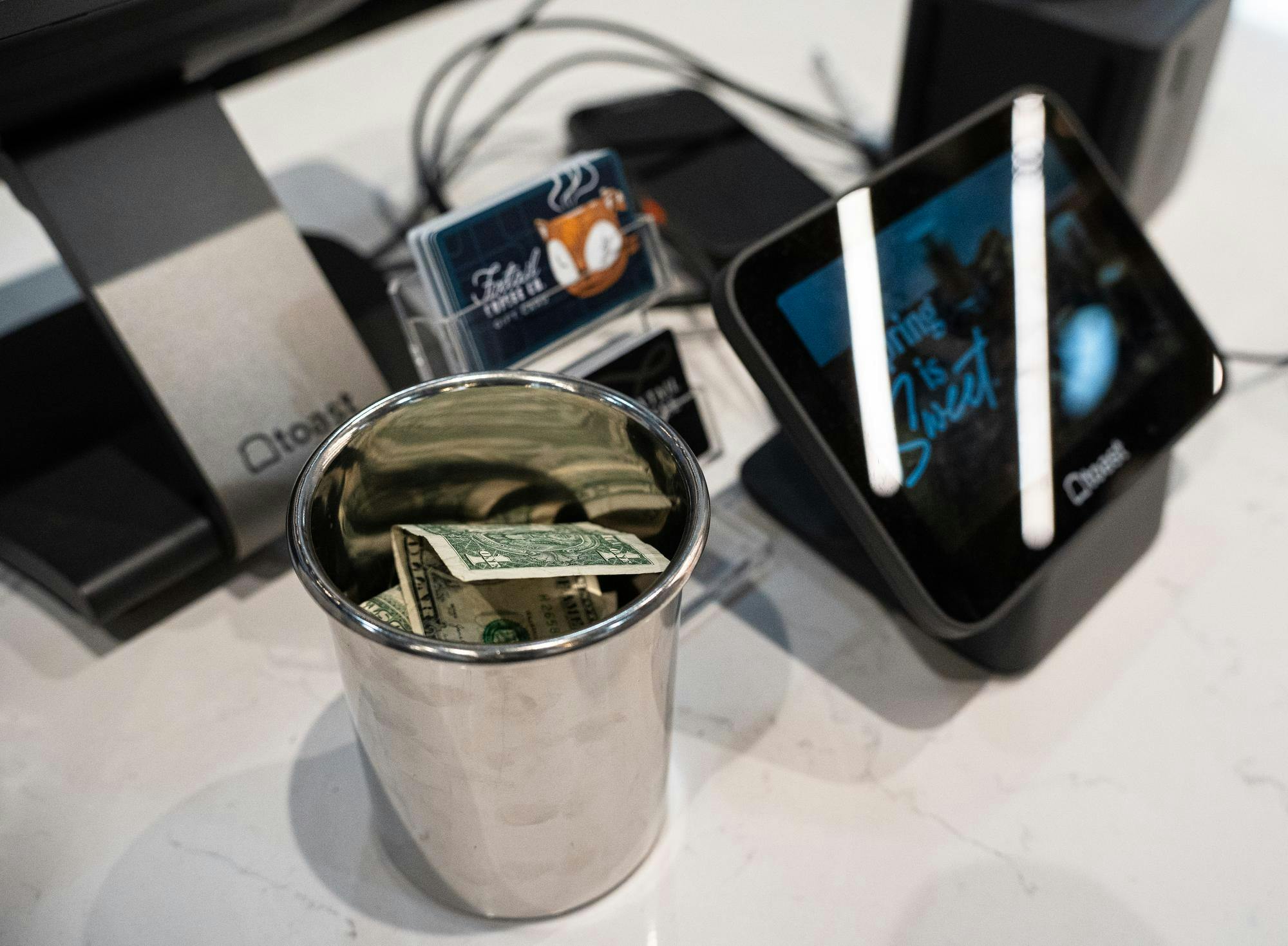
It’s a common dilemma for many Michigan State University students ordering a cup of coffee, grabbing a sandwich to go or purchasing any host of items on Grand River Avenue: Your cashier turns a small tablet to face you, forcing you contemplate whether to tip 18%, 20% or 25%.
Some students say the price of continually tipping is starting to catch up.
College of Music senior Hannah Bancroft, who was at Biggby Coffee one recent Wednesday afternoon, said that even though she has worked jobs where she relied on customers offering extra cash for good service, the continual toll of tipping is a drain on her wallet.
"It does just make me feel bad because the prices of things are going up. So, there’s already the stress of that, and then adding on the fact that I want to tip, but I might not always be in a position to do so," Bancroft said.
The issue is slightly less acute for students on dining hall plans that offer unlimited swipes and 12 combo exchanges a week. But for psychology freshman Jayde Simeons, the inability to tip on a combo exchange swipe is another bother itself.
"As much as it relieves the pressure of spending money, it’s also something nagging in the back of my mind like, 'Dang, I do wish I could tip though,''' said Simeons.
The phenomenon of rising tip costs isn’t just a figment in the imaginations of students, however. It has a name: Tipflation. As inflation has pushed prices for consumers upwards, the value of tips has increased, too. The sizes of tips have also grown in recent years, and consumers are being asked to tip more often.
Michael McCall, a professor in MSU’s school of hospitality and business, is an expert on tipping culture in the U.S. He says the phenomenon of Tipflation brings together the social and technical.
Researchers like McCall have attributed the increasing price of tips to a variety of factors, though no single cause is solely responsible. Tipping culture is becoming more commonplace, tip amounts are changing and new checkout systems are adding more social pressure to tip.
"You are doing something for me, so I feel like I should return the favor. A lot of us have worked as servers before. We know what it’s like. And a good part of it is social norms," said McCall.
This example McCall gave of how reciprocity and empathy contribute to a person’s choice to tip, or not to tip, can be seen in present-day tipping culture. But each person has a different threshold for what kind of service they believe deserves a tip.
McCall said that the threshold for tipping tends to be lower for purchases where you’re standing up for a service, like ordering a coffee, as opposed to dining in.
For political science senior Riley Jones, who was previously a barista at Strange Matter, she said she tips baristas, servers and bartenders all the same.
"I feel like when you’re at a coffee shop, the baristas are crafting drinks for you, especially with the new way of coffee where the barista is kind of like the centerpiece," said Jones. "I’m like personally crafting drinks, so I’m therefore doing a service, and therefore, get some sort of tip."
Still, tipping culture can have a squeezing effect on college students, who are famously strapped for cash, McCall said.
Bancroft, who is a commuter student that travels two hours every day to come to MSU, said that because she is spending so much money on gas and other necessities, she gets coffee as a treat. If she can get a coffee at a lower price, she will tip.
"That’s something that really helps me feel financially okay with getting a treat like coffee," said Bancroft. "But if it’s a situation where I don’t think I am in a place where I can tip, I usually just won’t go out."
A good portion of Tipflation can be attributed to new technologies like point-of-sale systems, the tablets found at many establishments that prompt you to tip after making a purchase.
According to McCall, it makes all aspects of tipping more visible. A customer has to look at their server as they decide whether to tip and others around can see the amount they choose to tip.
And these machines typically offer three tip choices that can be configured to present higher default options, like 20%, 25% and 35%. For many consumers, it’s easier to just hit a button than to calculate a lower tip.
Support student media!
Please consider donating to The State News and help fund the future of journalism.
Jones emphasized that Tipflation won’t be easily fixed.
"I think it’s very delicate, because while you’re calling out the corporations for this, you're not solving any problems by not tipping. It really has to come from somewhere else, and I think we should redirect this question somewhere that’s not the consumer and the server themselves," said Jones.
Discussion
Share and discuss “'Tipflation' a drain on students' wallets” on social media.