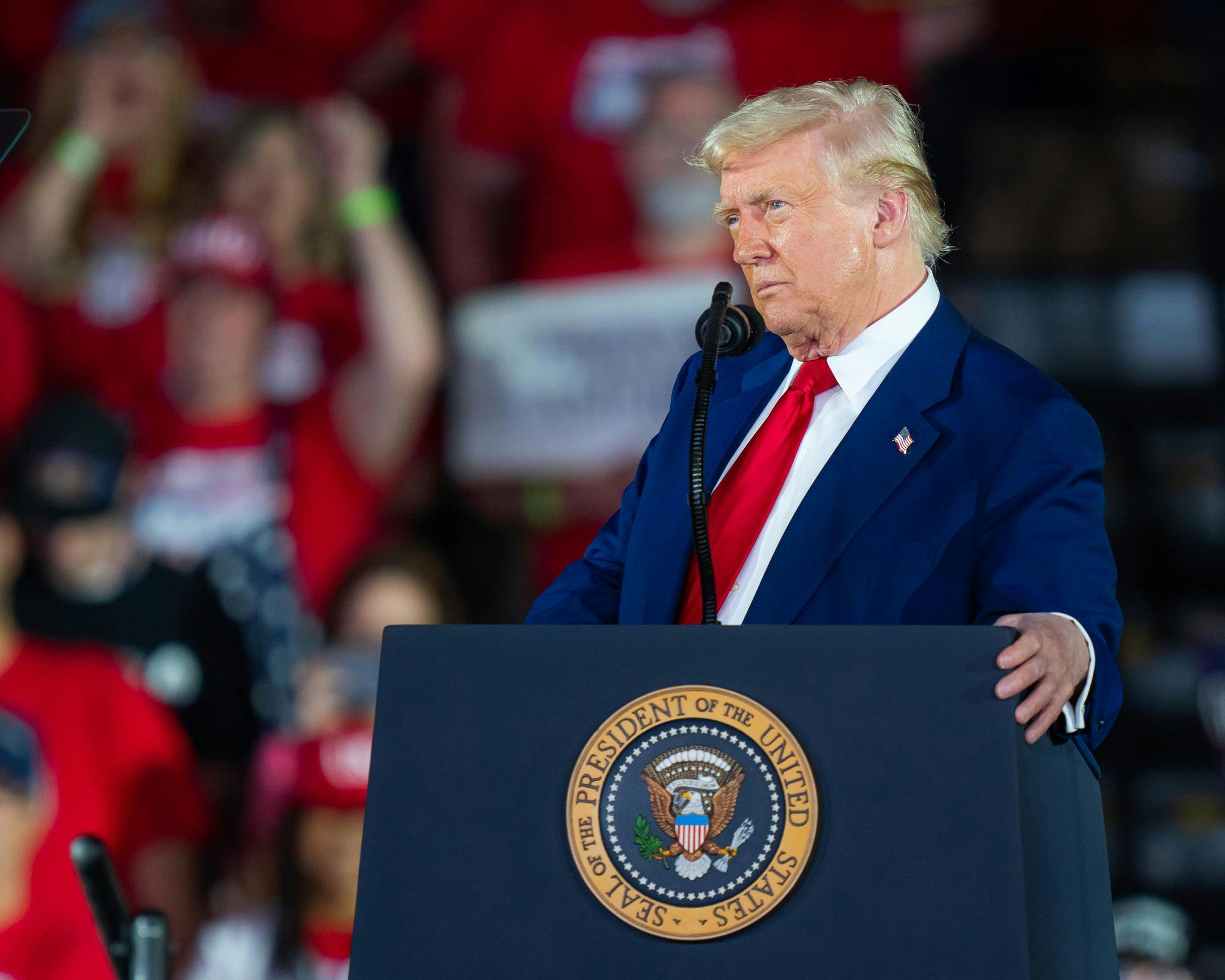
In a perhaps unsurprising development, Trump’s newest enemy is the Pope. The president went off on a tirade criticizing the leader of the Catholic Church, who has been increasingly critical of Trump in recent weeks.
On Palm Sunday, the American-born pontiff censured the violence in the Middle East, as well as any rationalization of this violence, in the name of Christianity. Pope Leo XIV’s later upbraiding of President Trump for the attacks on Iran is one of the first times he has addressed Trump by name.
It’s unusual for a pope, especially one known to be as mild-mannered as Leo, to call out world leaders so directly. However, Trump’s use of Christianity to rationalize violence in Iran presents a unique dilemma: The Trump administration’s use of religious crusade rhetoric to justify war in Iran is a directed effort to maintain the support of religious voters. However, in reality, this rhetoric is accomplishing the opposite effect and is actually driving away some religious groups.
This spat with the pope is not an isolated event. It’s indicative of the Trump administration’s gradual fall from grace in the eyes of religious voters. While it’s fairly typical for second-term presidents to see their popularity fade, there is a notable difference in these groups that make up a bulk of Trump’s support base. A PRRI poll shows an across-the-board decline in favorability among Christian voters between September 2025 and February 2026. Some groups, like white non-evangelical Protestants and Hispanic Protestants, saw a much steeper decline compared to that of all Americans.
This waning support over past months could be attributed to a number of factors, like economic strain or the release of thousands of documents related to Jefferey Epstein that seem to implicate the president. Trump’s posting of an AI-generated image that seemingly depicts him as Jesus also drew significant backlash from many religious figures. But perhaps the most salient reason Trump has lost favor with Christian voters has to do with his handling of foreign policy in the Middle East.
Recent U.S. attacks on Iran have predictably worsened public opinion of the administration. Wars tend to be unpopular nowadays, if not for morally upright reasons, then for the inflated gas prices that follow. The adoption of religious justification for involvement in Iran is an attempt by the Trump administration to regain support from Christian constituents.
This strategy has been most visible via U.S. Defense Secretary Pete Hegseth, who consistently describes the United States’ attacks on Iran as divinely licensed. In religious services he regularly holds at the Pentagon, Hegseth has expressed confidence that God is in favor of the US military and even prayed for “overwhelming violence of action against those who deserve no mercy.” This holy war-reminiscent language is not surprising coming from Hegseth, who famously has the words “Deus Vult” tattooed on his bicep, a phrase which is associated with the crusades and translates to “God wills it.”
Trump himself has also employed similar rhetoric, though not as frequently, explicitly saying that God supports the war in an April 6 press conference. He referred to the recovery of a missing US airman in Iran as an “Easter miracle” on Easter Sunday, after Hegseth compared the airman’s experience of hideout and rescue to the death and resurrection of Christ in the Bible.
These crusade-esque arguments have also made their way into the military, with commanders reportedly using “extremist Christian rhetoric about biblical ‘end times’” to vindicate action in Iran to troops. A month ago, the Military Religious Freedom Foundation watchdog group claimed to have received more than 200 complaints from service members.
By painting US involvement in the Middle East as a battle of good and evil, these leaders justify brutal military action against Iran as righteous, God-sanctioned, and destined for victory.
This influx of holy-war language to justify military action in Iran is a strategic attempt to win popular support for the war from one of Trump’s largest support demographics, white evangelical protestants. This includes many who favor Zionist ideology and support Israel, with groups like Christians United for Israel. They therefore often take on opposition to Iran, with Iran being considered an existential threat to Zionists and an enemy to Israel.
Maintaining white evangelical support is crucial for the Trump administration, especially considering that Trump has lost so much support among that base. A Pew Research report from February 2025 to January 2026 found confidence in Trump’s ethics in office dropped the most for white evangelical protestants, by 15 percentage points. This group also saw the second-biggest decrease in support for Trump’s plans and policies in this time period. With these drastically dipping numbers, it's easy to see how this might have encouraged the Trump administration to adopt this religious, good-versus-evil rhetoric to justify aggressive military action in Iran and keep evangelicals on board.
In terms of white evangelical protestants, the crusade language is succeeding at maintaining support. However, the use of Christian rhetoric to justify a violent war is proving to be massively unpopular among other sects. The most evident is among Catholics, as seen by the Pope’s rare explicit criticism.
Beyond the Catholic tradition, Churches for Middle East Peace, a coalition of more than 30 Christian denominations, put out a statement denouncing the administration's actions in Iran. This document refutes any claim that Christianity can be used to justify the violence enacted and threatened to be enacted. Many others, including prominent protestant leaders and conservative political figures, have condemned the administration’s holy war rhetoric.
The crusade rhetoric that is allowing Trump to maintain the evangelical Christians is the same that is driving other religious groups away, perhaps for good reason. Past presidents have employed religious language during times of conflict, but nowhere near to the extent that the Trump administration has. This leveraging of beliefs held personally by so many is rightfully an object of concern.
It’s one thing to justify a war for economic or even moral reasons. But it’s another entirely to frame it as divinely sanctioned and preordained to succeed. Americans of all faiths need to be wary of the rhetoric used by their leaders, careful to discern the representation versus weaponization of their beliefs.
Isabella Cucchetti is a sophomore studying Political Theory and Constitutional Democracy and is a columnist at The State News. The views in this article are her own and independent of The State News.
Support student media!
Please consider donating to The State News and help fund the future of journalism.
Discussion
Share and discuss “COLUMN: Religious rhetoric is backfiring on the Trump Administration” on social media.