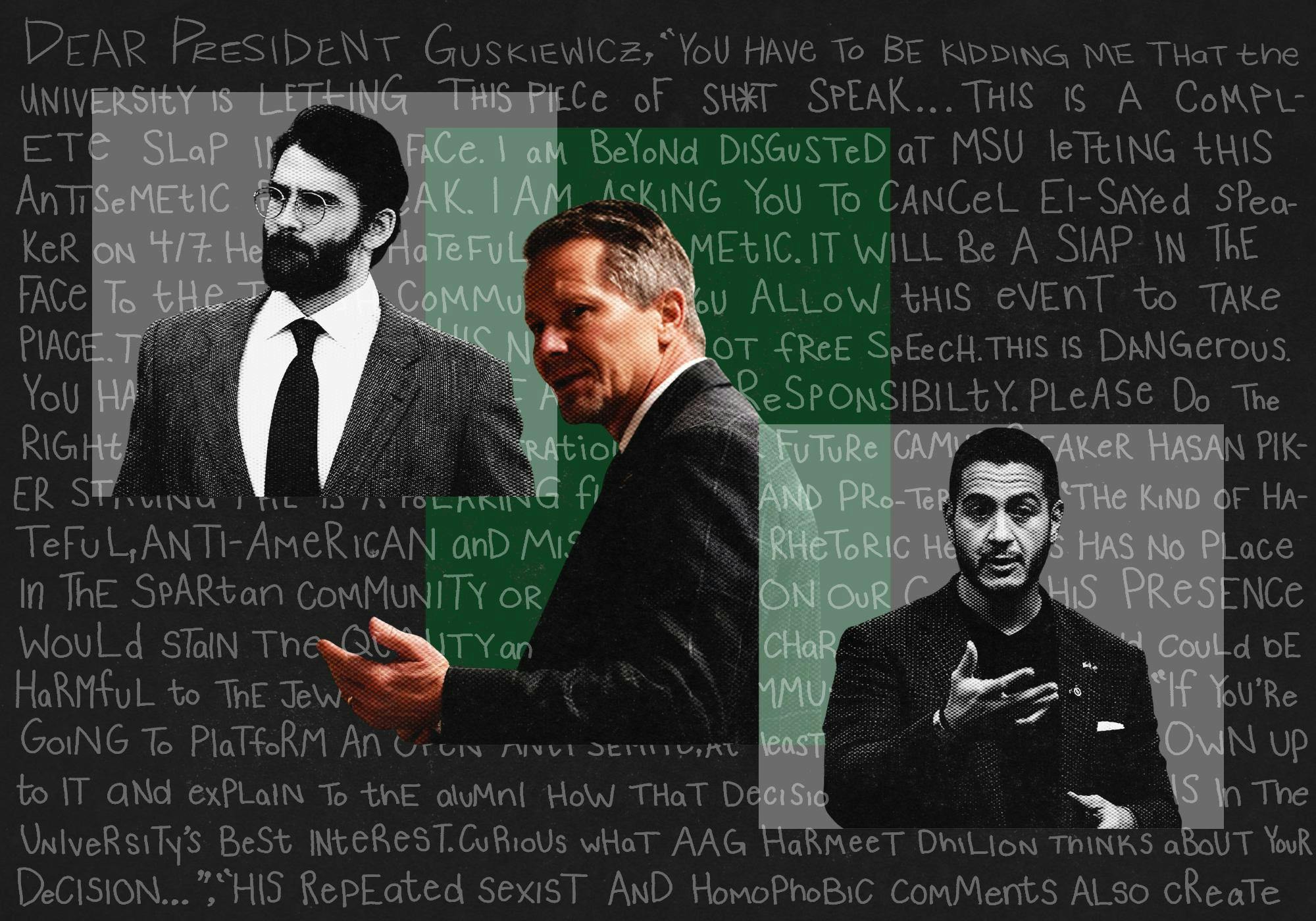
The messages urged Guskiewicz to bar Piker from MSU’s campus. Piker, they claimed, has promoted "extremism" and amplified "antisemitic rhetoric" in the past; Allowing him on campus would risk making Jewish students, families and faculty feel unsafe. Other senders even seemed to believe that Guskiewicz had personally invited Piker, rather than the two student groups that had invited the El-Sayed campaign.
To boot, one of the most prominent Jewish student groups on campus had released a statement dubbing Piker a “known antisemite” whose presence would create a "hostile environment" for Jewish students on campus.
Keeping him off campus isn‘t be so simple, however.
Public universities like MSU must walk a fine line between protecting First Amendment rights on their campuses while ensuring that their constituents aren't threatened by provocative speakers. They must also assess whether an event poses a tangible public safety concern.
As such, university leaders are often placed in a lose-lose situation. As highly visible figureheads they must make aggrieved parties feel heard while also preserving a key principle of American academia. Complicating things further is the watchful eye of the current federal administration, hypersensitive to antisemitism, an expert said, whose interests universities now must factor into decision making.
Weighing these considerations, Guskiewicz and the Board of Trustees ultimately opted to release a statement that walked that thin line. It expressed the need to uphold free speech and "diversity of thought" on campus while also acknowledging how recent comments made by Piker, "who the university did not invite, have caused pain and concern, particularly among members of our Jewish community."
"Antisemitism and discrimination of any kind is unacceptable and inconsistent with our institutional values and has no place in a community grounded in respect, inclusion and dignity," the statement continued.
The statement had become necessary, Guskiewicz said at a press conference days after the rally, because "there was a lot of information suggesting that I personally had invited him to speak here, that the administration had invited him to speak here. We wanted to clear the record and make sure that we were offering support to our community."
Not the first
MSU is no stranger to controversial speakers. Appearances by conservative activists, for example, like Candace Owens in 2022 and Charlie Kirk in 2025, have drawn backlash and student protest. And last fall, MSU's own student government tried to prohibit an Israeli playwright from speaking on campus.
Regardless of how people feel about certain visitors, however, the First Amendment makes it fairly clear that public universities cannot deprive anyone of speech unless it becomes a threat to the wellbeing of any group on campus.
Only when a speaker's language crosses the threshold into targeted harassment or creates a hostile environment for vulnerable groups can a university finally step in.
MSU faced this very dilemma in 2017 when white supremacist Richard Spencer attempted to book a campus space for a talk. MSU at first denied the request, pointing to a potential public safety risk in the wake of violence at the "Unite the Right" rally in Charlottesville, N.C., where Spencer was a speaker.
Spencer's organization challenged this denial with a lawsuit that was ultimately settled between the two parties. The settlement terms allowed for him to deliver his speech, albeit on the first day of spring break. Those very public safety concerns MSU had were seemingly warranted after all, as a brawl between protestors and supporters of the white supremacist resulted in 25 arrests, 13 of which were for felony charges.
'That usually gets everybody upset'
"I urge you to take prompt action and to not allow Hasan Piker on your campus," read 19 nearly identical messages addressed to Guskiewicz, in addition to the president of the University of Michigan, where Piker was also expected to speak.
"Your administration should evaluate whether hosting this speaker aligns with your stated commitments to inclusion, student safety and respectful dialogue, and whether sufficient safeguards are in place to prevent harm to the campus climate and community," continued the messages, which were included in a batch of more than two dozen correspondences received by MSU in the six days after the rally was announced, and obtained by The State News through a public records request.
When faced with grievances of this nature most universities undergo a review process to assess whether a particular individual or event is an actual threat to the public, said Jim Finkelstein, a George Mason University professor emeritus who studies higher education. But no matter what a university president does, "you’re damned if you do, damned if you don’t."
Support student media!
Please consider donating to The State News and help fund the future of journalism.
The situation then becomes even more complex when looking specifically at political rallies. Finkelstein said it's hard for universities to justify interfering with them; unless the university policy is to prohibit all rallies on campus, it becomes a "pretty slippery slope."
Universities can also adopt a strategy of trying to strike a balance of competing ideas, but, Finkelstein said, "That usually gets everybody upset, it rarely works out."
A 'complete slap in the face'
The 19 uniform emails Guskiewicz received declared Piker a "highly controversial online personality", and outlined several statements and actions which Piker has made in the past that "promote extremism, excuse violence and amplify antisemitic rhetoric."
Those include publicly stating the United States "deserved" the September 11 attacks, his commentary following the Oct. 7, 2023, Hamas terrorist attacks that "disputed and downplayed report of atrocities," promoting a conspiracy theory that suggests "Christians visit Israel to serve the Jewish people" and platforming Rashid Al Haddad, "someone who identifies as a terrorist soldier fighting for the Houthi rebels, further glorifying US-designated terror groups."
"Hosting Hasan Piker sends a message, intended or not, about what kinds of discourse your institutions are willing to legitimize," the messages read. "At a time of heightened tension for Jewish students on campuses nationwide, this decision warrants immediate reconsideration."
Some of the remaining personally written messages slammed Guskiewicz and MSU for its inaction regarding Piker. One accused the university of paying Piker to come to campus, while another simply stated "I was with you until the Hasan Piker story. Sad."
One particularly aggrieved emailer wrote that Piker’s presence on campus was a "complete slap in the face."
"I am beyond disgusted at MSU letting this antisemitic (sic) POS speak," the same individual wrote.
Prior to the current federal administration universities would typically err on the side of free speech when faced with these situations, Finkelstein said, however this approach has shifted. Now, universities must consider the potential funding at risk if they don’t appeal to the values of the federal government, or donors.
The federal government has been especially sensitive to the issue of antisemitism, he added, something which most university presidents are very aware of.
One message alluded to the wrath MSU may incur if they were to learn the university willingly allowed a figure like Piker on campus.
"Curious what AAG Harmeet Dhillon thinks about your decision...," the message read, invoking the assistant attorney general for civil rights at the Department of Justice.
Finkelstein said Guskiewicz's decision to release a statement ahead of the rally may have been intended to dodge potential scrutiny from the federal government.
"If you have a speaker or politician on campus who regularly would express antisemitic views, and a president is silent on that, the president may think, 'well, I'm inviting an investigation from the government if we don't condemn that hate speech,'" Finkelstein said.
Discussion
Share and discuss “'Damned if you do, damned if you don't': MSU President faced free speech test ahead of Hasan Piker visit ” on social media.