The past decade at Michigan State University has seen multiple presidential resignations, dramatic infighting on the institution’s governing body and litigious fallout from the firing of its disgraced ex-football coach.
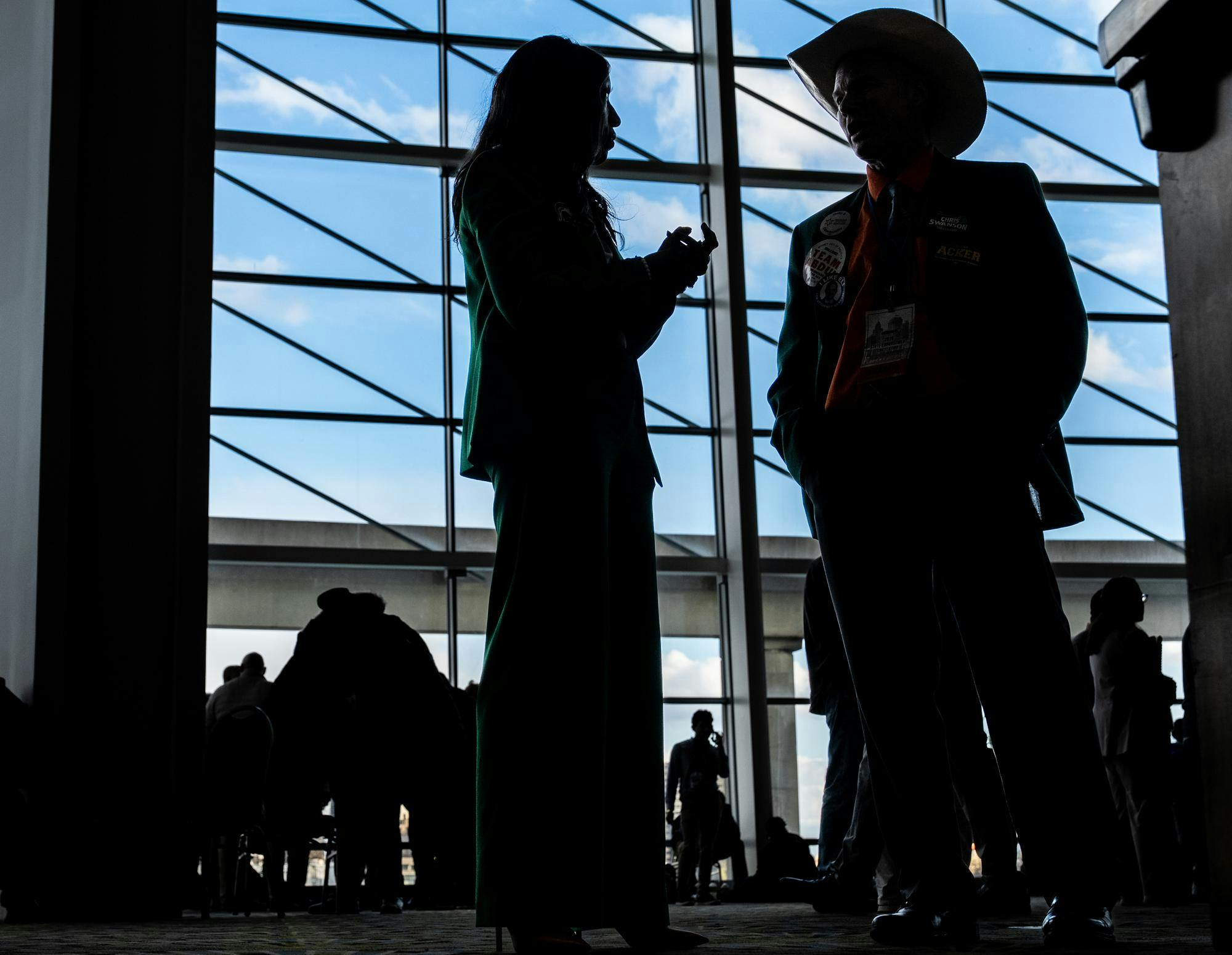
Still, it was the long shadow of the Larry Nassar crisis that tinged how Democratic candidates for the MSU Board of Trustees pitched themselves to delegates at the Michigan Democratic Party convention Sunday.
For Trustee Kelly Tebay Zemke, who netted the Democratic nomination alongside board chair Brianna Scott in Detroit yesterday, the promises she made as a newly elected trustee in 2018 to address how the university handled Nassar, the disgraced former university doctor who sexually assaulted hundreds of young women under the guise of medical treatment, were a recurring theme in her conversations with delegates Sunday.
“I wanted to make a difference, and I wanted to make sure that this didn't happen to anyone else at Michigan State,” Tebay Zemke told various caucuses at the Huntington Center. “And while we haven't fixed the problem, we made a lot of progress that I'm really proud of.”
That the aftermath of Nassar continues to loom over the university’s broad public perception feels somewhat apt given the still-reverberating impact the crisis has had on MSU. The board of trustees, after years of delay, allowed the university to release internal documents related to Nassar to the state general attorney in 2023. And just this month, MSU announced it had landed on an outside firm to conduct a review intending to uncover the “root causes” of the university’s much-criticized handling of Nassar, in addition to reviewing reforms implemented in the years since the scandal.
The university’s response to Nassar was also referenced by trustee candidate state Sen. Sylvia Santana, D-Detroit, whose efforts to unseat Scott and Tebay Zemke were unsuccessful.
While campaigning around the convention center Sunday, Santana told delegates she would advocate to fully un-redact the documents that MSU delivered to Attorney General Dana Nessel that were subsequently released by her office.
Santana was nominated by Valerie Von Frank, the director of an advocacy group representing parents of the “sister survivors” of Nassar, who delivered a speech at the convention. Von Frank said during the nominating speech that Santana had been the first trustee candidate in eight years to consult with the advocacy group, Parents of Sister Survivors Engage.
Von Frank praised Santana's history of advocacy for survivors, saying that Santana champions the transparency MSU lacks.
The strategy netted Santana some support, including 2020 MSU graduate Edmund Rushton, who said the second-term state senator “has always been the person who fights the hardest for us.”
“I'm very excited to see somebody like that take on the institutions of Michigan State, which I know from personal experience, tend to be pretty corrupt,” Rushton said ahead of the nomination announcement.
On the other hand, delegate Emily Rollins, 41, a consultant from Birmingham, described Santana focusing on Nassar as “interesting.”
“Obviously, it was a major thing at the university, but there are so many other things that happen at the university that I feel like we should start talking about … students and faculty,” Rollins said.
Tracy Zeman, a delegate and lecturer at the University of Michigan, agreed with Rollins’ sentiment, noting that the two incumbents were “more focused on Michigan State as a whole.”
Scott did not bring up Nassar in her conversations with delegates Sunday or her victory speech, instead focusing on affordability and protecting federal funding for the university.
Conversations with delegates Sunday also revealed a level of unfamiliarity many had with the candidates and the inner workings of MSU as a whole, a phenomenon pointed to by critics of Michigan’s system, in which trustees are elected through statewide election. Rollins and Zeman said they didn’t know the names of a single trustee nor the candidates before the convention, and 10 other delegates told The State News they had minimal knowledge of the board’s composition.
“Of all the races, that was the one I knew the least about,” Rollins said. “I wish I could be more eloquent about it.”
Rollins and Zeman attempted to research beforehand, but said they struggled with the lack of information on the candidates. They couldn’t find websites to figure out trustee platforms, aside from the occasional newspaper article, and the candidates didn’t participate in panel interviews that the two delegates said they use to determine their votes in local elections.
Other delegates based their votes on select criteria. Grant Howe, the vice chair of youth outreach for the Livingston County Democratic Party, said the ideal trustee candidate is someone who considers both faculty and students, as well as pro-labor initiatives.
Howe voted for incumbents Scott and Tebay Zemke as a result of the duo’s outreach. He added that he admired Scott’s “passion” for higher education and “fighting back” against budget cuts due to a lack of federal funding.
Support student media!
Please consider donating to The State News and help fund the future of journalism.
And delegate Dave Justin, 74, said he made his vote off interactions with the incumbents in his local county.
Discussion
Share and discuss “At Democratic convention, Nassar scandal a recurring theme in trustee race” on social media.