The Big Ten Tournament can be classified as a tournament of momentum. When one team plays three days in a row, it’s tired. When another plays back-to-back games, it has momentum. When one plays its first game — especially in the later days of the tournament — it’s rusty.
On Friday night, Michigan State didn’t have that momentum. Instead, UCLA did. In the quarterfinals of the Big Ten Tournament, the No. 3 Spartans fell to the No. 6 Bruins, 88-84.
“UCLA played desperate tonight, and we did not,” MSU head coach Tom Izzo said. “They kicked us from start to finish and deserved to win. They punched us in the mouth and that doesn’t happen very often. It’s my job to get my players ready to play, and they were not ready to play.”
On Thursday night, UCLA was playing Rutgers in the third round of the Big Ten tournament. It won 72-59. While the Bruins were playing and gaining momentum, the Spartans were on the couch, scouting and growing cold.
It’s a factor that Izzo pointed to in his weekly press conference before the Big Ten tournament — that when a team gets a bye, there’s always a concern because the team that played the night before possesses momentum.
Those concerns became true, as UCLA possessed this momentum in its physicality and in its shooting. It happened to be the perfect recipe to claim its victory.
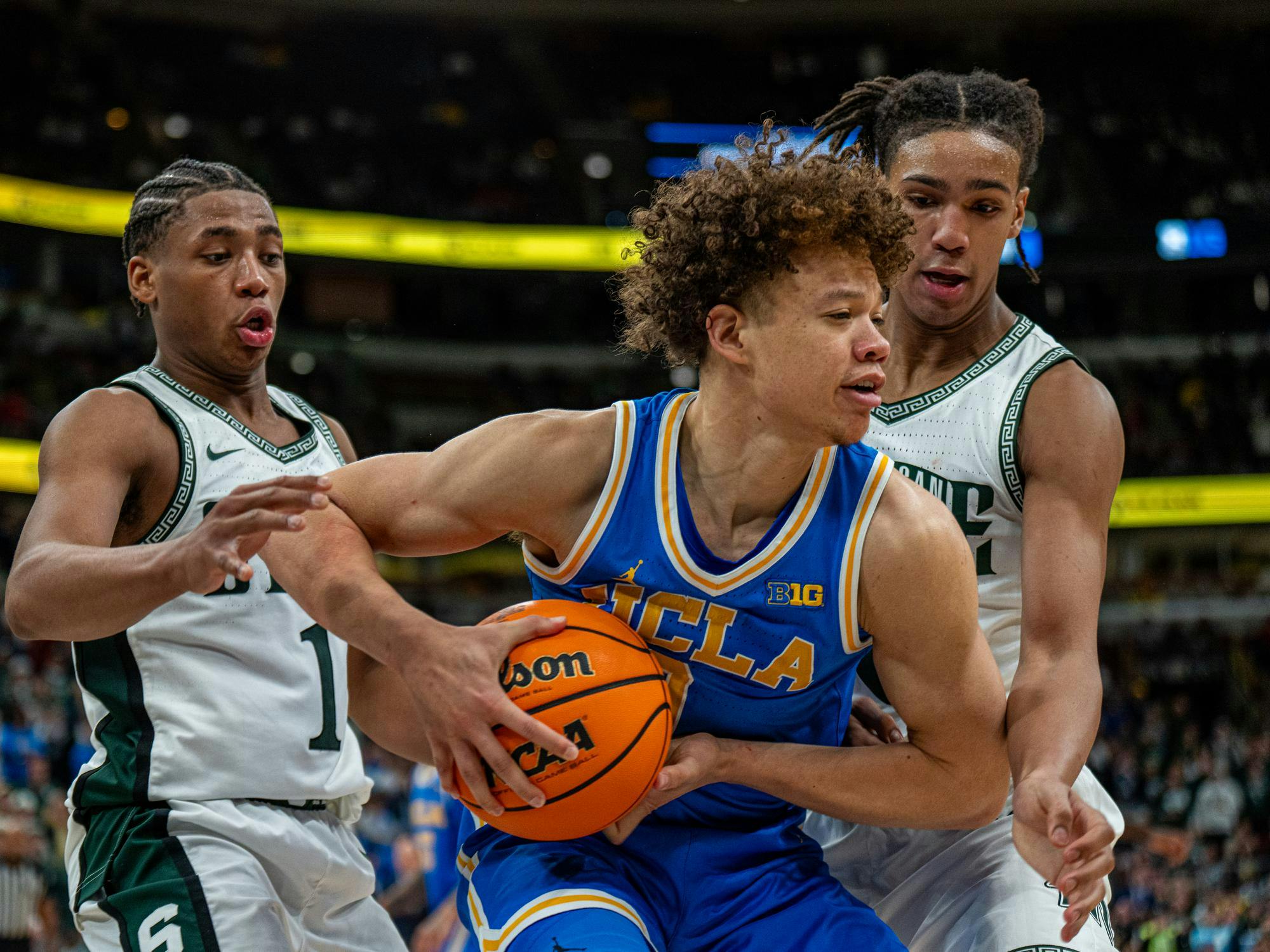
UCLA’s physicality came primarily in the post, where defenders denied entry passes by latching onto Spartan hips and fronting their positioning. When Michigan State was able to get the ball inside, UCLA defenders condensed the paint, where a swarm of blue jerseys created a wall between the ball and the basket.
This reflected a Spartan team at a loss for identity. MSU couldn’t out-physical its opponent in the paint, meaning it found limited success on offense. While that held true throughout the game, it was especially evident in the first half. MSU outrebounded UCLA 17-12 but was outscored in the paint 14-8. Senior forward Jaxon Kohler and senior center Carson Cooper contributed little, combining to shoot 2-for-7 with only five rebounds.
It was this style of play that gave them an 11-point halftime deficit that they could never recover from.
Kohler and Cooper would both finish with underwhelming games on such a big stage. They combined for 6-for-13 shooting with 20 points and 12 rebounds. If MSU wants to compete in the NCAA tournament, the Spartan big men need to fight through opposing teams' physicality and make a statement. It’s something that they didn’t do tonight, and now they’ll be watching the rest of the Big Ten tournament at home because of it.
“We had a couple possessions where we gave them three rebounds in a row,” Izzo said. “That’s hard to overcome. My seniors weren’t really with it tonight.”
It wasn’t just on defense where UCLA showcased its physicality, but also on offense. This front court physicality correlated to strong and efficient dribble drives that led to easy layups. The leader of this style of play was Bruin guard Donovan Dent. Following his triple-double the night prior, Dent stepped onto the court with a quickness about him that MSU couldn’t defend — he found success in driving to the hoop, finding the open man and shooting from beyond the arc. He was the Bruins all-star player against Rutgers the night before, just as he was the all-star player against MSU.
Dent would finish shooting 8-for-18 with 23 points while tallying 12 assists. Guarding him was sophomore guard Jeremy Fears Jr., who struggled to keep up with Dent’s quickness and agility. While Fears would finish shooting 7-for-14 with 21 points and 13 assists, it was his messy defense against Dent that hurt MSU the most.
“Dent’s first game [against Rutgers] was huge for him,” Fears said. “He played great tonight. He got his guys open shots, and he did what he needed to do to help his guys win. I didn’t do my job in containing him and making it hard for him, so he was able to be successful tonight.
As the game progressed, Dent’s dribble drives drew Spartan defenders into the paint, opening UCLA’s passing lanes. That made it easier for the Bruins to find the open man and knock down open shots.
The result was one of UCLA’s best shooting performances of the season. The Bruins finished 30-for-54 (56%) from the field, 13-for-27 (48%) from beyond the arc and 15-for-19 (79%) from the free-throw line.
In crunch time when MSU attempted to muster a late game comeback, it was these shots that made the difference. Anytime MSU began to gain momentum late in the second half, the Bruins would push the floor, find an open man and drill a shot that would always keep the Spartans a few steps away.
UCLA shot well, and while it deserves credit for converting those shots, most weren’t difficult. Because of the Bruins’ physicality and their small, quick style of play, the Spartans struggled defensively. For much of the game, they looked methodical — slow in transition, vulnerable to dribble-drive penetration and late on defensive recoveries.
“I do not think we played good defense like we were [during the regular season],” Izzo said. “We just got to get back to who we are and who we've been most of the year. I thought we looked out of sorts. I don’t know why yet. But there’s a lot to build on, because our players have already done it.”
In the quarterfinals of the Big Ten tournament, MSU displayed a performance that sends home teams in single-elimination games. In its 88-84 loss to UCLA, it learned that. Luckily for the Spartans, it still has one more tournament to play in.
Support student media!
Please consider donating to The State News and help fund the future of journalism.
MSU drew a No. 3 seed in the NCAA Tournament's East Region, which features No. 1 seed Duke at the top and No. 2 seed Connecticut at the bottom. The Spartans lost at UConn in an Oct. 28 exhibition and fell to the Blue Devils at home in early December.
MSU will face No. 14 seed North Dakota State in its first March Madness contest on Thursday, March 19, in Buffalo, New York. Tip-off is scheduled for 4:05 p.m. TNT will air the game.
Discussion
Share and discuss “UCLA’s momentum and physicality eliminate MSU from Big Ten tournament” on social media.