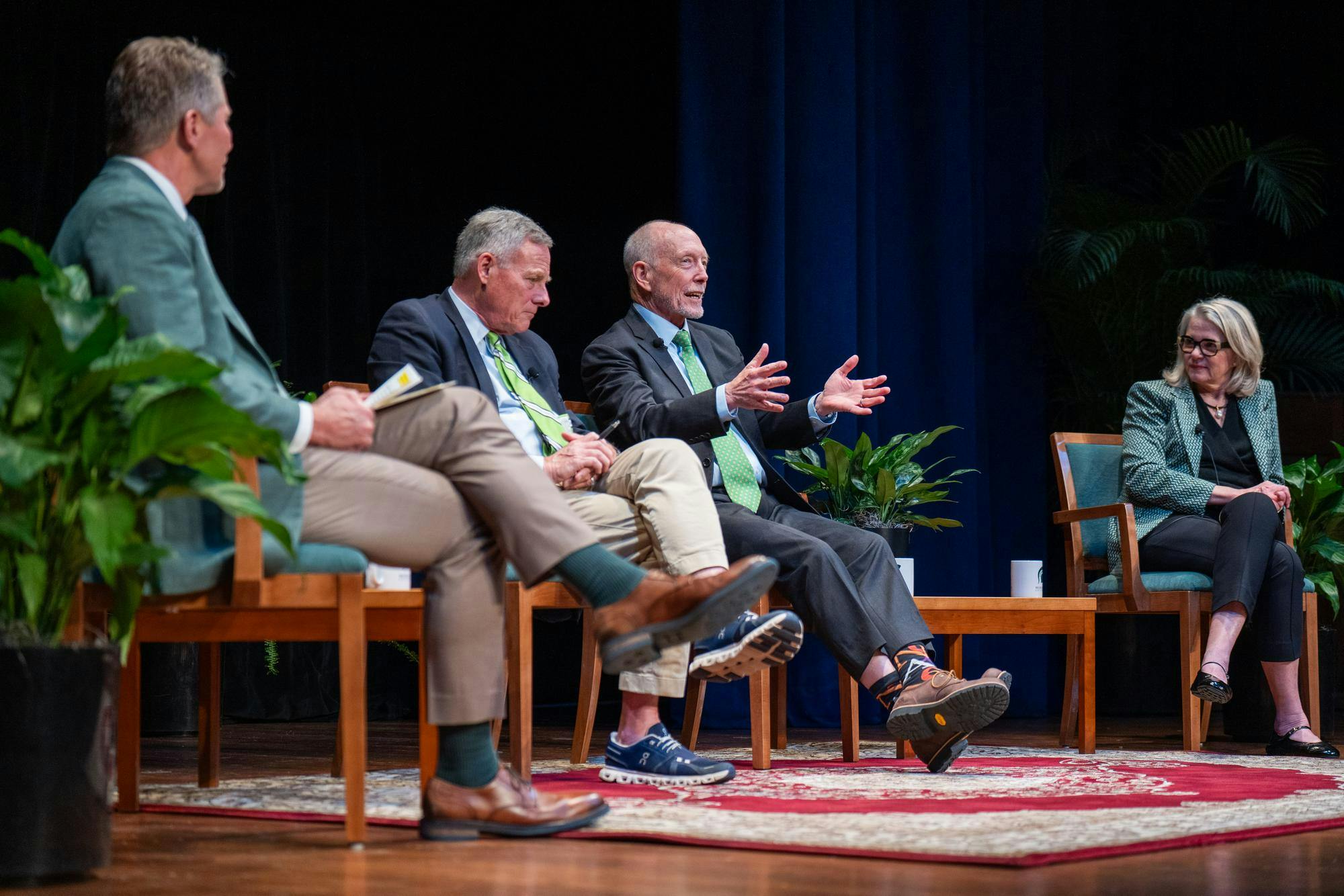
Michigan State University hosted the inaugural panel of its Presidential Speakers Series Tuesday evening, featuring a conversation on the role of higher education in civil discourse.
The speakers included Margaret Spellings, president and CEO of the Bipartisan Policy Center, former U.S. Under Secretary of Education Ted Mitchell and President of the American Council of Education and former Undersecretary of Education Richard Burr.
To introduce the event, University Distinguished Professor in Education Ann Austin explained that the event was conceived as an overarching university and community event that offers attendees examples of engaging in productive dialogue across a diverse range of thought.
“This series is intended to help illuminate the many ways to view the world and to give us perspectives to help process the unfamiliar and the challenging in very constructive ways,” Austin said. “We’re here to explore the role of higher education and civil discourse and its crucial support for upholding democracy.”
President Kevin Guskiewicz, the moderator of the discussion, explained that universities are a place where students test and debate their ideas, to prepare themselves to be future leaders and active citizens in a thriving democracy. Burr also described institutions of higher education as a “marketplace of ideas.”
Mitchell noted the importance of the faculty in universities challenging the ideas of students in order to enable their leadership skills.
“One of the most important things for a faculty member to do is to challenge students with a bunch of opposing views and generate the kind of critical thinking and analysis of information that's going to suit them well in the world,” Mitchell said.
In addition to the importance of faculty to facilitate civil discourse in classrooms, the panelists noted the importance of fostering an environment where faculty members can thrive in their jobs. Spellings said that faculty members are “starving” for support in being able to productively facilitate civil discourse in a classroom setting where students are comfortable expressing their opinions.
In response, Mitchell took this discussion a step further and suggested faculty divide the epistemological world in order to ask “big questions” that encourage civil discourse amongst students. Allowing faculty to “teach what they want to teach” and ask these questions encompassing a diversity of perspectives would help prepare students for their future in academia. To be inviting of other perspectives, Mitchell suggested that having courses co-taught by faculty from different disciplines and perspectives would create a larger scope for students to analyze.
Burr discussed how faculty can help initiate participation and conversation between students, and take a different approach in encouraging students to discuss with each other and to choose to remain curious.
“I think if we approach from the other side, we’d begin to focus on how team building happens and how responsibility of participation and picking up your share will succeed in solving a lot of problems,” Burr said.
The political scene beyond the classroom plays a role in fostering civil discourse and understanding the role of high institutions in democracy. Furthermore, the panelists analyzed the responsibilities of public universities to model and sustain civil discourse.
“I think that higher education especially has become such a focus in this country,” said Burr, adding that MSU is producing $10 billion worth in annual revenue and $1 billion in research.
Burr also noted that half of the investment into higher education comes from the federal government. There is a partnership between higher education and the federal government, according to Burr, but there is also emphasis placed on the importance of right-sizing that relationship.
In past years, Mitchell noted, Americans have begun to see higher education solely as an individual good and not as a public good.
“We need to change a little bit about that dialogue before we can truly accept our responsibilities to serve democracy. As a result of that big shift between public and individual, we have used almost all of the collective and individual measures that we have to identify higher education’s success by aggregating individual success,” Mitchell said.
Spellings, the former secretary of education under President George W. Bush noted the federal government’s role in supporting not only colleges but also preparatory schools to prepare student not only for civil discourse and uplifting democracy, but for employment as well.
She noted that in the 16 years of the Bush and Obama administrations, the federal government was going in the “right direction” and taking accountability for reading and math education and closing the achievement gap. Since COVID, Spellings pointed out, the federal government’s involvement in preparatory education has been reduced, but Spellings did note that the federal government does have the ability to support students from the base.
“So we do know how to use a federal role in a smarter way. It's not about particular inputs. It's about who do we care about, how do we find out and what do we do about it when we know,” Spellings said.
All of the panelists agreed that increasing transparency in education and a general consensus on education standards of discussion and acceptance of a diversity of opinions is crucial for continuing higher education’s role in propelling democracy and fostering civil discourse among students.
Support student media!
Please consider donating to The State News and help fund the future of journalism.
Discussion
Share and discuss “MSU hosts panel discussion on how colleges can foster productive discourse” on social media.