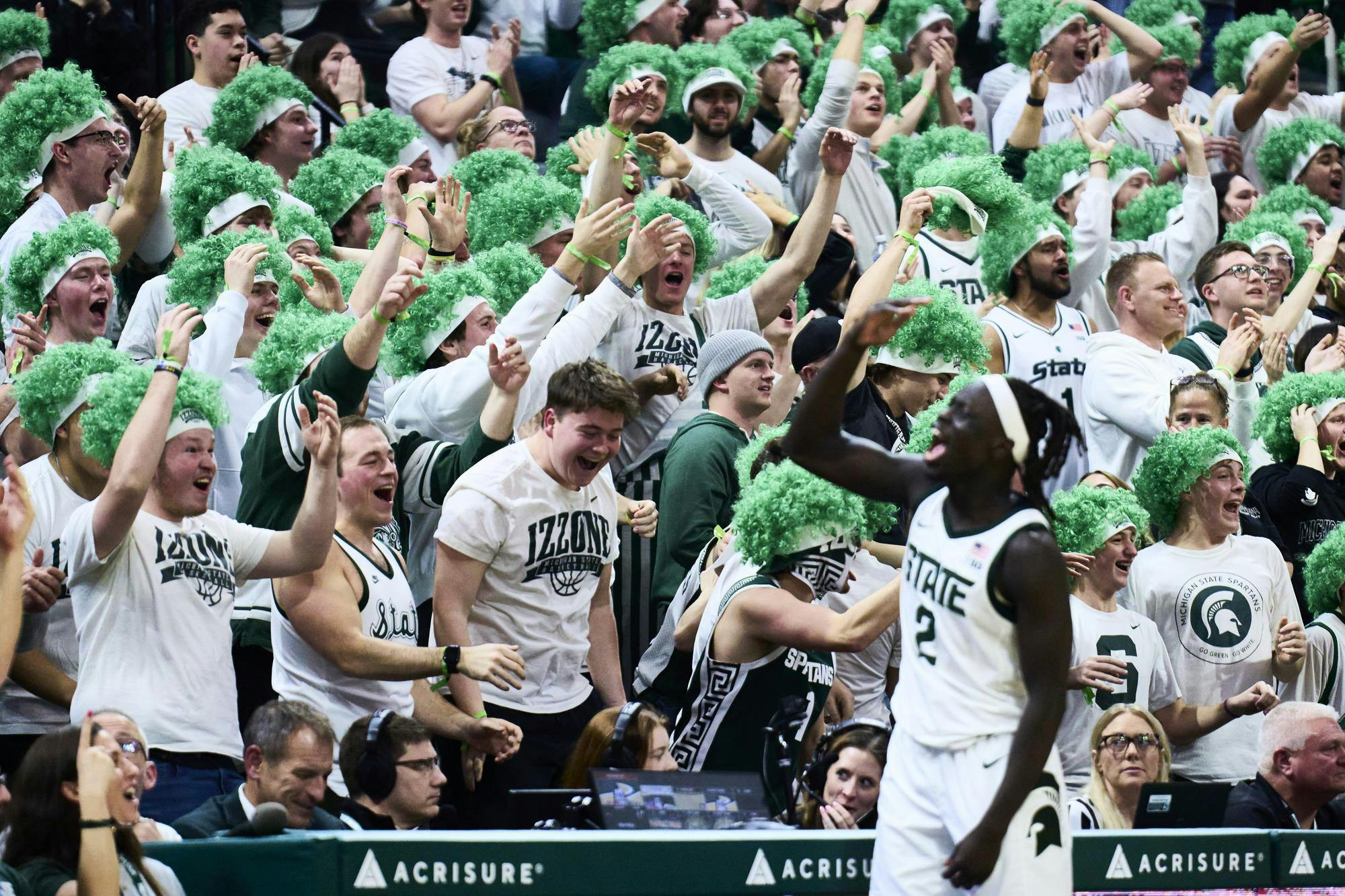
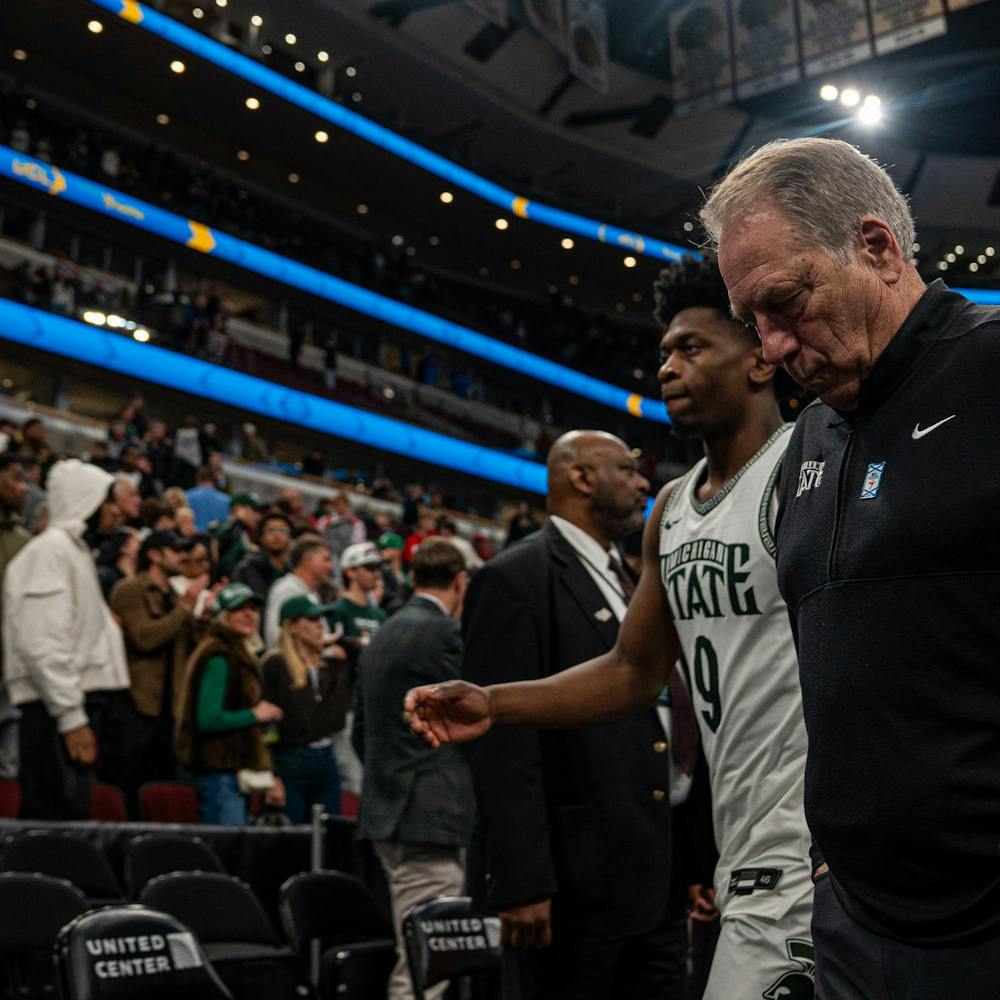
“There’s a side of this where we have to take [our selection] in and celebrate, but at the same time we have to be mature about this and make sure we don’t get too over-excited and to not lose focus on the main mission,” senior forward Jaxon Kohler said. “This is the most important stretch for us. Whether freshman or senior, we need everybody to play.”
MSU enters the NCAA tournament on a two-game losing streak—a loss to Michigan in its regular-season finale and a loss to UCLA in its Big Ten tournament opener. Now it enters a new season, one where the stakes are high and the emotions run deep, one where a single team will stand victorious and 67 others will be sent home with nothing.
MSU has made three final fours when losing its Big Ten tournament opener. Against a strong region of teams, it looks to do it again.
“As always when you go into these tournaments, you have to know your competition but worry more about your team,” MSU head coach Izzo said. “That’s what we practiced today, and tried to iron out a few things that we thought we didn’t do a good job of in the last game.”
The Spartans are familiar with these high stakes and intense emotions. This tournament will mark MSU’s 28th consecutive NCAA tournament appearance, which is currently the longest active NCAA tournament appearance streak. It’s also tied for the longest consecutive streak in NCAA history, tying the 1990-2017 Kansas Jayhawks.
Last year’s NCAA tournament run brought renewed expectations for MSU basketball. After four consecutive years of mediocrity—a 4-4 tournament record and an inability to advance past the Sweet 16—MSU advanced to the Elite Eight thanks to a deep bench and strong senior leadership. While the Spartans fell short of the Final Four with a 70-64 loss to No. 1 Auburn, they offered a vision of what MSU basketball can be year in and year out.
On Thursday, this vision returns, and with it, the hope of cutting nets in April.
A date with No. 14 North Dakota State
The NDSU Bison (27-7, 14-2) are hot. Having won both the Summit League regular-season and tournament championships, the Bison are well-coached and thrive on shooting from beyond the arc while applying pressure on opposing offenses. This marks their fifth NCAA tournament appearance in school history and their first since 2019. The Bison hold a 2-4 tournament record, highlighted by an upset victory over No. 5 Oklahoma in 2014.
“We like the side of our bracket,” senior center Carson Cooper said. “North Dakota State is a good team, and they make a lot of shots. It’ll be a good matchup and a good region for us.”
NDSU is coached by David Richman, who has led the Bison for 11 seasons. Under his physical style of play, the team currently averages 80.7 points per game while allowing 69.6. Their greatest strength — and, at times, potential vulnerability — is their reliance on the three-point shot: they attempt an average of 25 per game, converting 36.5% of them.
When this aspect of their game is off, the Bison find themselves struggling. When it’s on, they thrive.
The Bison also boast a deep bench for MSU to scout. With nine players averaging more than ten minutes per game, NDSU always has a substitution ready when a player struggles. MSU will need to keep a close eye on guards Damari Wheeler-Thomas and Trevian Carson, both fast, physical players who can shoot and attack the basket. Wheeler-Thomas averages 14.4 points, 3.5 rebounds, and 1.2 steals per game, while Carson contributes 12 points, 6.4 rebounds, and 1.9 steals.
MSU has an advantage in size, just as it does physicality. Like UCLA, the Bison are guard oriented, relying on small ball to take down opponents – they’re so ‘small’ that they don’t even have a registered center position on their roster. What this creates is a matchup between two teams that have an opposite style of play.
For MSU’s style of play to thrive and blossom, there must be a physicality in the post that was absent against UCLA last week. If this fails to happen, then NDSU may relive its 2014 upset victory, just as MSU may relive its 2016 upset loss.
A region of good basketball
There are four regions in the NCAA tournament – the east, south, west and midwest. MSU was bidded to the east, which happens to be arguably the most difficult in the tournament.
If the Spartans are victorious against NDSU, it will advance to play the winner of No. 6 Louisville and No. 11 South Florida on Saturday in Buffalo. This season, Louisville (23-10, 11-7 in the ACC) has shown spurts of greatness and spurts of luster — in other terms, the Cardinals are as inconsistent as they come, beating some tournament teams by 30 and losing to others by the same margin. They average 84.8 points while allowing 72.2, and their best victory was against both Kentucky and NC State.
Support student media!
Please consider donating to The State News and help fund the future of journalism.
For South Florida (25-8, 15-3 in the AAC), it’s coming off a season where it won both the regular season and tournament championships. Unlike Louisville, there’s been a consistency to this team that thrives in the form of fast pace basketball – close losses to good teams, blowout victories to the bad. The Bulls average 87.7 points while allowing 75.5, and their best victory comes against both Wichita State and Utah State.
“We will prepare for all three teams,” Izzo said. “The deal here is to win the weekend. It’s what I learned, it’s what I do, and I think that it’s valid. We know that you gotta win the first game to get to the second, but with those quick turn-arounds, [preparing for all three teams] has helped us over the years.”
While MSU may not be thinking about the later rounds, many other people are. If past NDSU, and if past the winner of Louisville and South Florida, MSU will find itself in the Sweet 16 for the second consecutive year. The team that would meet them in the Sweet 16 – and the teams that would meet them beyond, if they were to continue winning – would be too difficult to tell.
What’s not difficult to tell, however, is the difficulty in the east region.
Holding the outright No. 1 seed are the Duke Blue Devils (32-2, 17-1 in the ACC), a team that defeated MSU earlier this season, 66-60. The Spartans have historically struggled against Duke, but if the teams were to meet in this tournament, it would only be in the Elite Eight. Such a matchup would not only serve as a rematch of this season’s meeting but also recall MSU’s 68-67 victory over Duke in the 2019 Elite Eight.
The No. 2 seed in this region is the Connecticut Huskies (29-5, 17-3 in the Big East), a team that has enjoyed recent NCAA tournament success, winning back-to-back national championships in 2023 and 2024. If MSU and UConn were to meet in this tournament, it would be in the Sweet 16. The matchup would also serve as a rematch of MSU’s 76-69 exhibition loss to the Huskies earlier in the pre-season.
It’s not just Duke and UConn. There are other teams that pose a threat to MSU down the line, too. At the No. 4 seed are the Kansas Jayhawks (23-10, 12-6 in the Big 12), a historically good March team that – this season – consistently battled in a tough conference. At the No. 5 seed are the St. John Red Storm (28-6, 18-2 in the Big East), a team that has grown hot when it matters the most.
Beyond the top six seeds in this region, there’s No. 7 UCLA, No. 8 Ohio State, No. 9 TCU, No. 10 UCF, No. 12 Northern Iowa, No. 13 Cal Baptist, No. 15 Furman and No. 16 Siena. In March, none of these teams should be discounted.
“We have to be focused, because it was proven that a few years ago, a one seed can lose to a 16 seed,” Izzo said. “The parody is so much different now. So you have to focus on the first team, and that’s what we’ll do.”
The beginning of single elimination basketball begins. In a field of 68, only one team will remain. For MSU, it hopes to be that one team. On Thursday, March 19 at 4:05 p.m. the Spartans will face NDSU at the KeyBank Center in Buffalo, N.Y. The game will be aired on TNT.
Discussion
Share and discuss “MSU enters stacked region, opens March Madness vs. NDSU” on social media.