Postseason runs are defined by many facets of a team. Mental components, physical performance and team chemistry can all play a part. But there are also statistics — a direct reflection of a team’s game.
While numbers will never fully encompass a team or player, they can still provide insight into Michigan State hockey’s upcoming contest against the University of Connecticut (UConn).
The No. 1-seeded Spartans are set to face the No. 4-seeded Huskies in the Worcester Regional, the opening rounds of the NCAA Tournament. Puck drop is set for 1:30 p.m. Thursday, March 26, at DCU Arena.
Records and recent contests
MSU enters the tournament with a 25-8-2 record and a chip on its shoulder. The Spartans’ last game was a 3-2 overtime loss to Ohio State in the Big Ten Tournament semifinals. The Buckeyes were the only conference team to defeat the Spartans this season, as MSU went 1-3-1 against them.
UConn holds a 20-12-5 record and is also fresh off a close-contest loss. The Huskies fell 2-1 to Merrimack in the Hockey East Tournament Championship, which the program has never won.
In their last 10 games, MSU is 5-3-2 and UConn is 3-5-2.
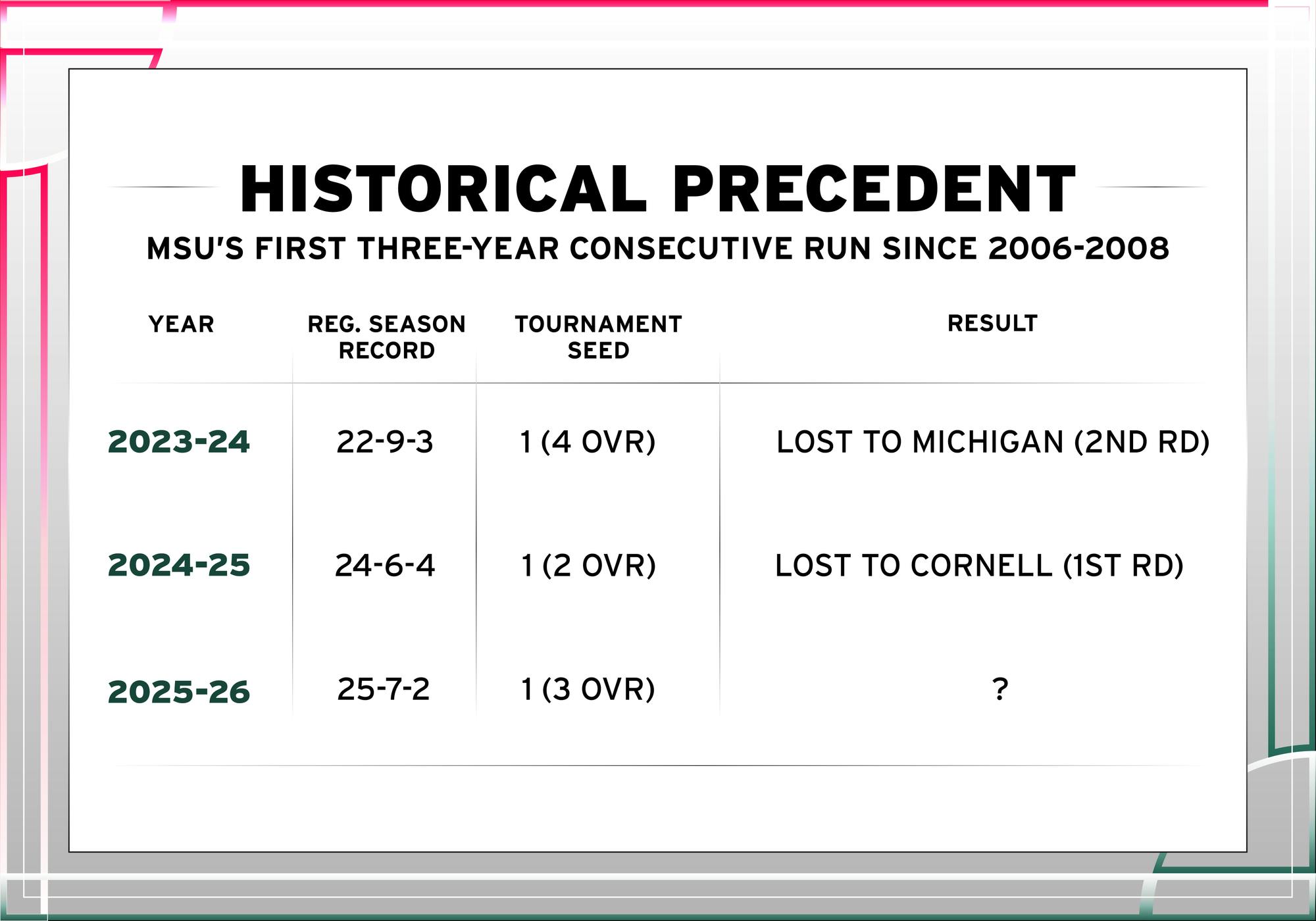
MSU has made the NCAA Tournament for the third straight year under head coach Adam Nightingale. Overall, the Spartans have reached the tournament 30 times, advancing to 11 Frozen Fours and winning three national championships (1966, 1986, 2007).
UConn is making its second-ever tournament appearance, after marking its first one last year. The Huskies fell to Penn State in the second round of regionals last year, 3-2 in double overtime.
Players to watch
Both teams are led by their top line of forwards.
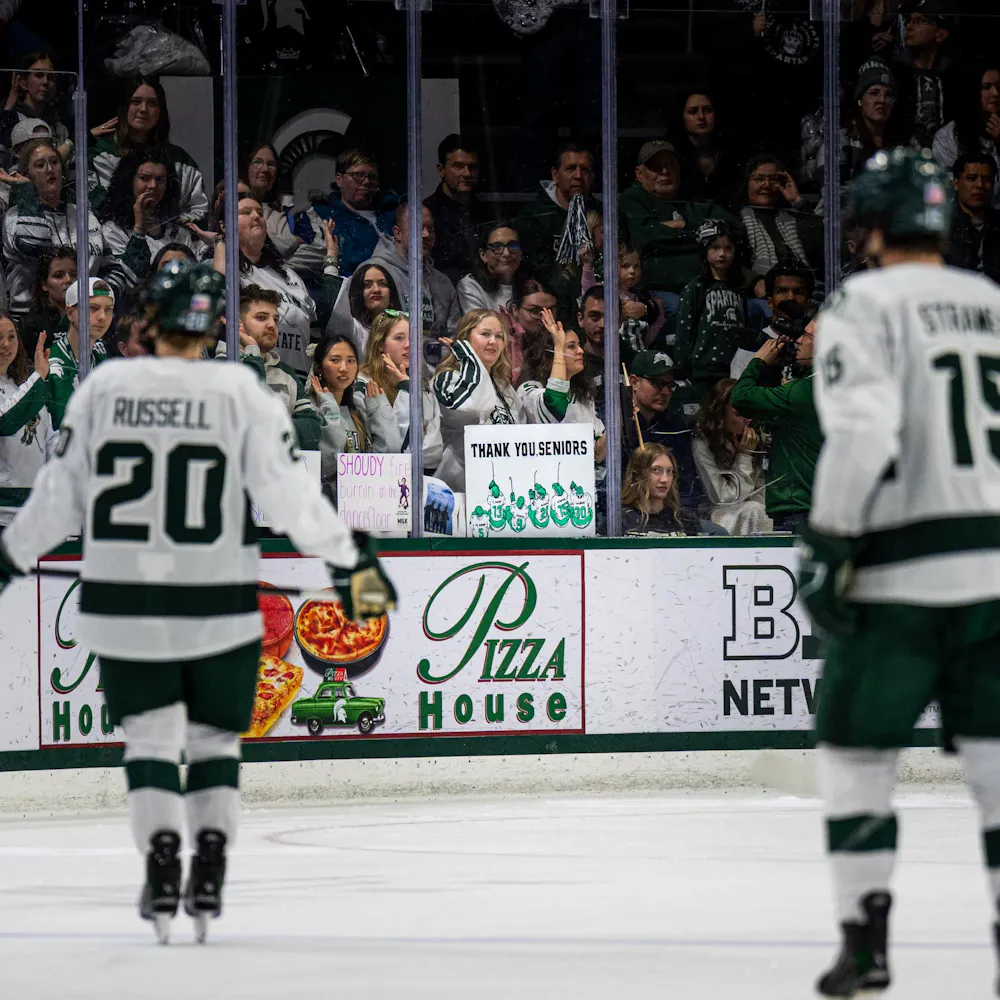
For UConn, that line features Joey Muldowney, Ryan Tattle and Jake Richard. For the Spartans, it consists of senior forwards Daniel Russell and Charlie Stramel, along with freshman forward Porter Martone.
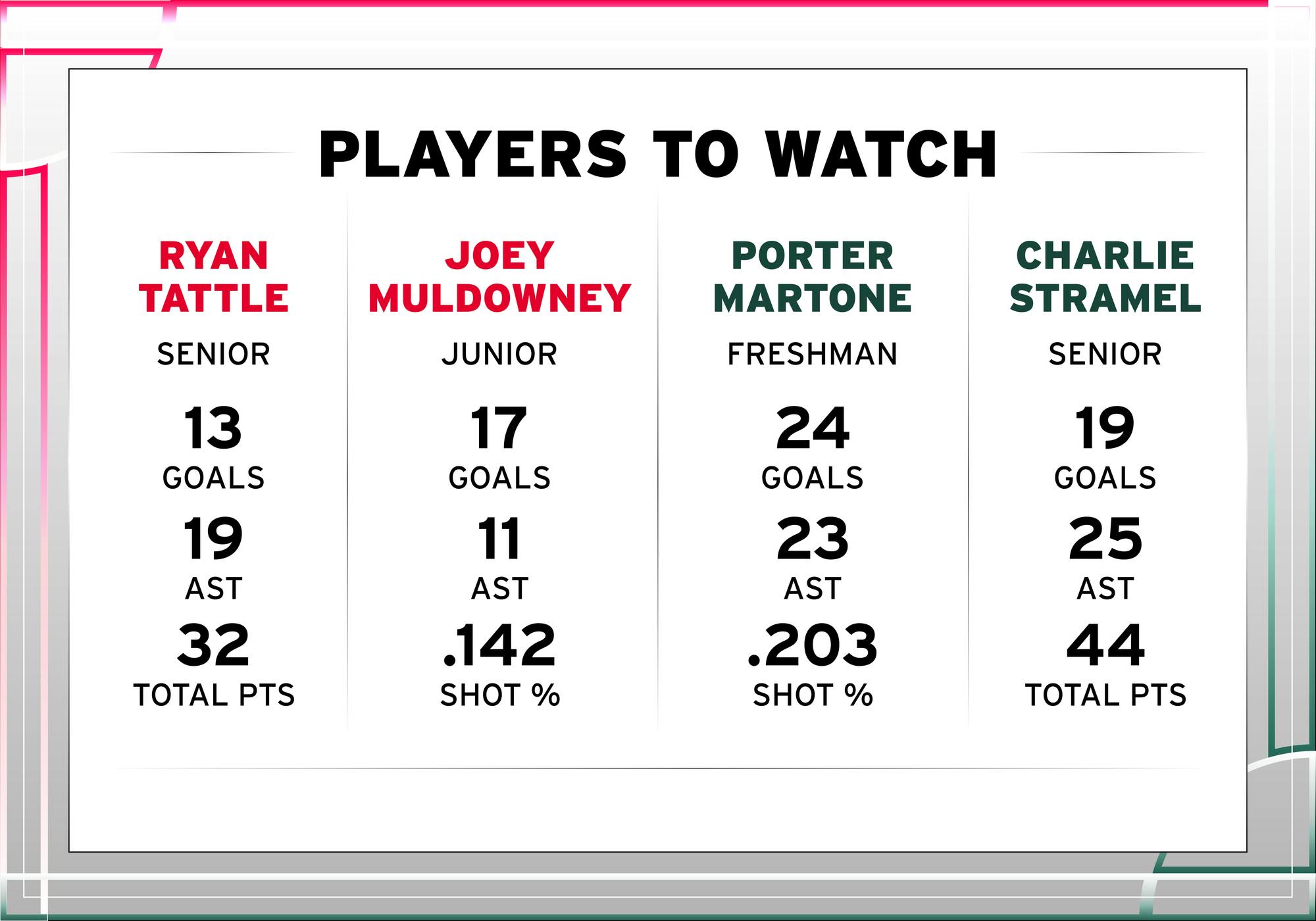
Muldowney leads UConn with 17 goals and 28 points as a junior. He has spent his entire collegiate career with the Huskies and broke out last season. After a nine-point freshman campaign, Muldowney finished his sophomore year with 47 points (29 goals, 18 assists). His goals ranked second in the country. He remains a dangerous player despite decreased production this season, as timeliness matters.
The Spartans' leading goal scorer has been Martone. He ranks second in the country in goals per game, while Muldowney ranks 25th. Martone leads MSU with 24 goals (24-23--47) and has registered points in all but four of his 33 games.
Stramel trails just behind Martone with 44 points (19-25--44). He's already tallied 17 more points than his career-high last season and said confidence is one of the biggest areas he's grown. Stramel's net-front presence on offense and defense will be key for the Spartans. His 461 faceoff wins are second in the country, far ahead of Tattle's 349 wins.
Tattle is the Huskies' starting center, leading the team in faceoffs, assists and points (13-19--32). He’s in his fourth season with the Huskies after spending four years in the British Columbia Hockey League (BCHL). Tattle has had time to develop, and it shows in his game.
Russell and Richard play similar roles on their team. Russell is a reliable offensive backbone and leads the Spartans in assists with 28 (11-28--39). Richard has made 17 assists and 27 points.
MSU’s on-ice ratings for its first line are better than UConn's. The trio has a combined rating of plus-86, while the Huskies’ trio is a combined plus-20. However, both sides have depth. Eleven of the Huskies have tallied double-digit assists this season to generate offense.
Support student media!
Please consider donating to The State News and help fund the future of journalism.
“Whoever you're going to play, you're going to play a good team,” Nightingale said on Sunday. “Certainly that's the case with UConn. They've had a heck of a season, and they got a ton of depth. They got a really good goaltender, and they play in your face.”
For the Spartans, some of their depth is highlighted by freshmen wingers Ryker Lee (14-14--28) and Anthony Romani (14-13--27). They trail the first line in production and have stepped up in big games.
The two played on a line at the start of the season (built around freshman center Eric Nilson) but were later separated as the team stepped into its roles. Nightingale reunited the original freshmen line in the final-regular season series, citing a need for scoring depth.
MSU averages 3.74 goals per game, which ranks sixth in the country. UConn ranks 23rd, averaging 3.11 goals per game.
In the D-Zone
Defense involves more than just blocks, but the Huskies hold an edge in that category. UConn has blocked 488 shots this season, compared to MSU’s 381 blocks.
UConn defenseman Tom Messineo has blocked 84 shots to lead the Huskies. Defenseman Viking Gustafsson Nyberg is second to Messineo with 50. The Huskies have five players with 30-plus blocks.
MSU’s sophomore defenseman Colin Ralph leads the Spartans with 45 blocks. Senior defenseman Matt Basgall follows with 39, and then junior defenseman Maxim Štrbák with 36. They are only Spartans with at least 30 blocks.
Still, MSU’s scoring defense is No. 5 in the country. The Spartans allow an average of 2.11 goals, compared to UConn’s 2.38.
Between the pipes
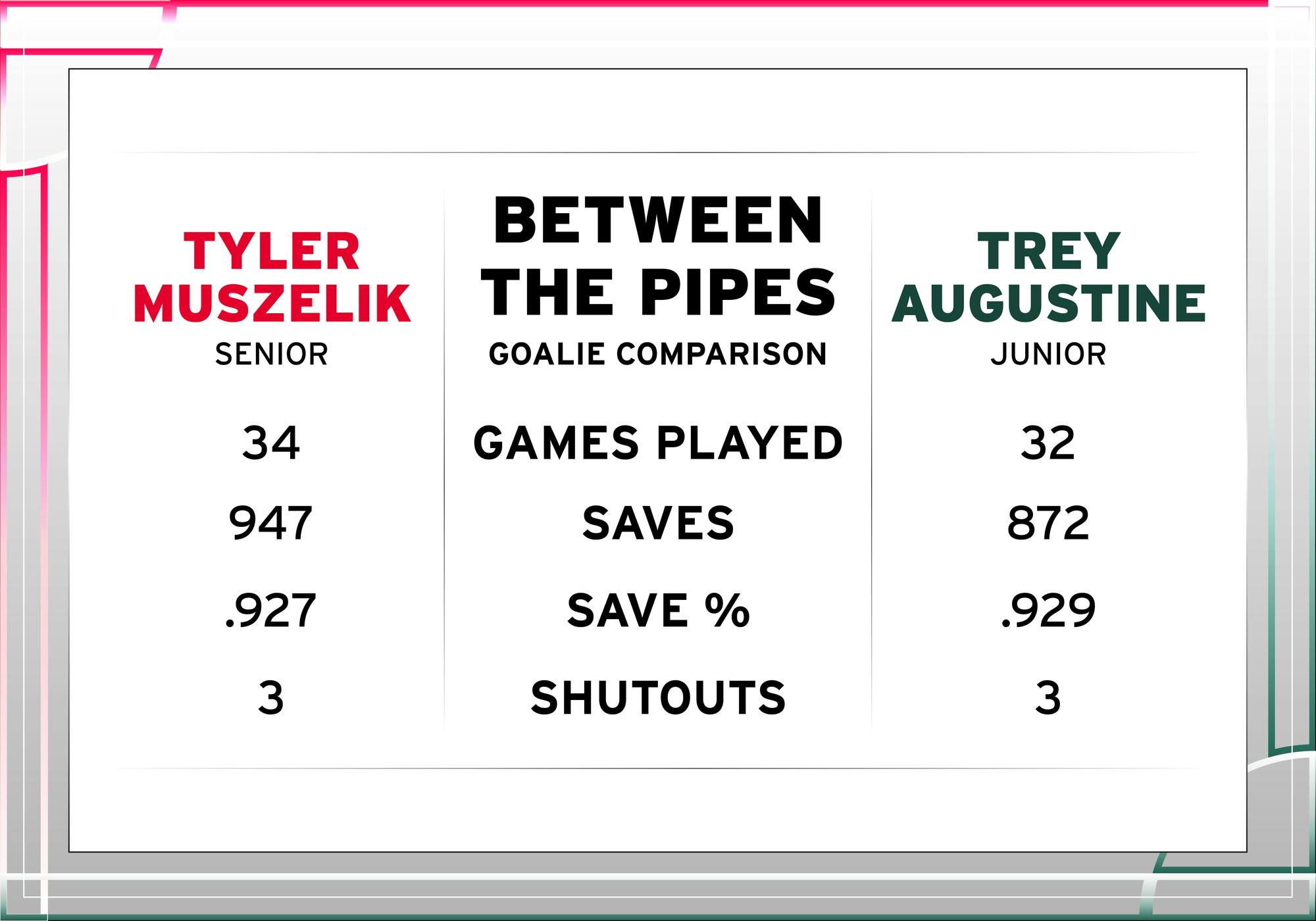
Goaltender Tyler Muszelik is expected to start for the Huskies. He's played the majority of their games and holds a 2.21 goals-against average, ranked 16th in the NCAA.
MSU will have junior goaltender Trey Augustine in the net. Augustine has backed the Spartans in all three of their NCAA Tournament games over the past two seasons. His 2.21 goals-against average ranks 11th in the country. Augustine has played two fewer games than Muszelik and made fewer saves, but he holds a better goals-against average and save percentage.
Special teams
UConn's power-play unit has a .224 conversion rate, and its penalty-kill has found success .795 percent of the time.
MSU has a .284 power-play percentage and an .813 penalty-kill percentage this season. However, its power play has gone 18-for-51 over its last 17 games — a .353 success rate — since Jan. 1.
"Our power play has gotten better down the stretch here," Nightingale said a couple of weeks ago. "We haven't gone on the power play a ton. So it seems like the more reps we get in games, the better we get the second half of the year."
Both teams have strengths and weaknesses reflected in their season statistics, but the outcome will be decided on the ice when MSU and UConn meet on March 26.
Discussion
Share and discuss “By the Numbers: Breaking down MSU hockey vs. UConn” on social media.