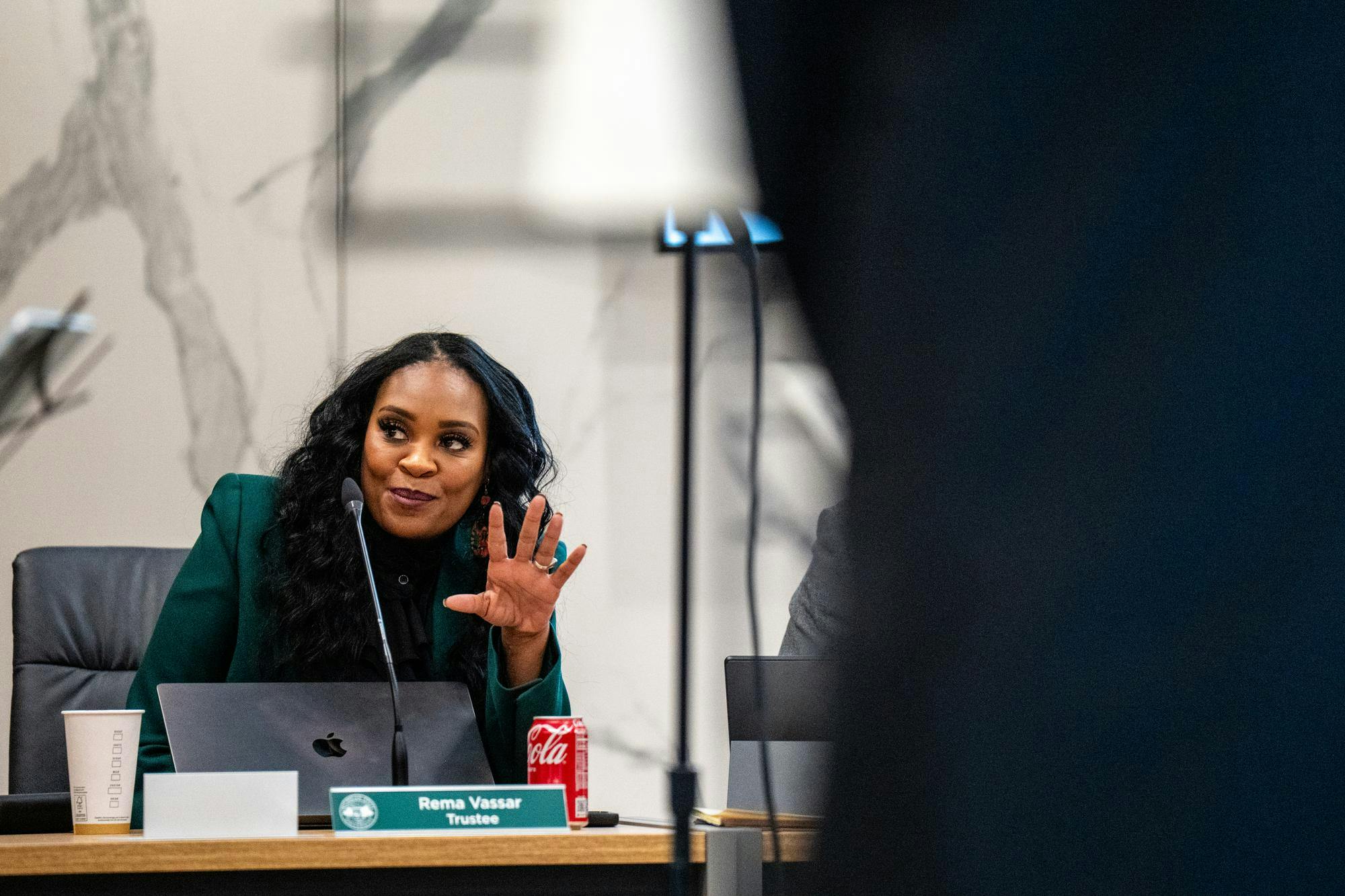
That piece, written days before the MSU Board of Trustees’ February meeting, was criticized by MSU President Kevin Guskiewicz, who said he and other administrators were disappointed by the Op-Ed. Board Chair Brianna Scott said the article put the work that MSU has done in a negative light, and cast doubt where “it should have not been.”
But in a second opinion essay published last Friday in the Michigan Chronicle, Vassar claimed that her characterization of Black students’ experiences could be verified if MSU were to release disaggregated data on the “enrollment, graduation, time to degree, academic probation, student debt, and climate for Black students.”
Vassar argued that trends in this data would reveal a history of the university not attending to the needs of Black students. MSU, however, disagrees with Vassar’s portrayal of the situation — claiming that it supports students in a variety of ways, and that graduation rates for Black students have remained stable for the last decade. In 2025, the graduation rate for Black students was 68%, while the graduation rate for white students was 85%, according to university data.
Since the inauguration of President Donald Trump, the university has removed references to DEI from several public-facing websites and instructed student organizations, including groups based around certain identities, to adopt language that makes it clear that all students are welcome to join, among other changes. It has also restructured how groups like the Black Students’ Alliance procure university funding, which used to be dispensed automatically — something Vassar has criticized.
“Whatever is written as policy will be followed,” Vassar said. “If you are taking out language, scrubbing websites and erasing critical policy, then you're also going to erode support — because it won't be mandated.”
In a statement to The State News, University Spokesperson Amber McCann wrote that MSU is ”proud to support student success from enrollment to graduation in a variety of ways,” pointing to programs that help students get paid for undergraduate research, and increasing programming for first-generation students, among other initiatives.
Meeting with MSU officials
Vassar’s new opinion piece directly references MSU’s reaction to her previous commentary, claiming that the university “issued internal memos and public statements accusing me of ‘misinformation,’ quibbling over semantics, and rebranding its diversity infrastructure,” instead of directly addressing the experiences of Black students.
After Vassar’s initial commentary was published, she met with MSU administrators and fellow trustees to discuss her piece. In an interview with The State News, Vassar said the university only pointed out one specific inaccuracy in the piece, involving her call to restore Vice President and Chief Inclusion Officer Jabbar Bennett’s title to "vice president and chief diversity officer.”
Vassar argued that this alteration stretched beyond pure language and impacts the day-to-day function of his role, which MSU denies. Bennett himself requested the name change, Guskiewicz said, adding that his work remains the same.
“It's a semantics conversation they want to have,” Vassar said.
McCann declined to provide specific mischaracterizations present in Vassar’s opinion piece.
The university has argued that DEI will continue to be challenged by the federal government, regardless of the administration’s appeal being dropped. Vassar, however, says that the university’s response to anti-DEI executive orders is an “indicator of a larger problem.” To her, it shows that MSU is not delivering on its commitment to student success.
Concern for Black student success
In her piece, Vassar asserted that across multiple years, Black students have the lowest graduation rates, the highest rates of academic probation, the heaviest student loan debt, and the lowest sense of belonging on campus. To her, these trends “form a pattern in which Black students are consistently positioned at the bottom of nearly every measure of ‘student success’.”
“Those are protracted outcomes that I've seen with my own eyes, so the university can certainly produce it,” Vassar said, referencing her call for MSU to release disaggregated data over the last 30 years tracking measures of success for Black students.
McCann, in an email to The State News, wrote that graduation rates for Black students have remained stable over the past decade.
“Although there is room for improvement, the 6-year graduation rate for African American/Black students at MSU is among the highest in the state,” McCann wrote.
Support student media!
Please consider donating to The State News and help fund the future of journalism.
MSU’s Institutional Research website hosts data pertaining to enrollment and graduation rates, but doesn’t track the other metrics Vassar mentioned in her piece.
“If MSU leadership truly believes their equity programs are thriving under new names, disaggregated data would prove it,” Vassar wrote in an email to The State News. “Their refusal to provide transparency suggests they know what the numbers would reveal.”
Individual incidents
Her commentary also discusses the racism Black students have faced on campus, arguing that the university has failed to deliver accountability for racial violence through channels like the Office of Institutional Equity, which has led to further degradation of Black students’ well-being on campus.
She alleged that Black students who attempt to file a report with OIE “enter a maze with no exit.” Vassar claimed that, in one case, a Black transgender student submitted nine OIE reports without a single one being investigated.
Black Students’ Alliance President Jayanti Collins said she personally knows the student Vassar is referring to in her commentary, adding that the entire BSA board is aware of the situation, which began at the beginning of the academic year. Collins added that the group met with Scott, the board chair, to discuss the situation, but despite Scott’s desire to resolve the situation, they ”haven't heard much.”
Collins agreed with many of Vassar’s assertions in her opinion piece, stressing the multitude of situations where Black students have experienced harassment and discrimination on campus.
“Just last week, as a board member was leaving our meeting, they were called the N-word walking to their dorm by someone just driving by,” she said.
Collins said Black students feel discouraged from making a report, however, due to many never hearing back. Although she said she understands that MSU can’t do much in certain situations, she believes that the university needs to take initiative and address these issues directly.
“I want to see intent from the university to try and come up with parameters that would lead more students to feeling like they're receiving justice when these things happen,” Collins said.
The mood at recent BSA meetings has shifted considerably due to these racist incidents, Collins said, with turnout at events plummeting. An event earlier this week yielded only four attendees, Collins said — a far departure from previous years, where upwards of 100 students would attend meetings.
“It's extremely draining to be seeing these situations happening on campus and then the university not really responding,” Collins said.
Since her newest commentary was published, Vassar said she has not had any “substantive conversations” with MSU to address the student experiences she outlined in her piece.
Funding for student groups
Vassar, in her commentaries, also lambasted the university for restructuring how the Council of Racial and Ethnic Students & Council of Advocacy and Marginalized Students (CORES & CAMS) received funding from MSU. Last year, CORES & CAMS groups were notified by the university that they would no longer receive the previous allocation of $100,000 of automatic funding.
MSU stressed that Vassar mischaracterized that these groups no longer receive funding and that it is still available to them. McCann explained that the process to receive funding has been streamlined for all Registered Student Organizations so that any student organization, CORES & CAMS groups included, can take advantage of a pool of money through an application process.
Collins said this new process has impeded BSA’s ability to hold events and provide for its community. She explained that this new system requires them to request items via email to a Student Affairs liaison around three weeks prior to an event.
That system has yielded unfavorable results for BSA, Collins said. She pointed to instances where requested items haven’t been ordered, the orders have been incorrect, or have even been delayed so as not to arrive in time for events.
“It’s very counterproductive,” she said.
Guskiewicz reached out to BSA last week to organize a meeting discussing what Vassar wrote about in her commentaries, Collins said. However, a date has yet to be set as the organization is waiting on MSU to follow up with more details regarding the meeting.
McCann, the spokesperson, said on Tuesday that Guskiewicz “has had conversations with folks in the MSU community addressing some of their concerns.”
Discussion
Share and discuss “Trustee doubles down on call to restore diversity efforts at MSU, improve support for Black students” on social media.