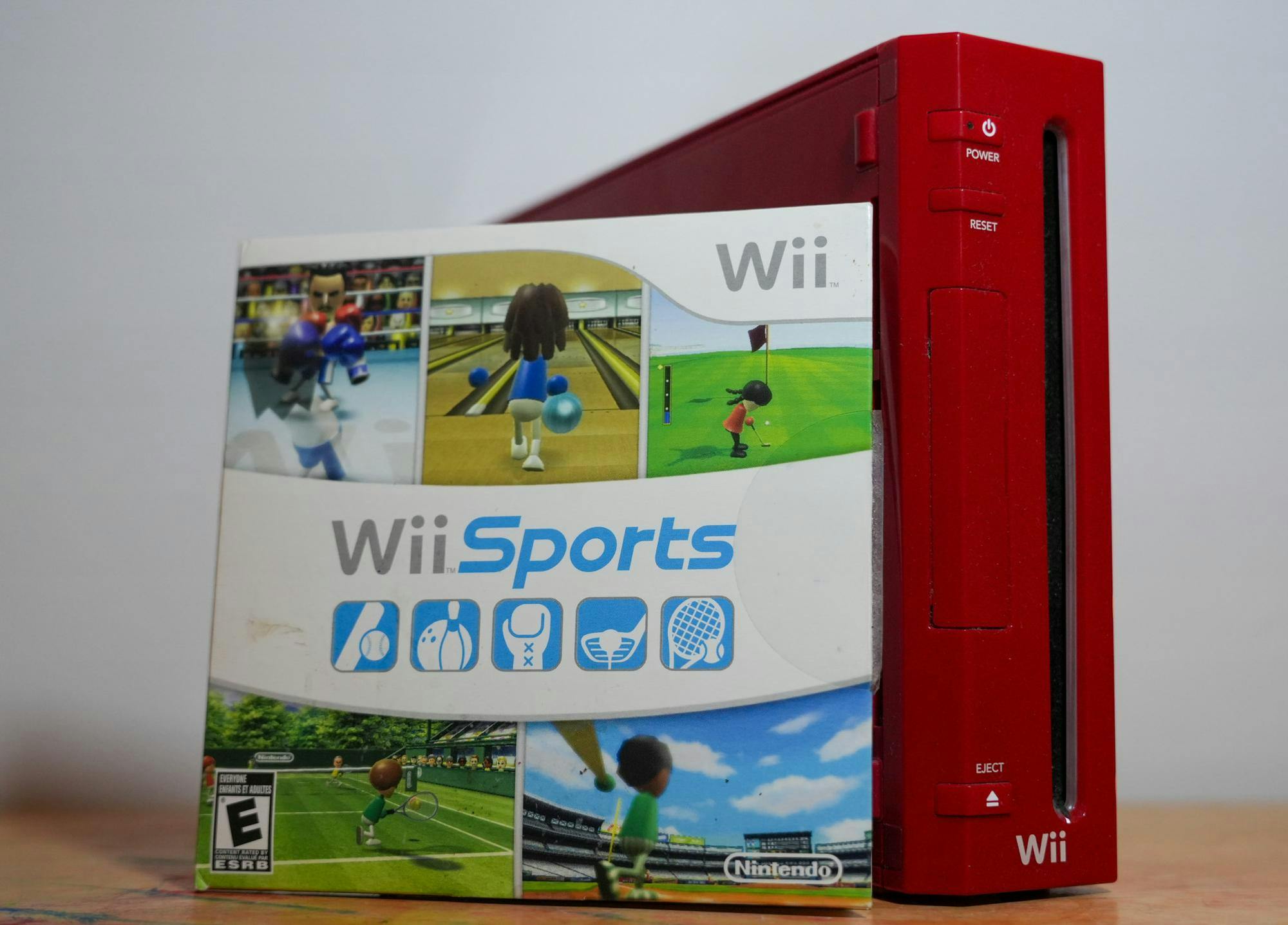
Many Michigan State University students grew up with a Wii console, or constantly hanging out with a friend who had one. As a result, Wii Sports became a staple game that students reminisce on, victories and ragequits and all.
In a world of doomscrolling and AI, it may be a shock to recall the release of popular game Wii Sports came 20 years ago. Technology has progressed substantially since 2006 and many may not realize the impact a game as nostalgic as Wii Sports had on the development of more modern gaming technologies.
Human resources and labor relations sophomore Lillian Moxley is no stranger to Wii Sports. Moxely had a Wii growing up and now attaches the memories with the nostalgia of her childhood.
“I can remember having a Wii when I was really young. It was one of our first household consoles. I believe I was about in third grade when we got our console. I still do play video games when I can.”
Moxley has kept her Wii around and still plays on the console when she's able to. Though the graphics of Wii Sports and other Wii games are no longer the most updated, that doesn't mean other games are “better.”
“I will go back with some of my roommates and play the old games on a Wii. We still have a system in our house, and I always find it hilarious comparing the graphics of some of the newer games compared to the old ones.”
Media and information professor and Director of the games for entertainment and learning lab (GEL) Brain Winn spoke on the novelty of Wii Sports beyond the nostalgia for Gen Z.
“The novelty of the Wii motion controllers has become more pervasive across gaming devices. Mobile devices, such as iPhones and other game consoles have adopted motion sensors as a method of input.”
Wii controller technology contributed to the development of these technologies. In the same vein, Wii Sports was a trailblazer in the development of graphics for Wii games and current gaming technology.
“The graphics rendering quality has been greatly enhanced with modern graphics processing units (GPUs) to the level of ultra-realism. Internet-based multiplayer has all but replaced the couch co-op experience. It is rare nowadays for people to be gaming in the same physical space," Winn said. "At the same time, a majority of our gaming experiences have a multiplayer element to them.”
Similar to the Gen Z students Winn teaches, he has his own favorite mini games from Wii Sports.
“My two favorite Wii Sports games were bowling and tennis. Both had very intuitive motion controls and really captured the natural, fun experience of the real sport within the Wii gameplay," Winn said. "I remember playing Wii Bowling, in particular, a lot with my family, from my siblings, to my parents and even my grandparents, many of whom were not game players but really enjoyed the bowling experience in the family room.”
The game is still enjoyed today and can be credited for its aid in development of more modern gaming experiences. Gaming professor Rabindra Ratan said that the impact of Wii Sports and the Wii console as a whole expands beyond the impact of motion sensor technology and graphics.
“Over the last 20 years, console gaming has changed in ways that go well beyond graphics getting better. Of course, visuals improved dramatically— higher resolutions, smoother frame rates, more realistic lighting and animation — but the bigger shift is that consoles became connected platforms and services," Ratan said. "Games now live in an ecosystem of accounts, downloads, patches, social features, and cross-play. The console isn’t just a device that runs a disc; it’s the hub for an ongoing social and media experience, where play can be persistent, shared, streamed, and updated over time. The Wii stands out in that history because it pushed consoles toward embodied play in a way that reached far outside the traditional “gamer” audience.”
Ratan explained how “motion input changes the psychological connection to the avatar.”
“When you swing, point, or gesture, it can create a stronger sense of actually performing an action compared to a purely button-based experience because of your psychological connection to the avatar," Ratan said. "That helped make gaming more accessible because the controls mapped onto familiar everyday actions, and it turned gameplay into something that worked well in social settings, pretty much anybody could watch, understand immediately and jump in quickly.”
Support student media!
Please consider donating to The State News and help fund the future of journalism.
Discussion
Share and discuss “Strike! Reflecting on 'Wii Sports' role in video game development 20 years later” on social media.