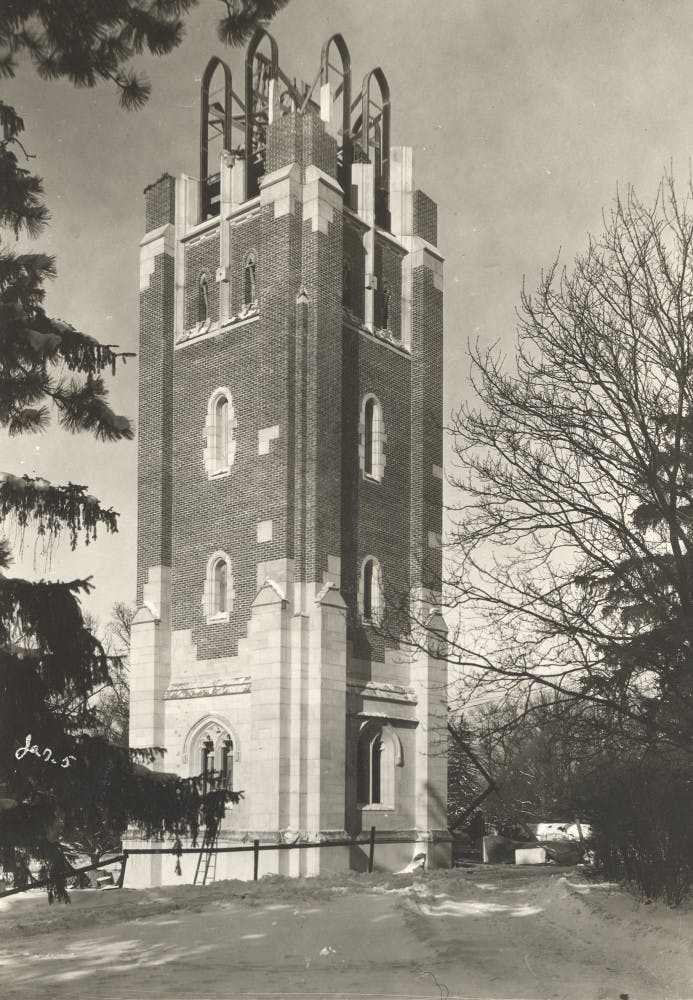
I was born in what, until recently, seemed the lowest American moment since the Civil War.
In 1933, the world had plunged into a fearsome economic crisis. Adolf Hitler came to power and soon began rearming Germany. The Great Depression and World War II would later shape my path toward teaching.
I was born at home on my parents’ mortgaged Midwestern farm before “Doc” King could arrive.
That saved a few dollars at a time when lucky workers might earn only a dollar a day.
Everyone still remembered when my great-grandfather’s small-town bank failed, wiping out whatever savings my parents and neighbors had.
My mother’s parents had just sold a large farm and lost every dollar they had deposited.
In 1933, new President Franklin Roosevelt immediately set his cabinet and the country to work creating unprecedented experimental programs, the “New Deal.”
These included government protection of bank deposits and programs to put the unemployed to work building dams, parks and roads, planting trees, restoring eroded farmland, supporting workers’ rights to form unions, easing retirement through Social Security and funding art and theater projects.
In MSU’s Main Library, a sample of Depression-era art hangs on the Special Collections wall across from checkout.
My colleague Ben Hickok saved it from destruction when the old East Lansing post office closed.
As in the Depression, as in World War II: President Roosevelt’s government again took the long view beyond war toward peace achieved through international cooperation and the creation of the United Nations, helping rebuild not only allies but former enemy countries.
I was convinced early on that government should protect even the least among us. My belief was based not on theory but on what I could see: terraces and planted trees still on our family farm, our mud road newly graveled, my father’s World War II UAW union pin that I still keep, and state and national parks open for all to enjoy.
Although often politically threatened, Social Security eases retirement for millions, including my wife and me.
Hard times and warfare, family and neighbors, schooling and Sunday School all taught me that courtesy, kindness, cooperation and international goodwill could overcome hatred and destruction in both speech and behavior.
After studying history in college and graduate school and serving in the Army, I came to Michigan State University in 1965.
I taught English composition and American studies primarily to undergraduates.
At one point in my career, my dear friend and colleague Joyce Ladenson invited me to teach in the Women’s Studies Program. I began in fear and trembling, but soon learned that students largely took kindly to my efforts.
I began with an awareness of how difficult life had been for my mother and grandmothers.
Through research, teaching and writing, and certainly from women students and even a few men, I learned more about how difficult life has been for women in America and elsewhere.
From those years of research, teaching and observation, I would say that women’s lives have improved somewhat over time.
Support student media!
Please consider donating to The State News and help fund the future of journalism.
But recently I have been reading Nobody’s Girl: A Memoir of Surviving Abuse and Fighting for Justice by Virginia Roberts Giuffre.
As is widely known, as a teenager Giuffre was trafficked by Jeffrey Epstein and Ghislaine Maxwell.
As she writes in her posthumous book, “When you grow up female, danger is everywhere.”
As I learned about the difficult lives of girls and women, I also began thinking about the difficulties boys face in trying to become men.
My colleague and friend Gladys Beckwith and I created a course on Men in America, which I taught until retirement arrived.
Retirement inevitably means unfinished work, perhaps left to others better prepared, perhaps allowed to wither on the vine.
But Michigan State University fosters hope that faculty, students and staff will contribute to human betterment.
Skin Pigmentation
When I was almost six, I was puzzled and confused when I was not allowed to play with another child.
Later, I realized that I had been cheated by American racism.
In 1965, my wife Joy and I came to MSU, where Black Southern football players were being welcomed, and we cheered with everyone else.
Another MSU effort to combat racism emerged closer to home. In the 1970s, Professor Joy Curtis led a successful federal project in the School of Nursing to recruit and support underrepresented students, who went on to become outstanding nurses and leaders.
Finally, in 1970, MSU welcomed Clifford R. Wharton Jr. as the first Black president of a major White American university.
The Wharton Center is dedicated to Clifford Wharton and his wife, Dolores Duncan Wharton, in recognition of their patronage of the arts.
Joy and I recently attended the world premiere of Sally by MSU’s own Sandra Seaton at the Wharton Center, an arresting portrayal of Thomas Jefferson’s enslaved mistress.
Bruce Curtis is a retired Michigan State University professor who taught American Studies and Gender Studies from 1965 to 1995. Born in 1933 during the Great Depression, he credits the crises of his early life with shaping both his teaching and his belief in public institutions. He and his wife, Joy Curtis, also a retired MSU professor and former Ombudsman, remain active members of the campus community.
Have an opinion or expertise you want to share with the MSU community? The State News welcomes guest commentaries from students, faculty, staff, alumni and community members. If there’s an issue you care about or a perspective you think others should hear, we encourage you to submit a piece for consideration. To learn more, visit the portal for information.
Discussion
Share and discuss “GUEST COMMENTARY: What being born in 1933 taught me” on social media.