Is 2016 back? The first couple weeks of 2026 was marked by an unusual and pervasive trend, where users posted pictures with a pinkish-purple filter overlay and a caption that said something like “2026 is the new 2016.” Much nostalgia for ten years ago followed, as many reminisced on the Snapchat puppy dog filter, tumblr-esque mirror selfies and songs like Lean On by Major Lazer. This trend was everywhere, and is maybe the first time that this era was not considered “cringe.”
The past few months has seen a resurgence of music that was popular in 2016, namely house and dance music, with the poster child being Zara Larsson. But in terms of trends and style, 2016 is not back. Fashion in that era was characterized by high-waisted jeans, chokers and ankle boots. It was largely inspired by 90s styles, meanwhile the styles dominating 2026 are reminiscent of the 80s. Additionally, our culture has changed so much since then, especially with TikTok and AI, it scarcely looks similar to 2016.
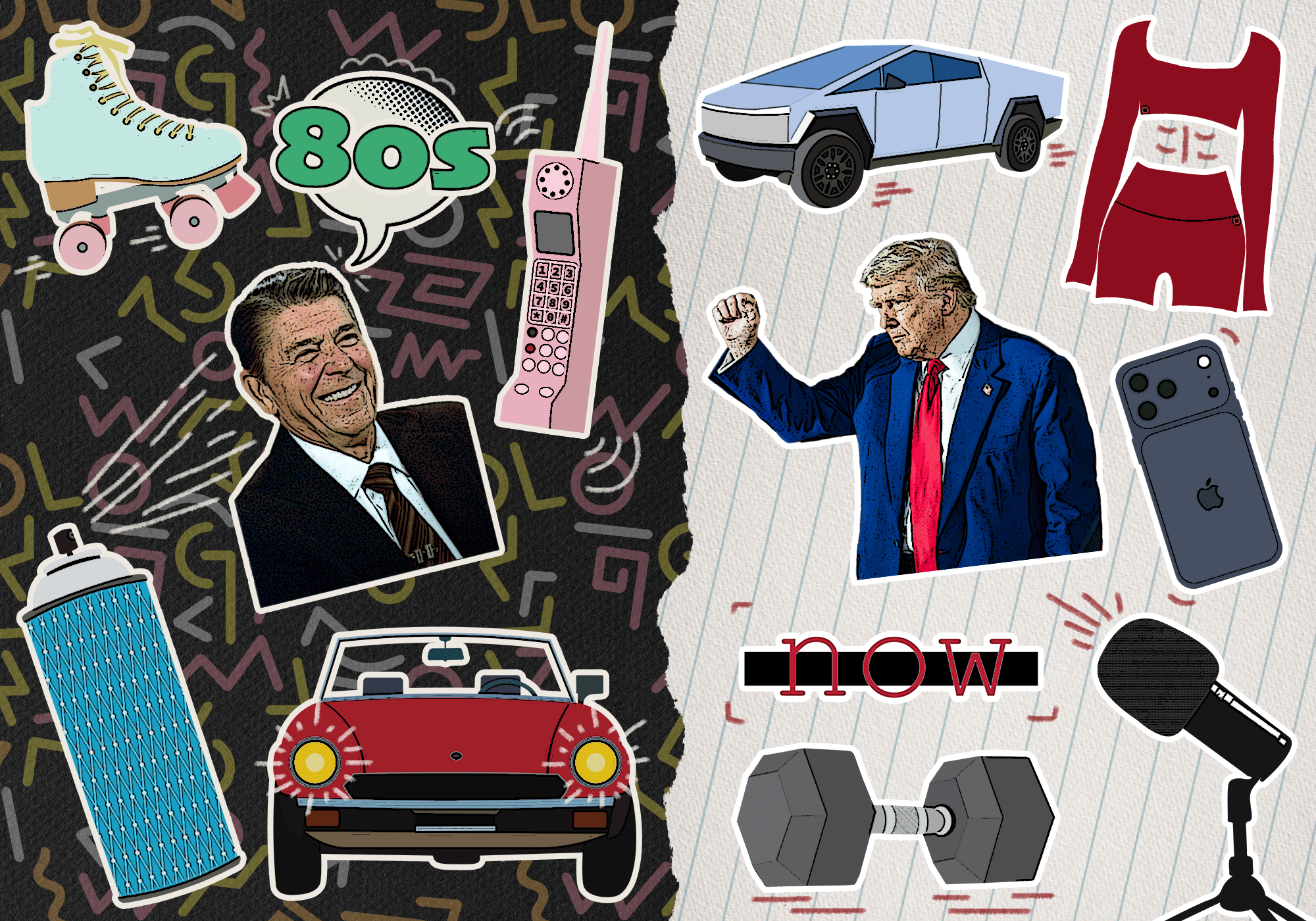
While there may be some similarities between now and 10 years ago, there are more parallels to be drawn between now and 40 years ago. The 80s are back; culturally, socially and politically.
We are currently seeing, in today's society, many of the same cultural shifts that defined the 1980s. For example, individualism. 40 years ago, everyone became focused on self-reliance, prioritizing personal ambition to gain status and wealth. This mindset has been reincarnated to what we now call self-care and grind culture. Self-care has been circulating the internet for a few years, targeted and promoted primarily by girls, preaching consumerism as a means of self-improvement, just like the 80s did. Grind culture is generally oriented towards men, but can appeal to anyone. This attitude teaches that waking up early to work out, working long hours and achieving material goals is the path to personal fulfillment.
Forty years ago, these cultural shifts were reflected in the fashion of that time, and the same can be seen today: for example, the popularization of athletic-wear. If people are focusing on themselves, a common route to self-improvement is working out. Think velour tracksuits and aerobics attire, famously donned in Olivia Newton John’s music video for “Physical.” Nowadays, this is seen in athleisure or smaller trends like soccer jerseys and rugby shirts. On the other hand, if people are becoming more individualistic and success-oriented, they ought to dress the part. The 2020s saw this with things like the “office siren” trend and surging popularity of Ralph Lauren and quarter zips bringing professional wear in vogue. The 80s did power dressing first though, with shoulder pads and sharp tailoring made iconic by figures like Nancy Reagan and Margaret Thatcher. In fact, these two women are at the forefront of a shift not only fashionably but also politically. There was was a remarkable conservative shift in the U.S. both then and now.
In the 80s, this was called the “Reagan Revolution,” championed by the president who held office from ‘81-’89. The movement was social and political, affecting both mindsets and voting habits. Reagan had a strong religious appeal, which made him popular given that many were beginning to call for a return to traditional values aligning with Judeo-Christian morality. Similarly in the 2020s, we have seen developments like the tradwife movement, which championed stay-at-home mothers homemaking and cooking from scratch, and conservative podcasters like Andrew Tate who promote traditional gender roles and massive wealth accumulation. These movements are evidence of a general conservative shift in the 2020s.
Other podcasters have driven a related movement of economic conservatism, like Joe Rogan and Dave Portnoy’s barstool conservatism. This group indicates a libertarian shift also shared with the 1980s. They are primarily anti-government, wanting less economic regulations and lower taxes. The 80s saw the incorporation of this anti-government stance into the mainstream G.O.P. with Reagan, whose economic policy known as “Reaganomics” favored free markets and low taxes. Many republicans held onto this strategy in the coming decades, but it has gained more traction thanks to podcasters like Rogan and Portnoy.
Part of Reagan’s popularity came from his ability to appeal to both religious conservatives and anti-tax libertarians, two dispositions which have been resurging in recent years. Once again, they can be united under a Republican president: Trump.
Trump has said many times that he admires Reagan, who remains legendary to the Republican party. The capacity of both to appeal to many was instrumental in their elections. Their ideals are similar, even if their policies don’t exactly align. It makes sense that these figures emerged when they did considering the similarities between the events that occurred just prior. During economic struggles and disillusionment with liberal policies, these figures come to light advocating for economic efficiency above all. For example, in the wake of previous years’ high inflation and government spending, Trump’s DOGE efforts bear a considerable likeness to Reagan’s strategy to cut costs and deregulate.
Reagan and Trump also united by vowing to protect against the threat of communism. That’s another similarity between the 80s and now: suspicion of foreign communist powers. This fear was way more prevalent in the Red Scare in the 40s and 50s, but it was also present in the 80s, and still is today. Both eras involve significant groups afraid of secret communist influence, and both presidents advocated strongly for defense against them. In the 80s, it was the Soviet Union. In the 2020s, its China.
All this being said, 2016 isn’t back. But why do people think it is, or at least want it to be? Many have speculated that the trend is inspired by the craving for a time when things felt simpler. To many, looking back on 2016 feels like looking back on the good old days, before everything got bad. But was it really that great? That year had its own host of issues. The 2016 election cycle was characterized by unprecedented polarization as well as huge, divisive scandals for both Hillary Clinton and Donald Trump. Sure, internet users bonded over Pokemon GO!, Vines and the fear of killer clowns, but we were still far from a united culture. In the 1980s and 2016, things were often way more complicated than our memories would have us believe. There’s nothing wrong with reminiscing, but don’t let nostalgia blind you.
Isabella Cucchetti is a sophomore studying Political Theory and Constitutional Democracy and is a columnist at The State News. The views in this article are her own and independent of The State News.
Support student media!
Please consider donating to The State News and help fund the future of journalism.
Discussion
Share and discuss “OPINION: 2016? No, it's 1986 that's back” on social media.