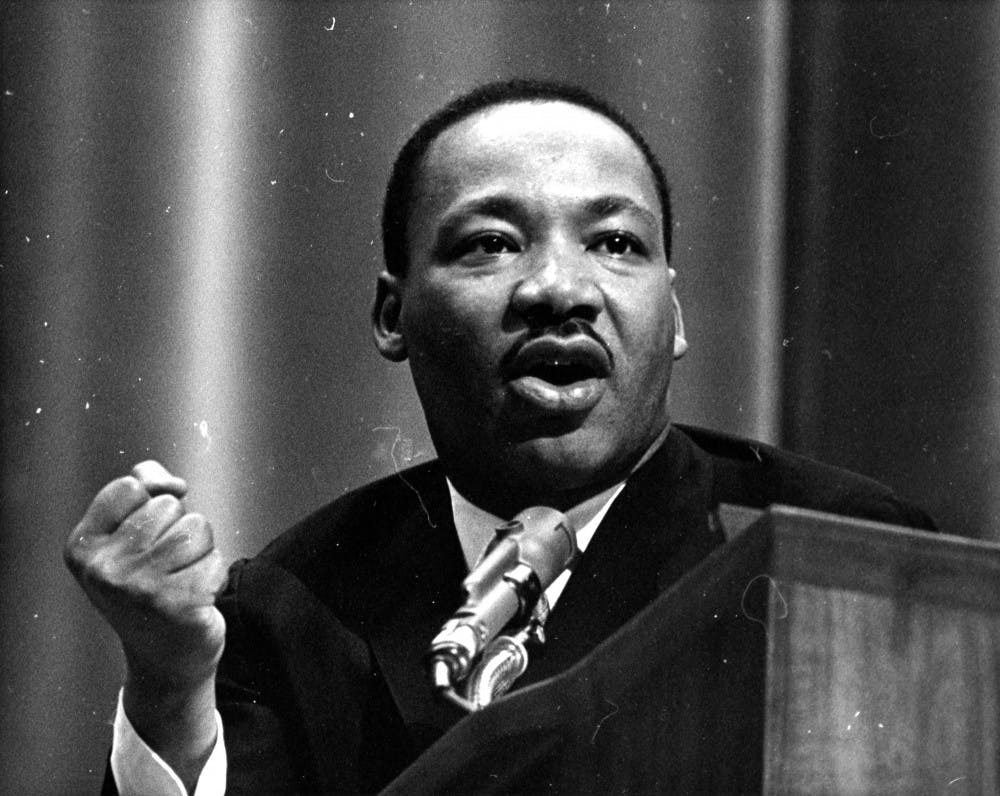
Martin Luther King Jr. speaks at Michigan State University on February 11, 1965. Photo courtesy of the MSU Archives.
First signed into law in 1983 and first observed in 1986, Martin Luther King Jr. Day commemorates the birthday of the civil rights leader while honoring decades of activism that helped transform his vision of equality into lasting change.
President Ronald Reagan signed legislation establishing King’s birthday as a national holiday on Nov. 3, 1983, 15 years after the proposal was first introduced in the wake of King’s assassination in 1968. The path to federal recognition, however, was long and fiercely contested.
Push For Day of Remembrance
Four days after King was assassinated on April 4, 1968, U.S. Rep. John Conyers of Michigan introduced a bill in the House of Representatives to create a federal holiday honoring King’s life and legacy. The effort failed repeatedly over the next decade, struggling to garner enough support in Congress.
As the years passed, public backing for the holiday steadily increased, intensifying pressure on lawmakers. Cultural influence also played a role. In 1981, Grammy Award–winning artist and Michigan native Stevie Wonder released the song "Happy Birthday," which contributed to the movement's turning point in establishing the holiday.
In 1983, the House took up the legislation once again — 14 years after it was first introduced. Following renewed marches, public demonstrations and advocacy, the bill passed by a vote of 338–90. It then advanced to the Senate, where it was approved 78–22.
A Turning Point and Long Time Coming
In 1983, Reagan signed the bill into law after more than a decade of legislative gridlock, with King’s widow and the holiday’s strongest advocate, Coretta Scott King, standing beside him.
"But traces of bigotry still mar America, so each year on Martin Luther King Day, let us not only recall Dr. King but rededicate ourselves to the commandments he believed in and sought to live every day," Reagan said at the signing.
Although the bill became law in 1983, official observances of Martin Luther King Jr. Day did not begin until 1986. Several states initially declined to recognize the holiday, and it was not until 2000 that all 50 states formally observed it.
Early Recognition by Spartans
Michigan State University began recognizing King’s birthday as a day of celebration in 1980, six years before it became a federally observed holiday. That year, an MSU graduate student founded the Committee Commemorating Dr. Martin Luther King Jr., launching campus-wide events honoring King’s legacy.
Since then, the university has held annual celebrations highlighting King’s work and its continued relevance. In 2000, the Office for Inclusive Excellence and Impact began coordinating MLK-related activities and later succeeded in endowing a scholarship program in King’s name in 2003.
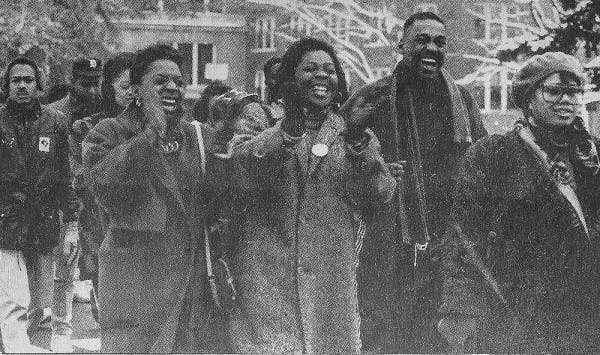
Among the most visible traditions is the annual MLK Commemorative March, during which the university closes to allow students, faculty and staff to observe the holiday.
Office for Inclusive Excellence and Impact Communications Manager Henry Mochida said as part of the university's commitment to education, service and community engagement, MSU has a long history of recognizing and celebrating MLK Day.
"For decades, MSU has marked Martin Luther King Jr. Day with programming that invites students, staff, faculty and community members to reflect on Dr. King’s teachings and their relevance to the work of higher education and a democratic society," Mochida said.
Now, more than four decades later, the program continues to grow, aiming not only to honor King’s life, but also to reaffirm the pursuit of justice, equity, and dignity he envisioned, goals that many continue to strive toward today.
"MSU remains committed to honoring Dr. King’s legacy not only through annual observances, but through ongoing efforts that promote access, opportunity and excellence in teaching, research and outreach and engagement throughout the year," Mochida said.
Support student media!
Please consider donating to The State News and help fund the future of journalism.