One student suggested polluting the intake vents of the iconic campus parking enforcement vehicle with "fart spray." Or, another proposed, they could pour milk in the backseat and let it spoil.
Others weighed in with darker pranks. What if, one GroupMe member wondered, they filled the gas tank with sugar? Loosened the car's lug nuts? Put "jizz in the A/C?"
The comments were par for the course in the massively popular "Pace Spottings" GroupMe, where the student body’s animosity for parking enforcement is on full display, from playful quips to gruesome threats.
In theory, the GroupMe is a way vehicle owners can warn each other when parking enforcement is nearby. But the chat can quickly devolve into ruthless harassment of the MSU employees that issue tickets, all current and recently graduated students themselves.
MSU’s parking enforcers tell The State News they’ve taken notice. Knowing angry drivers will post pictures of them online, they go to lengths to conceal their faces while out on the job. Some have secretly joined the chat to keep a closer eye on who they're up against.
The online harassment mirrors in-person abuse. "I want them to feel unsafe," wrote one GroupMe member, admitting that she’s screamed at parking enforcers "many times" from her car window. Verbal abuse is routine, some employees say, and more than once, parking lot spats have required police intervention.
Even amid the online insults and occasional physical intimidation, some parking enforcers said they understand why their fellow students are upset by what they do. They, too, find the lack of parking options on campus frustrating.
But must they bite the hand that tickets?
A novel way to avoid tickets
Anger over campus parking is nothing new. Decades ago, the late, long-time higher education administrator Clark Kerr described the American university as a "series of individual faculty entrepreneurs held together by a common grievance over parking." It’s a uniquely uniting cause on college campuses, often treated as a righteous pursuit — a matter of access to education, not just convenience.
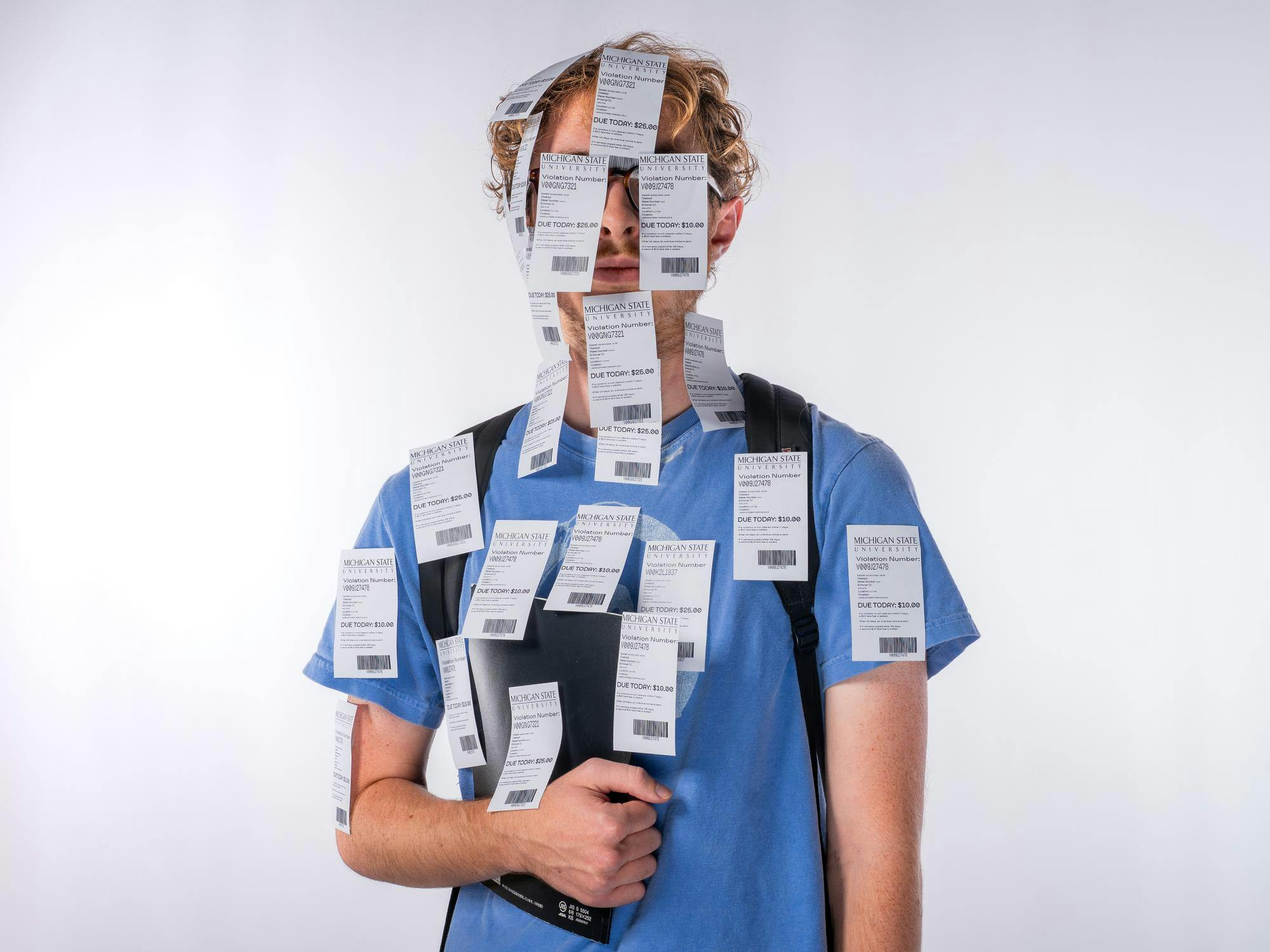
Considering the size of MSU’s parking operation, it's no wonder drivers see themselves as underdogs in the fight. Halfway through the university's current fiscal year, from July 1 to Dec. 31, 2025, MSU issued 41,635 tickets, raising a total of $1.426 million to cover transportation-related expenses on campus, according to a spokesperson for the campus police department.
The consequences of ignoring pricey parking fines — ticket costs range from $20 for meter violations to $115 for disabled parking violations — are many. If a ticket isn’t paid within a week, the fine goes up $10. After four weeks, it goes up another $10. If a ticket isn’t paid in over 70 days, students risk a hold on their account, said Parking Services Manager Kathleen Bissett, and after 150 days, the matter is taken to district court. Rack up six unpaid tickets, and MSU can tow your vehicle. Students can’t receive their diploma until all such debts are paid.
Students have attempted creative solutions to these burdens for years, with varying levels of success. Where bureaucracy has failed, drivers have tried to leverage everything they’ve got to avoid parking tickets: technological innovation, personal influence, even physical aggression. Once, a driver even filed a formal complaint with the campus police department, claiming a parking enforcer was "harassing" and "targeting" them with relentless ticketing. (An internal investigation found that each of the person’s seven tickets was issued by a different parking enforcer.)
Of course, many have also gone the university-approved route to fight parking tickets: Submit an appeal. In 2024, 11% of the total tickets issued were appealed, and of those, nearly half led to reduced or withdrawn tickets. But to be successful, vehicle owners must prove that the parking enforcer was wrong. And no, "I only parked in that space for a few minutes" doesn’t cut it.
That's why, to many students with vehicles on campus, the GroupMe is a game-changer. Members report in real time wherever they see enforcers, so that others parked in the area can move their cars before it's too late. The chat’s title, "Pace Spottings," refers to the popular but incorrect name for parking enforcers that work for MSU ("PACE" is the acronym for the city of East Lansing’s parking department).
The thread was created two and a half years ago by a student with a fitting surname: Kennedy Parker, a third year law student, who got the idea when she was in undergrad from a post on the anonymous social app YikYak.
As of writing, the GroupMe has 2,659 members — as far as Parker can tell, mostly students, who find out about it from word of mouth and social media. Until recently, anyone with the link could join, but after an influx of bots, Parker changed the settings so that each new member requires her approval. (Messages from the GroupMe were viewed by The State News when the chat was public.)
Students in the GroupMe, some of whom count the number of tickets they’ve gotten in the double digits, find it to be a godsend. It’s "saved me quite a few times," said Mason Fielding, an agriculture business senior.
Support student media!
Please consider donating to The State News and help fund the future of journalism.
MSU officials don’t seem to mind, either.
"If users pay a parking meter, purchase a parking permit, or move their vehicle out of a restricted parking area because of a GroupMe chat, we’re glad to see them following the rules and regulations to make parking better for everyone," wrote John Prush, director of MSU’s Public Safety Bureau, in a statement.
'Remorseless people' or innocent student employees?
However, with thousands of scorned drivers in one place, it's no surprise that the GroupMe can sometimes stray from its utilitarian purpose.
When it isn’t helping avoid tickets, the chat is a place for drivers to commiserate about the people who hand them out. The chatter can often be cruel, sometimes outright violent.
According to comments made in the GroupMe, being a parking enforcer makes you a "rat," a "b-tch," a "mutt," a "f-cker" and a "c-cksucker." They are "soul-less (sic), remorseless people" who would "crawl over 1000 miles of glass to give one broke college kid a ticket." They are "low-IQ," "ugly" and "ill adjusted." They deserve "sleep deprivation," "no friends," and "pain and suffering."
For these disgruntled parkers, there’s no such thing as a low blow. Sometimes, members of the GroupMe pass around pictures of enforcers and make fun of their weight and posture. They speculate what might drive someone to take the job: Maybe, one once wrote, "if everyone hated me." Another would do it "If I had no friends and my family disowned me." (Prush wrote in a statement that the "Safety of student employees is paramount," and reports of unlawful activity or policy violations will be "taken seriously" and investigated.)
In truth, MSU’s fleet of parking enforcers — around 15-25 at any given time, according to Prush — are all current or recently graduated students, paid $14 an hour, who took the job because the hours are good or so they can add an impressive line on their resume. Some have cars on campus. Some have even gotten ticketed.
"We have to follow the same rules as everyone else," said one current parking enforcer who recently graduated from MSU.
The parking enforcer, who spoke to The State News on the condition of anonymity to protect her safety, said she’s "been yelled at too many times to count" on the job. Once, an angry driver even followed her car back to the police department. The driver and parking enforcer circled the lot for thirty seconds before employees came out and told him to leave.
Confrontation with parking enforcers isn’t uncommon and can be intense.
In September 2025, a parking enforcer requested police come to a parking lot. Someone was recording them, and "they felt uncomfortable," Chris Rozman, deputy chief of the campus police department’s Staff Services Bureau, wrote in a statement. The officer determined that a crime hadn’t occurred, and no police report was filed.
A similar story happened in 2003, when former Spartan wide receiver Charles Rogers allegedly pushed a parking enforcer, and in 2008, a law student was heavily disciplined under a strict university ordinance for yelling at a parking enforcer. The law student sued, and the case made it to the Michigan Supreme Court, which ultimately struck down the ordinance.
"There were plenty of times where I was verbally berated or threatened while on the job," recalled Nick Doyle, an MSU alumnus who worked for the department from November 2019 to May 2022 as a parking enforcer and later a student supervisor.
For Doyle, deescalating confrontations with frustrated drivers "could be mentally draining," but it wasn’t difficult. Most would calm down after he explained the restrictions of the particular lot and they "realized their mistake."
Not everyone can take the heat. Harassment has helped drive some out of the job, the anonymous parking enforcer said.
Those that remain must be vigilant. Parking enforcers are required to take a picture of every ticket they issue, and multiple enforcers said they angle their camera to avoid catching their reflection in the car mirror so its recipient can’t use it to track them down. Some also wear baseball caps and masks to conceal their faces on the job.
As an additional measure, the anonymous parking enforcer discreetly joined the GroupMe last year. That way, if its members "say that they want to do something bad" to her while she’s out ticketing, she knows when to leave.
Members of the GroupMe suspect that this is the case, and the idea that undercover agents are attempting to thwart their efforts is a prevalent concern in the chat. Members are scolded when they ask for or recommend less-ticketed lots, fearing they’ve given the "pace rats" lurking in the chat new places to target.
But the recently graduated parking enforcer said she "really couldn’t care less" about the methods the GroupMe discusses to evade tickets. She can find cars to ticket "all over campus" without needing to consult the chat, the parking enforcer said.
In fact, there’s not much incentive to go above and beyond when issuing tickets. Contrary to popular assumption, parking enforcers don’t make a commission off of tickets, she said.
Another misconception: That parking enforcers ticket campus in a trackable pattern. In the past, ticket-evasion projects tried using spreadsheets and artificial intelligence to predict which parking lots and structures are ticketed and when. But parking enforcers are assigned to general zones on campus, not specific, unchanging routes, the parking enforcer said.
The parking enforcer understands where the members of the GroupMe are coming from. But parking enforcement is a necessary evil, she said.
"If we made all parking free, then all 50,000 students would have a car," she said. "Then there would be absolutely no place to park, ever."
That sentiment is shared by another parking enforcer, who spoke to The State News anonymously to protect their employment with the university. While this parking enforcer was upset by some of the more extreme comments in the GroupMe — they recalled when someone allegedly wrote "#RapePace" in the threat — they’re generally unbothered by the online activity and haven’t run into much danger out on the field.
Though the parking enforcer worries about accidentally sending a picture of their car window reflection to angry drivers after issuing a ticket, they say it's students’ right if they want to take pictures of public officers in a public setting. And, while the enforcer did join the GroupMe, it was mostly out of curiosity — and "to see if they got my good angle," they said.
Parker, the creator of the GroupMe, acknowledged that the online banter has sometimes "gotten out of hand." She removes the worst offenders from the chat herself. Recently, she said she kicked someone who sent a message threatening sexual violence against parking enforcers.
"Like, yes, I get that we all dislike (parking enforcers)," Parker said. "But that doesn't mean that you need to threaten their lives."
The point of the GroupMe isn’t to "foster hate towards anyone," Parker said. "It's supposed to help people."
Though playful ribbing should be expected online, some people take it "way too far" in the GroupMe, said physiology junior James Dubin. He understands why parking enforcers might want to keep an eye online. Besides, Dubin said, parking enforcers aren't so horrible. They’re "like the least bad cop there is," he said.
His own comments in the GroupMe tell a different story. Once, responding to a picture of a parking enforcer, he wrote, "Jump him."
Asked about it, Dubin said he sees how his messages, while intended to be a joke, might cause worry.
"I'll definitely make sure to refrain from that in the future," he said.
Discussion
Share and discuss “The plight of the parking enforcer” on social media.