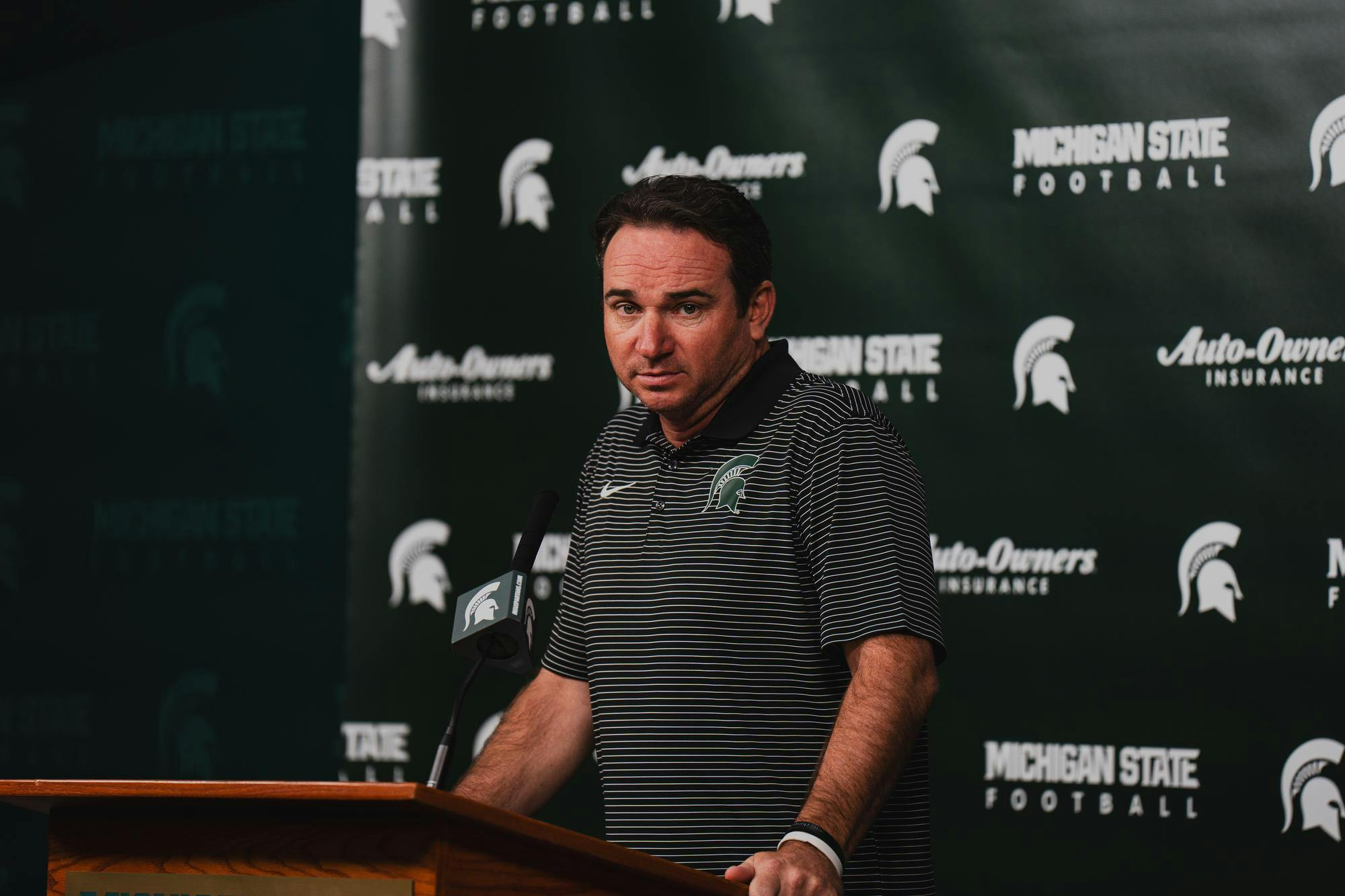
Jonathan Smith’s era at Michigan State is officially over after the university parted ways with the head coach earlier this week. His short, unsuccessful tenure lasted just two years and ended with a 4-20 record in East Lansing, affected in part by disciplinary actions tied to the program’s probation. For Smith, though, a long list of problems ultimately led to his firing.
The Beginning
On Nov. 25, 2023, Jonathan Smith was named the 26th head coach of the MSU football team following six years at Oregon State, where he elevated the program and gave fans hope he could do the same for the Spartans. Smith took over a messy program still dealing with the aftermath of Mel Tucker, leaving him with significant work to do. Although he wasn’t unfamiliar with rebuilding jobs, this challenge was on another level.
Smith became the fifth MSU head coach to start 3-0 in his first season on the sideline of Spartan Stadium. Unfortunately, the season quickly went off the rails. After that, MSU would go on two separate three-game losing streaks and finish with a 5-7 record, falling short of becoming bowl eligible. Far from a perfect season — or the expectations of fans — there were still signs of promise throughout the year, with a young, developing roster that Smith hoped to improve during his first full offseason of recruiting and using the transfer portal.
"In this landscape, I still think this thing is a game of development. So whoever's on your roster, those guys need to get better and develop. We've got some good players on this roster that have a lot of years left and eligibility, and we are confident that our approach to those guys will continue to work, and that's on us as coaches to develop. At the same time, you have to continue to add good players, they can play at a high level that are in on our approach to doing it, and we are confident we can do that. And, if it turns into these next couple of months, there will be quite a bit of that," Smith said following the final game of the 2024 season.
Recruitment
Smith came into the job with a reputation of being known for developing players, coaching 10 All-Americans, 22 NFL draft picks and more than 100 all-conference selections in his career. Naturally, many believed this would carry over to MSU, but that would not be the case, as recruitment was nothing special in his two years as head coach.
There were some positives, including the running back duo of Brandon Tullis and Makhi Frazier, and quarterback Alessio Milivojevic, who finally saw action at the end of the season. But the most notable bright spot was star receiver Nick Marsh. Marsh has led the team in receiving in each of his first two seasons, topping 600 yards both years and scoring 9 total touchdowns. He proved to be an explosive, big-play threat and, through years of inconsistent offensive performance, the lone reliable option on his side of the ball.
The recruitment was overall mediocre for Smith, a big reason why things didn’t work as he struggled to bring players into the program. MSU ranked 11th among teams in the Big Ten and 42nd nationally during Smith’s first recruitment in 2024. Things got worse the second time around, ranking 12th among Big Ten teams for recruiting and 57th in the nation. A lack of success in recruiting and developing players became one of several factors behind Smith’s failed coaching stint.
Transfer Portal
In the current NCAA football landscape, the transfer portal is crucial — often the most important key to success — and it was something Smith couldn’t fully capitalize on. His biggest additions from the portal included Elijah Tau-Tolliver, Chrishon McCray and Omari Kelly, along with two standouts who followed him from Oregon State: Jack Velling and Aidan Chiles.
Velling arrived with high expectations as a dominant tight end who would be difficult to game-plan for and create matchup problems for defenses, but he never lived up to the hype. In his two years with the program, he totaled 770 receiving yards and just 4 touchdowns — far from what many hoped he would become.
Chiles was heavily praised for transferring to MSU — most of all by Smith — and he had clear potential that fans hoped the head coach could develop. But the move ultimately became an inconsistent, failed experiment under center. Chiles threw for 3,807 yards and 23 touchdowns but also recorded 14 interceptions. After nine games this season and five straight losses, Smith elected to bench him in favor of Milivojevic in a search for wins and, ultimately, to try to save his job.
Smith was never able to use the transfer portal to strengthen the roster at the level seen across much of the country and within the Big Ten, which contributed to the team’s ongoing struggles to stay competitive.
Sideline presence
A big criticism of Smith was his presence on the sideline, specifically his apparent lack of emotion throughout the game. Fans want to see their coach passionate and fired up on the sideline. The more calm and less intense presence Smith brought to the sideline was seen as concerning, especially when the team wasn't winning games, leading them to quickly turn on the head coach, calling for his job.
As losses started stacking up this season, defensive coordinator Joe Rossi found himself under similar fire for calling plays from the box while his defense underperformed. Something Rossi decided was enough as he came down onto the sideline starting in the rivalry matchup against Michigan, where he was on the sideline fired up and yelling. In coming weeks, this saw a rise in the defensive play, something fans wanted to see from Smith that never came.
Lack of wins and culture
In coaching, the most important measure is winning games. The bigger the program, the higher the expectations and the less patience there is for losing — a reality Smith learned quickly. Inconsistent play on both sides of the ball contributed to a record this season that was worse than his first year at MSU.
Culture has become a huge part of sports. Building a team's identity to form a "winning culture" is something coaches preach to teams, media and fans all the time. For Smith, there appeared to be no culture or identity with his team. They were all over the place. At times this season, they were beyond disappointing, playing games like they didn’t care — a clear sign of a lack of culture and a lost faith in their head coach.
Support student media!
Please consider donating to The State News and help fund the future of journalism.
Smith’s time with the Spartans did not live up to the standard and expectations that were set by the university, leading to his firing after a short two years in East Lansing. MSU President Kevin M. Guskiewicz, Ph.D., and Vice President and Director of Athletics J. Batt announced that Smith would not return for the 2026 season in a press release.
"The 2025 football season has not lived up to our shared standard for Michigan State football. While that does not fall solely on Jonathan Smith, it’s become necessary to make a coaching change in order to chart a new direction for the program," said Batt.
The decision to part ways with Smith came after a season that fell short of expectations and followed ongoing challenges in both recruiting and on-field performance.
"This was not an easy decision to make," said Guskiewicz. "I want to thank coach Jonathan Smith for his service to Michigan State University and for his commitment to our student-athletes. He is a man of very high integrity, and I wish him success in his future endeavors. We will continue to support our players and staff during this transition and the future of Spartan football."
Discussion
Share and discuss “The struggles behind Jonathan Smith’s tenure at MSU” on social media.