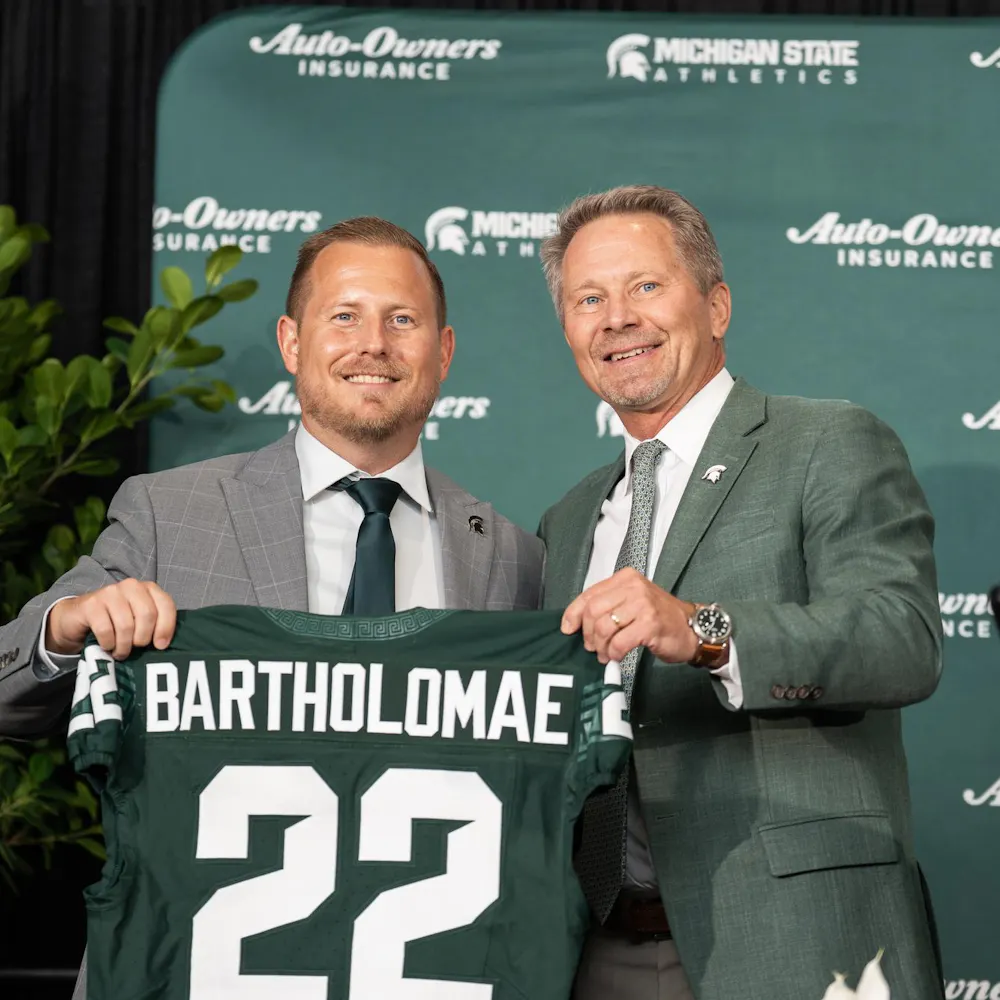
Win and get paid.
That is essentially what Pat Fitzgerald's contract spells out.
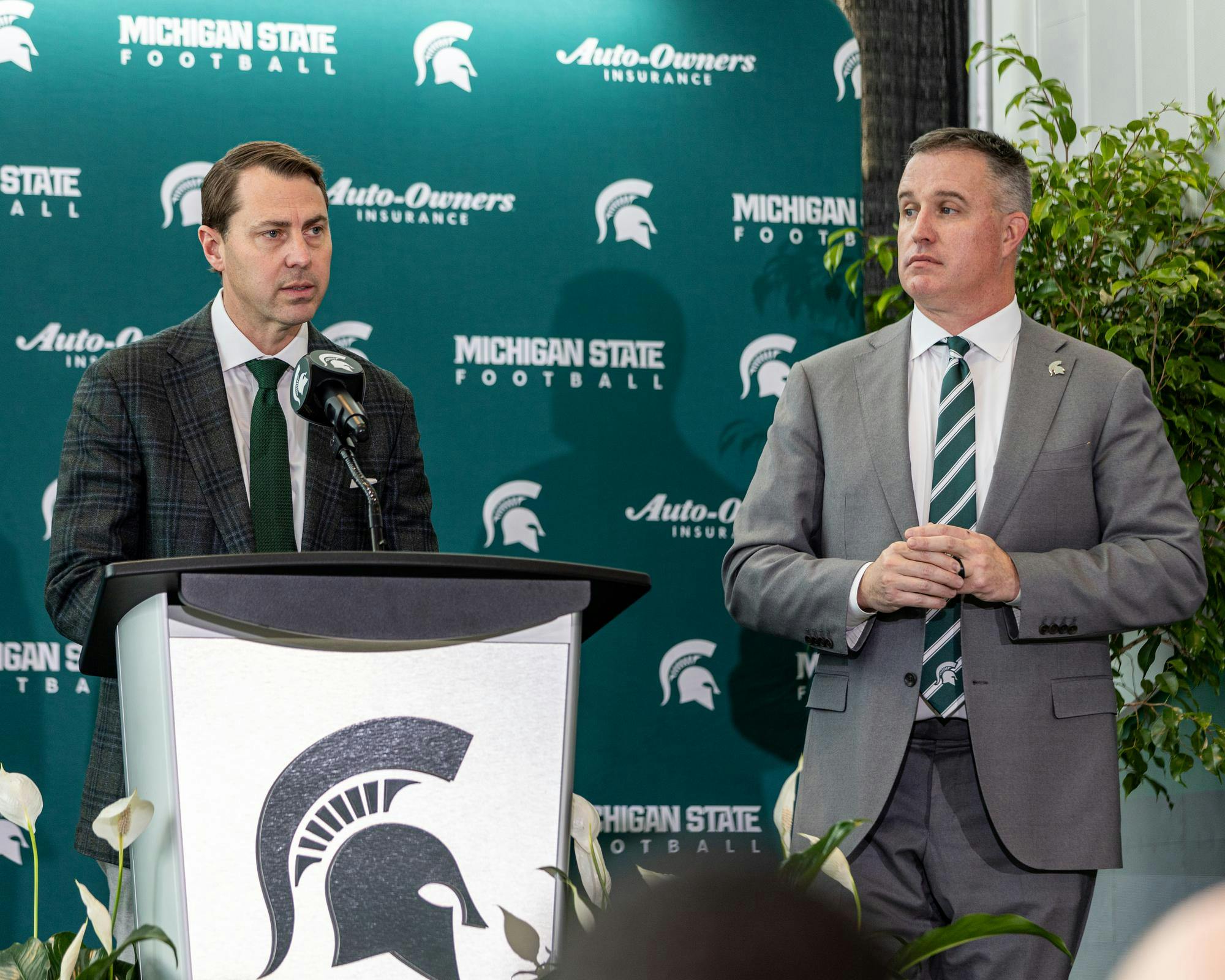
Win and get paid.
That is essentially what Pat Fitzgerald's contract spells out.
The new Michigan State football head coach who was hired Monday and officially introduced Tuesday has agreed to a five-year deal worth $30 million that will extend through Jan. 31, 2031, according to a terms sheet obtained by The State News.
The contract and what it means
Fitzgerald’s annual base salary will be $4 million each of the five seasons. This is not accounting for supplemental pay, which starts at $1 million and increases by $500,000 annually.
In 2026 — Fitzgerald’s first year as head coach — he will receive a $4 million base salary and $1 million in supplemental pay, totaling $5 million. In 2027, the supplemental pay will increase by $500,000, meaning Fitzgerald will earn $5.5 million in his second year. The supplemental pay will continue to rise by $500,000 each year through 2030 — Fitzgerald’s fifth and final year under contract — when he will receive a $4 million base salary and $3 million in supplemental pay, totaling $7 million.
Additionally, if Fitzgerald wins at least seven regular season games during the first three seasons of this agreement, there will be an additional year tacked onto the deal. The additional years added would also come with an annual $500,000 raise for Fitzgerald. In essence, if Fitzgerald were to win seven regular season games in each of his first three seasons, then those extra seasons could extend the deal to an eight-year contract worth a total value of $54 million, not including incentives.
To put this in perspective, Jonathan Smith signed a seven-year, $52.85 million contract with MSU in late 2023. That’s $6 million per year, without considering supplemental pay and incentives. This means that Fitzgerald's contract is cheaper per-year than the contract MSU gave Smith.
Smith is set to be paid 85% of his remaining MSU contract through the terms of the agreed buyout, meaning that the university will have to pay him $33 million in 62 monthly payments of roughly $532,000 from December 2025 through January 2031. This number does not include how much MSU will have to pay Smith’s assistant coaches. This number can also decrease if Smith takes a coaching job elsewhere.
Like Smith’s contract, Fitzgerald's contract also includes a buyout. If MSU were to fire Fitzgerald without cause like it did with Smith, then the university would have to pay Fitzgerald 72.5% of his remaining contract. This means that if Fitzgerald were to be fired during his second season with MSU — like how Smith was — then the university would owe him $14.5 million.
There is also the possibility that Fitzgerald terminates the contract without cause — essentially meaning that he quits his position for a reason such as finding a new job, though his reason is not limited to other possibilities. If this were to happen, Fitzgerald would owe MSU $6.5 million in his first year, $5 million in his second year, $4 million in his third year, $3 million in his fourth year and $1 million in his fifth year.
Fitzgerald’s contract also comes with heavy performance incentives, which are bonuses for specific achievements. These incentives range from winning Big Ten coach of the year — which includes a $25,000 bonus — to winning the national championship — which includes a $500,000 bonus.
Fitzgerald will also earn $500,000 if MSU wins six regular-season games, and an additional $500,000 for a seventh and eighth win. The incentives also include $25,000 if 85% of the MSU football team is eligible to graduate, $35,000 if Fitzgerald is named national coach of the year, $200,000 if MSU appears in the Big Ten championship game, $200,000 for winning the Big Ten championship, $200,000 for a College Football Playoff appearance, $250,000 for reaching the College Football Playoff quarterfinals, $300,000 for a semifinal appearance and $350,000 for a national championship appearance.
There are 13 incentive possibilities in Fitzgerald’s contract. If Fitzgerald were to achieve all 13 of these, then he would yield $3,585,000. In summary, if Fitzgerald wins, he makes money.
Fitzgerald will also receive perquisites, which includes an abundance of benefits, two courtesy vehicles, cell phone service, membership at a local country club, 25 hours of personal private air travel per year and $40,000 of relocation expenses.
The maximum amount of money Fitzgerald could receive from MSU in 2026 is $9,085,000. The maximum amount of money Fitzgerald could receive from MSU in 2030 during his final year under contract (if the contract is not extended) is $10,585,000. Both calculations would account for base salary, supplemental pay and all 13 incentives.
The contract would make Fitzgerald the 47th highest paid head coach in college football, tied with Iowa State's Matt Campbell, who also makes $5 million per year, according to USATODAY. This ranking does not include incentives.
Support student media! Please consider donating to The State News and help fund the future of journalism.