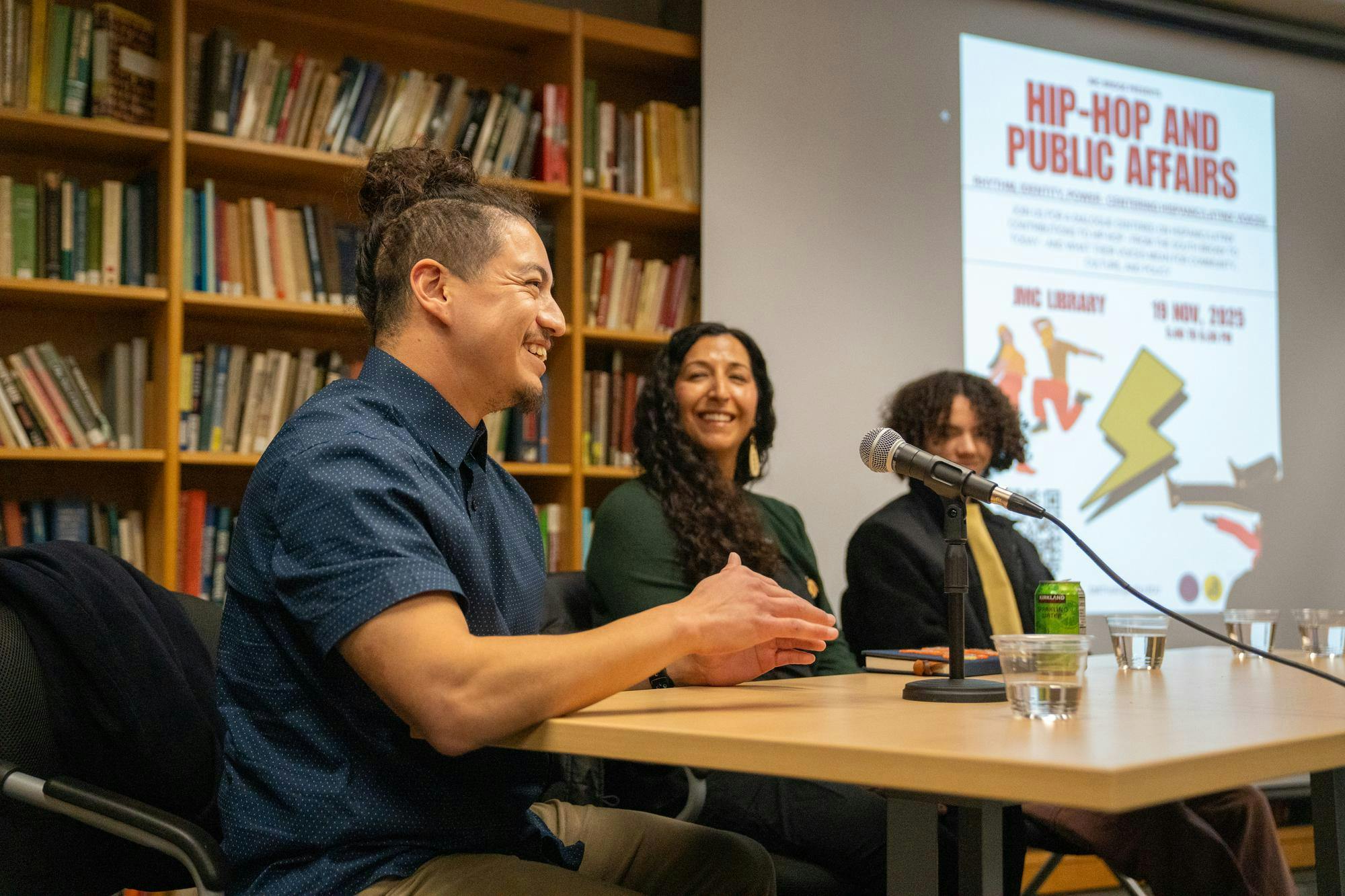
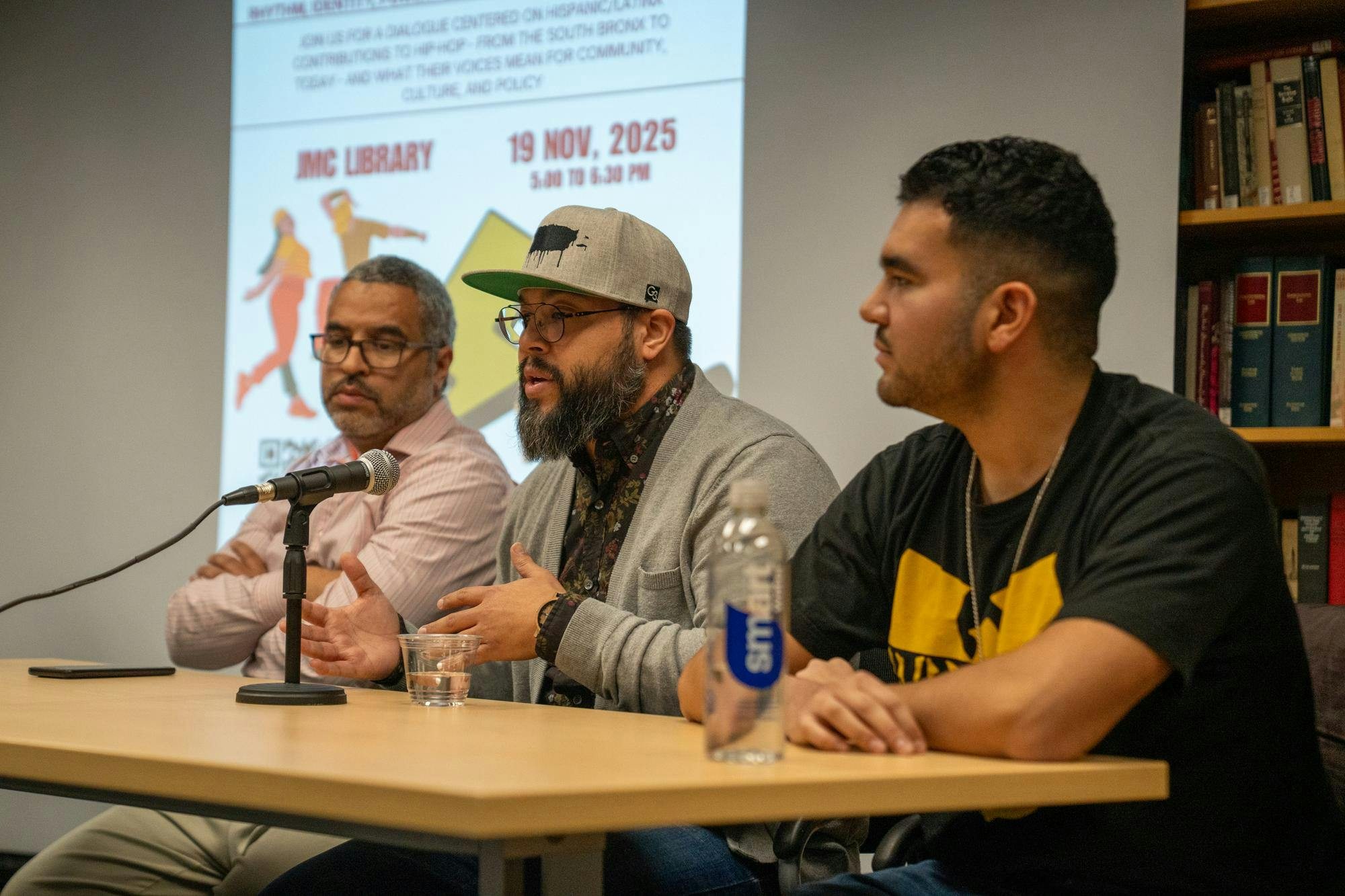
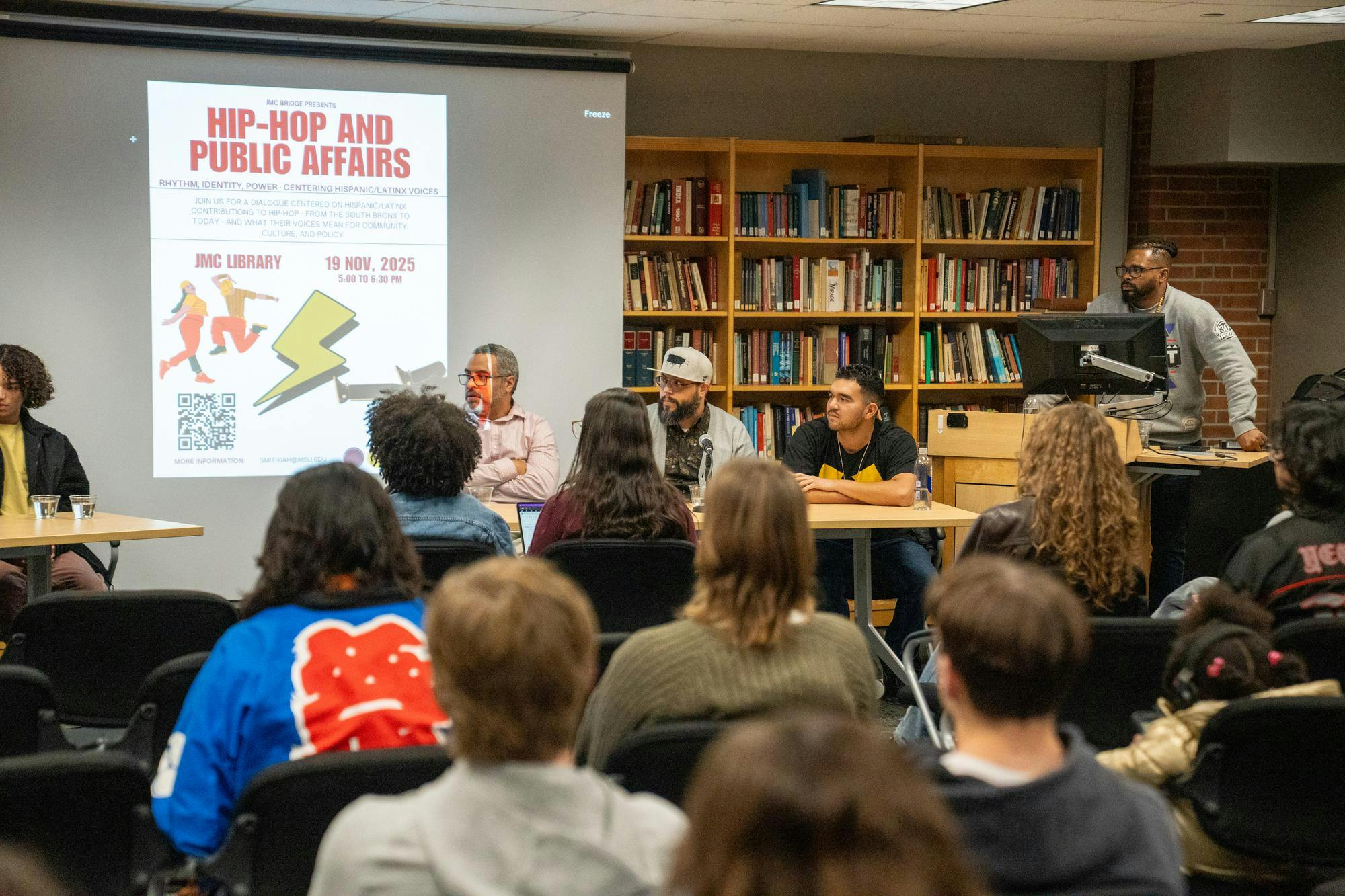
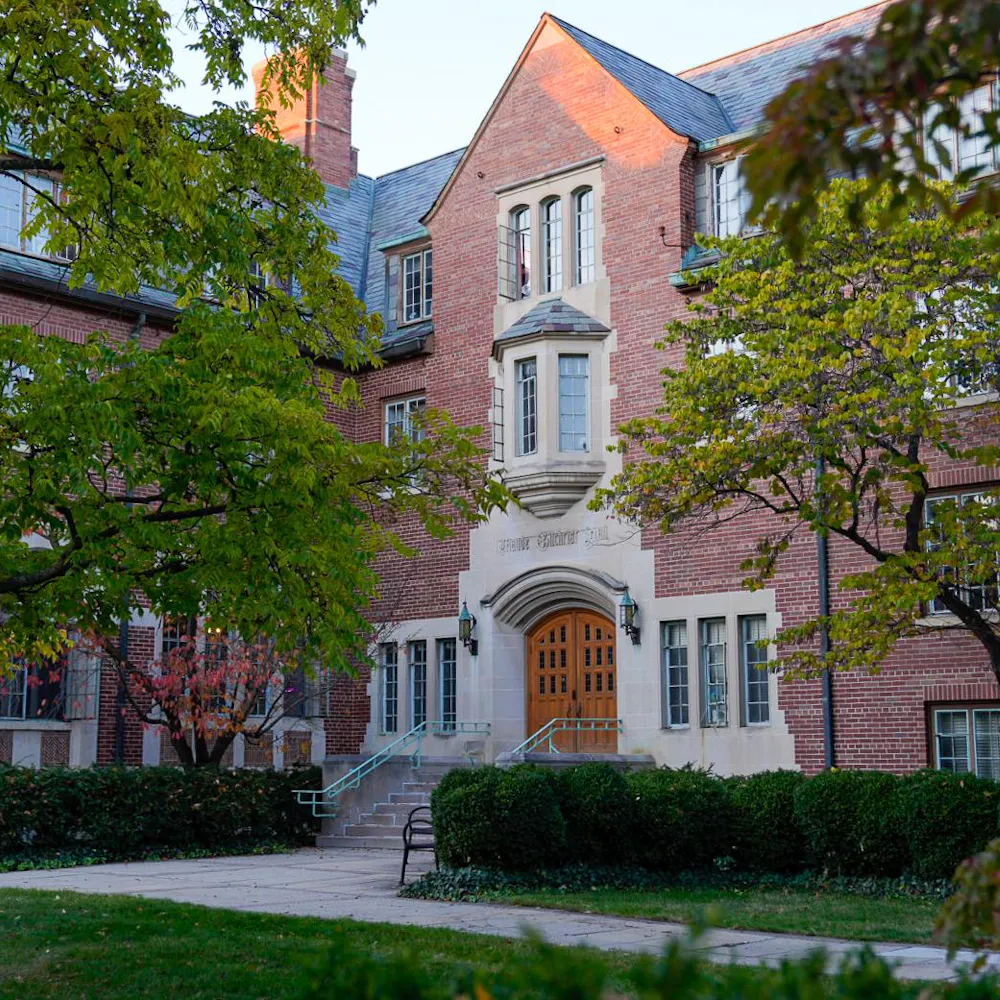
Panelists speak during the Hip Hop and Public Affairs series highlighting Hispanic and Latinx voices in Case Hall in East Lansing, Michigan on Wednesday, Nov. 19, 2025.
James Madison College’s Bridge program hosted the third installment of their Hip-Hop and Public Affairs series on Nov. 19th, highlighting the connection between politics, social movements, culture and art in the Hispanic and Latinx communities. The event featured a six member panel whose expertise wholly encompassed hip-hop’s main pillars: break dancing, DJing, MCing, graffiti and knowledge.
Hip-hop music was born in New York City in the 1970s and was developed out of a variety of factors. Umberto Rodriguez, a DJ under the name DJ Dolo, said that it is often described as "Black American diasporic music," but it is vital to understand the role that Latinos played in pioneering it. New York was a cultural melting pot, and many of these cultures were united in struggle.
"In these areas where there’s immigration, there’s plight," Rodriguez said. "There’s a hotbed for these things to develop."
While Rodriguez was hesitant to label hip-hop as protest music, he said that it was born out of resiliency. New York at the time was undergoing infrastructural changes that often divided and displaced minority communities. On top of that, these communities dealt heavily with poverty, police brutality and other forms of systemic maltreatment. Hip-hop emerged as a creative outlet against this oppression.
"The Bronx was burning," Rodriguez said. "But these conditions were what helped to nurture hip-hop."
For REHS Associate Director Francisco Velasquez, hip-hop bridged gaps. Having grown up in Chicago as the son of a Puerto Rican immigrant, Velasquez said that his identity often felt "nuanced" but hip-hop was a clear constant.
"When I go to Puerto Rico, they don’t look at me the same," Velasquez said. "Hip-hop has allowed us to build that connection between Puerto Ricans here and Puerto Ricans in Puerto Rico."
Similarly, hip-hop instructor Carla Brooks said that hip-hop’s storytelling helped to answer the questions that she had about herself and her background. Brooks said that her family kept quiet when it came to sharing their experiences, but hip-hop was a resource for her to understand more about her roots as a Mexican-American.
"Finding that storytelling was so empowering and helped me to feel like I belonged," Brooks said. "That was what I needed as a young person. You could be your full self."
Christian Sanchez, a faculty member in MSU’s Residential College of Arts and Humanities, credited hip-hop with increasing his confidence growing up. It helped him learn how to speak English while allowing him to experiment within a culture that felt familiar to him.
"I grew up in a community where there was a lot of graffiti and break dancing," Sanchez said. "It was about being able to express yourself in places that were historically more poor."
Hip-hop offers more than a connection to the self, it offers connection to the world. Supply chain management junior and DJ Tomas "Mix Master Mas" Tello said that hip-hop helped to spread information, both locally and nationwide, about political and social issues in New York City that may not have received proper coverage.
"It’s like a news network," Tello said. "It was letting people know what’s going on in their own communities that may be overshadowed by the main media."
Community was and is at the center of hip-hop’s culture. Asa Humphrey is currently a senior at Lansing Eastern high school and admitted that he is "new to the scene" compared to his co-panelists, but seeing and connecting with other Latinos through the hip-hop community has brought him a lot of perspective.
"I am not singular, my peers are not singular which I think is really beautiful," Humphrey said. "(Being Latino) does not define me but it influences everything that I do."
Carla Brooks has worked alongside All of the Above Hip-Hop Academy in Lansing to keep the art alive in the area. Brooks said that the saying "take space and make space" guides and strengthens the program, allowing everyone to learn from and teach one another.
"We ask that in all of our meetings that you share what you’re going through and take a moment to listen to everybody else," Brooks said. "Each person has something to give in this space, and that builds community quickly."
Though hip-hop is most commonly regarded as a music genre, there is an entire, complex culture associated with it. Hip-hop has paved the way for change not only in the arts, but in society as well. Each panelist had their own experiences with the culture but they did have one agreement: art is what transforms our world.
Support student media!
Please consider donating to The State News and help fund the future of journalism.
"It is less about the music and more about the community," Humphrey said. "If we keep this community alive and healthy, it’s bound to bring change at one point or another."
Discussion
Share and discuss “Hip-Hop and Public Affairs discusses complexity of Hispanic influence on the genre” on social media.