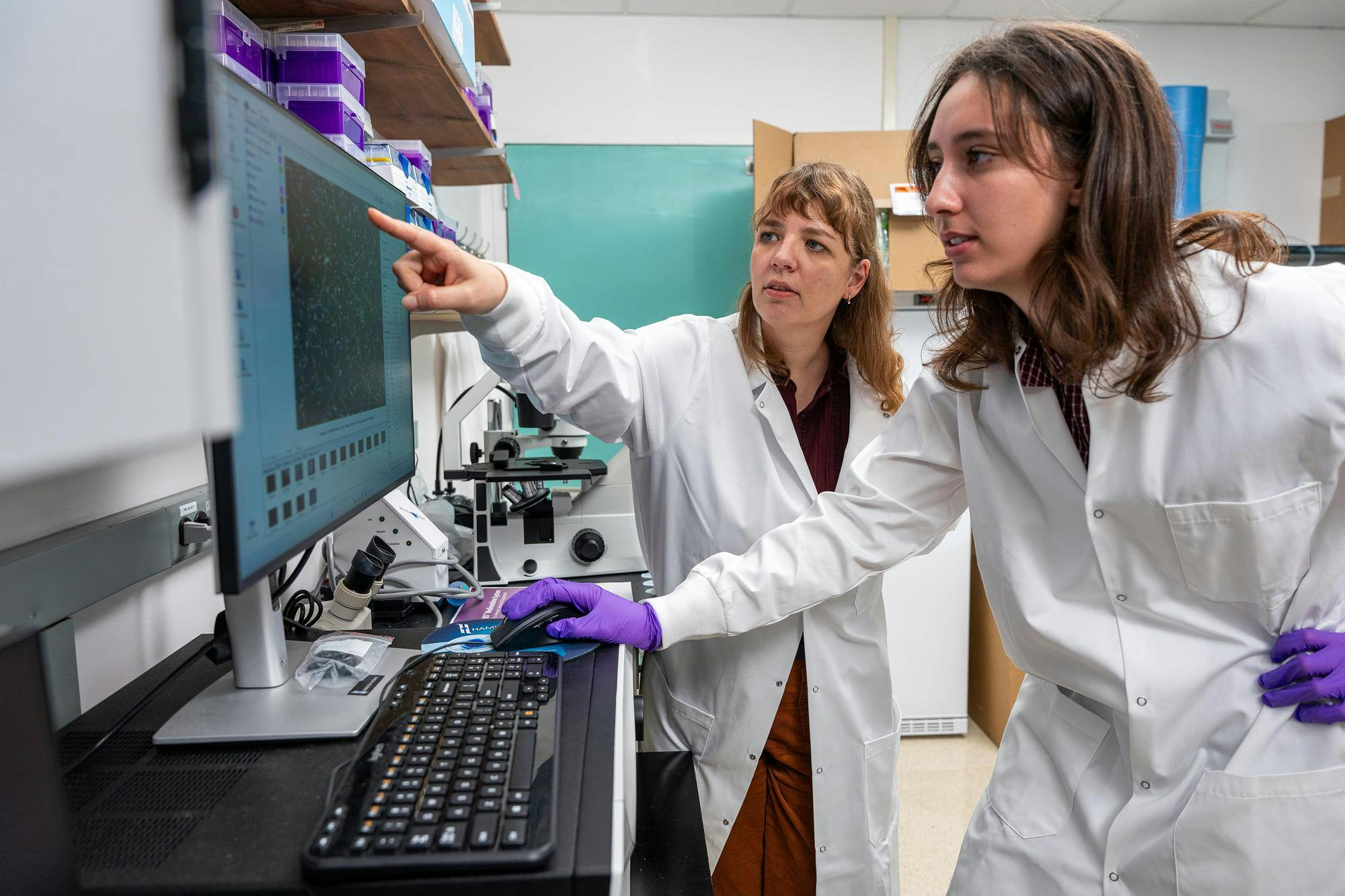
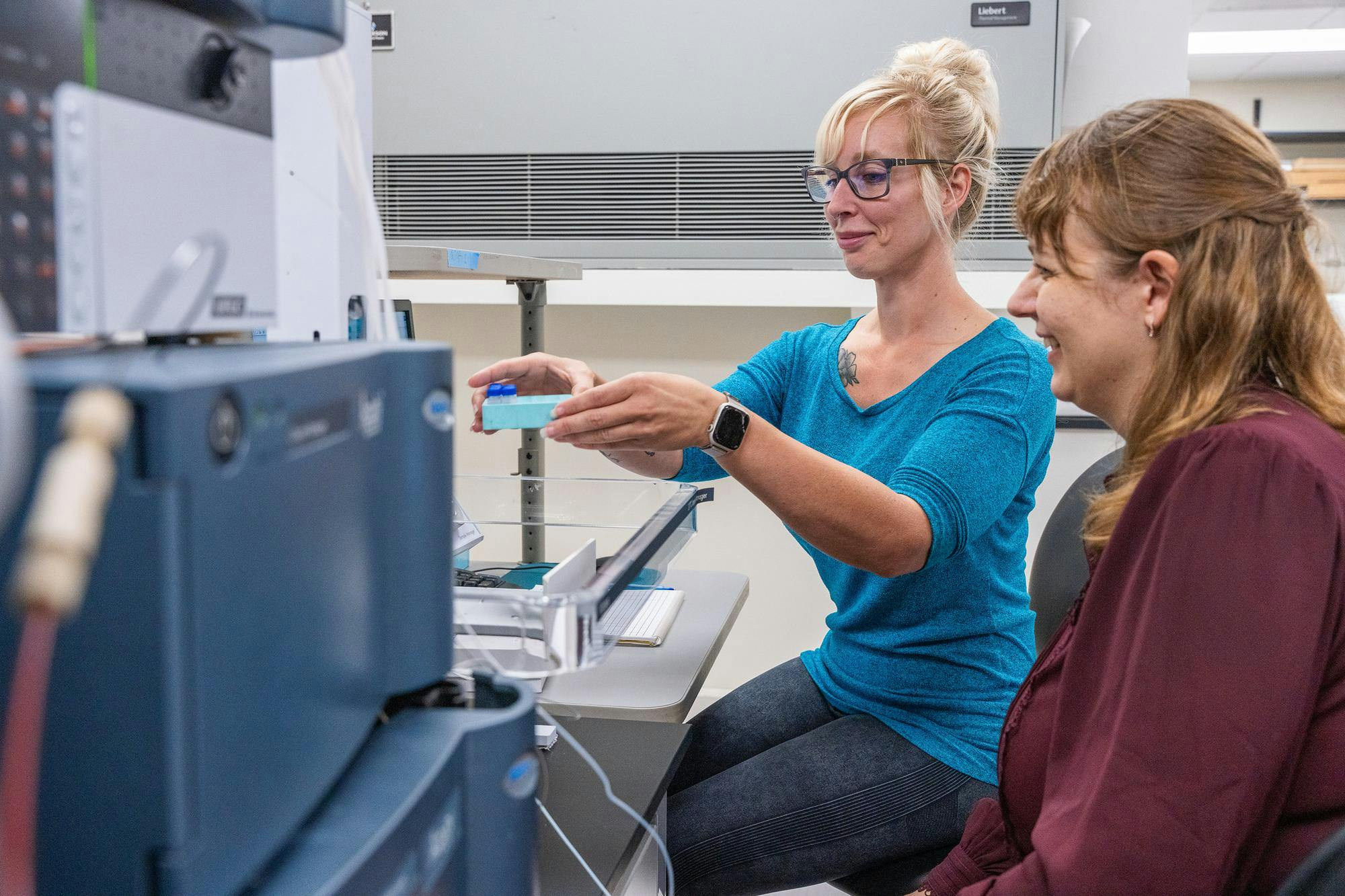
Using a special microscope, Melanie Balbach (L) and undergrad research assistant Lana Kouatli are able to track the quantities and motility of sperm in a particular sample. Courtesy of Finn Gomez, College of Natural Science.
In a New York lab, a colleague hesitated with the syringe. The mouse needed an injection for an experiment testing compounds to lower eye pressure, but she was too nervous to do it. Melanie Balbach, then a postdoctoral researcher, offered to take over—on one condition: she wanted to see how the compound also affected sperm.
The drug blocked an enzyme called soluble adenylyl cyclase—the same enzyme that acts as sperm’s internal "on-switch," producing the chemical signal that powers their movement. Within 15 minutes of the injection, Balbach found the sperm had stopped swimming altogether.
That result revived a once-abandoned idea that blocking the enzyme could form the basis of a temporary, on-demand male contraceptive, she said.
Now at Michigan State University, Balbach, an assistant professor in the Department of Biochemistry and Molecular Biology, leads a lab focused on understanding how sperm generate and regulate energy — a question that has remained surprisingly murky despite decades of reproductive research. Her team studies how these tiny cells "decide" which fuels to burn and which metabolic pathways to activate as they prepare to fertilize an egg.
That question led to a paper she recently published in Proceedings of the National Academy of Sciences, where her group mapped, for the first time, the precise steps sperm use to create and control energy.
"The ultimate goal is contraception only when you need it," Balbach said. "So, you take it 15 to 30 minutes before intercourse, and it works for a short period of time, maybe 24 hours, and then it’s rapidly reversible."
The research comes as scientists are rethinking who bears the physical and emotional weight of contraception. Despite decades of innovation in birth control, nearly all options still rely on altering female hormones — methods that can cause side effects and long-term health impacts.
Male-focused research, by contrast, has moved slowly, often hindered by funding gaps, pharmaceutical hesitancy and assumptions about who should be responsible for pregnancy prevention.
By targeting sperm metabolism instead of hormones, Balbach’s research could offer a simpler solution.
It relies on a specialized technique called stable isotope labeling mass spectrometry, which is used to trace how nutrients move through sperm cells. Balbach describes it almost like painting a few cars bright red and watching them weave through rush-hour traffic.
By tracking where those markers went, the team could watch sperm metabolize in real time — seeing which pathways turned on as the cells matured and began to move faster.
The study revealed that when sperm activate, they shift gears metabolically: turning up the energy-producing pathways that power movement while turning down those that build new molecules.
In the process, Balbach’s team identified several enzymes that act as the "knobs" controlling how quickly sperm can make energy — findings Balbach said could help explain certain unexplained cases of male infertility and inspire new, non-hormonal contraceptive approaches.
For Balbach, this connection between sperm metabolism and male contraception feels almost inevitable.
Years before her MSU study, that impromptu mouse experiment in New York showed that blocking a single enzyme — the one acting as sperm’s internal "on switch" — could halt movement for up to 24 hours before motility returned.
Now, her work on energy regulation offers a more complete picture of what’s happening inside the cell when that switch is flipped.
By mapping the enzymes that control sperm’s fuel use, Balbach and her team hope to identify new molecular targets that could safely "pause" fertility without hormones.
The idea builds on the same principle that sparked her early discovery: if you can temporarily interrupt the process that lets sperm generate energy, you can stop them from swimming — and therefore, from fertilizing — without affecting other cells in the body, Balbach said.
It’s an approach that could lead to what researchers call an on-demand contraceptive — a pill or compound that takes effect within minutes and wears off within a day.
Support student media!
Please consider donating to The State News and help fund the future of journalism.
The next challenge, Balbach said, is chemistry. The compounds that stop sperm in mice don’t always hold up once diluted in semen or introduced into the female body.
"You need something that binds to the sperm and stays on," she explained. "If it falls off, then the sperm are just going to function again."
Discussion
Share and discuss “A hunch, a mouse and a moment that could change male contraception” on social media.