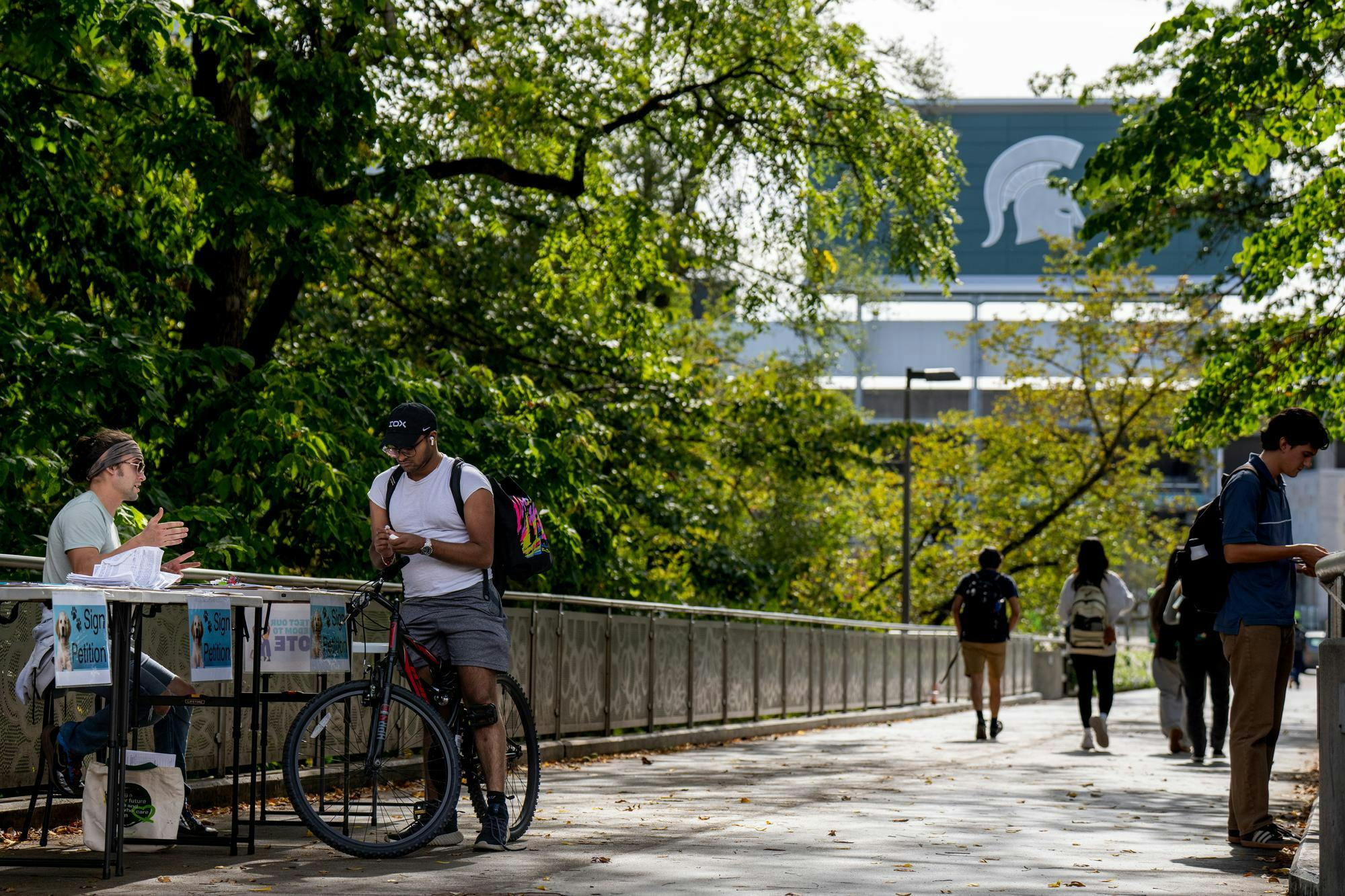
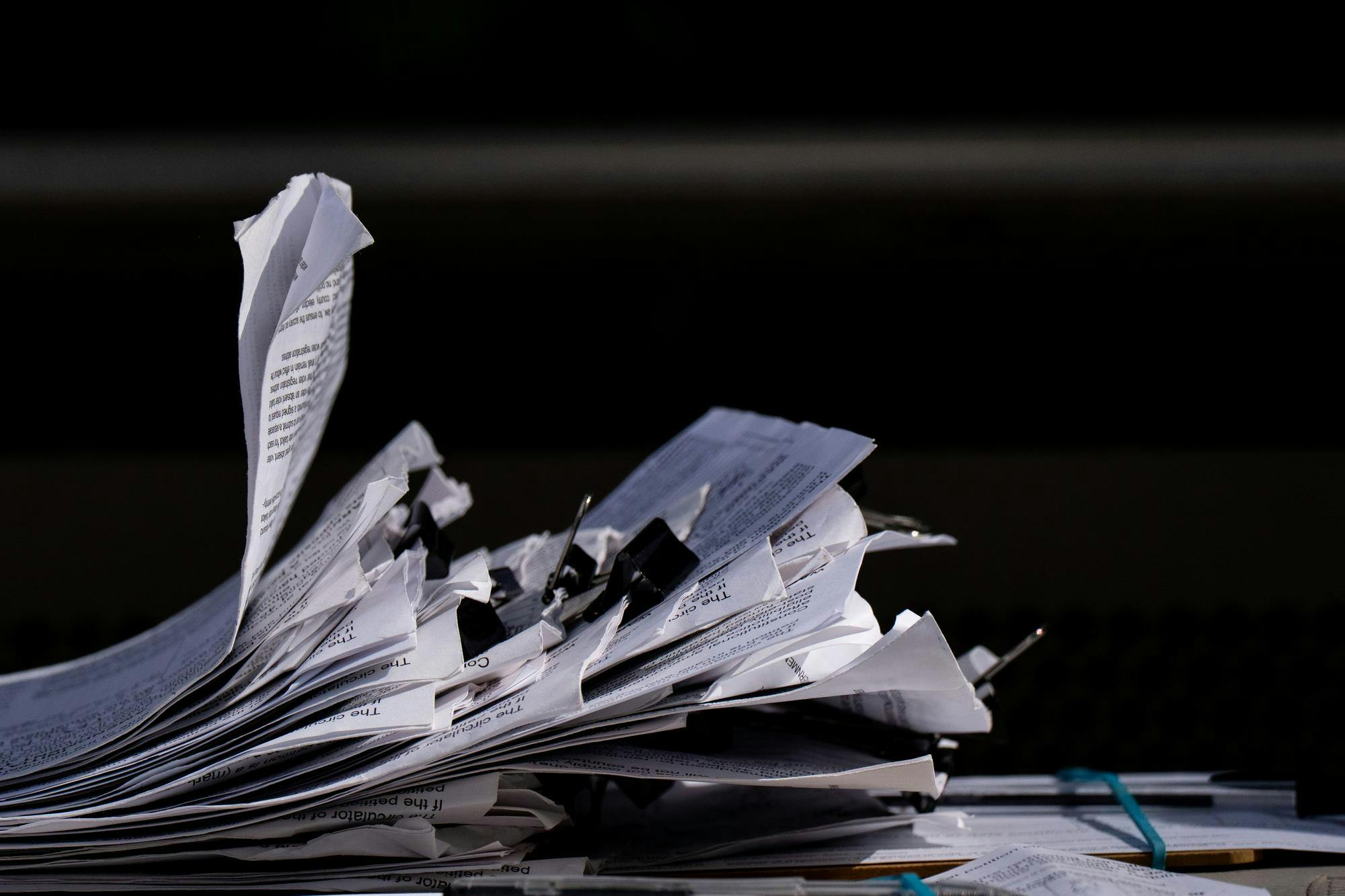
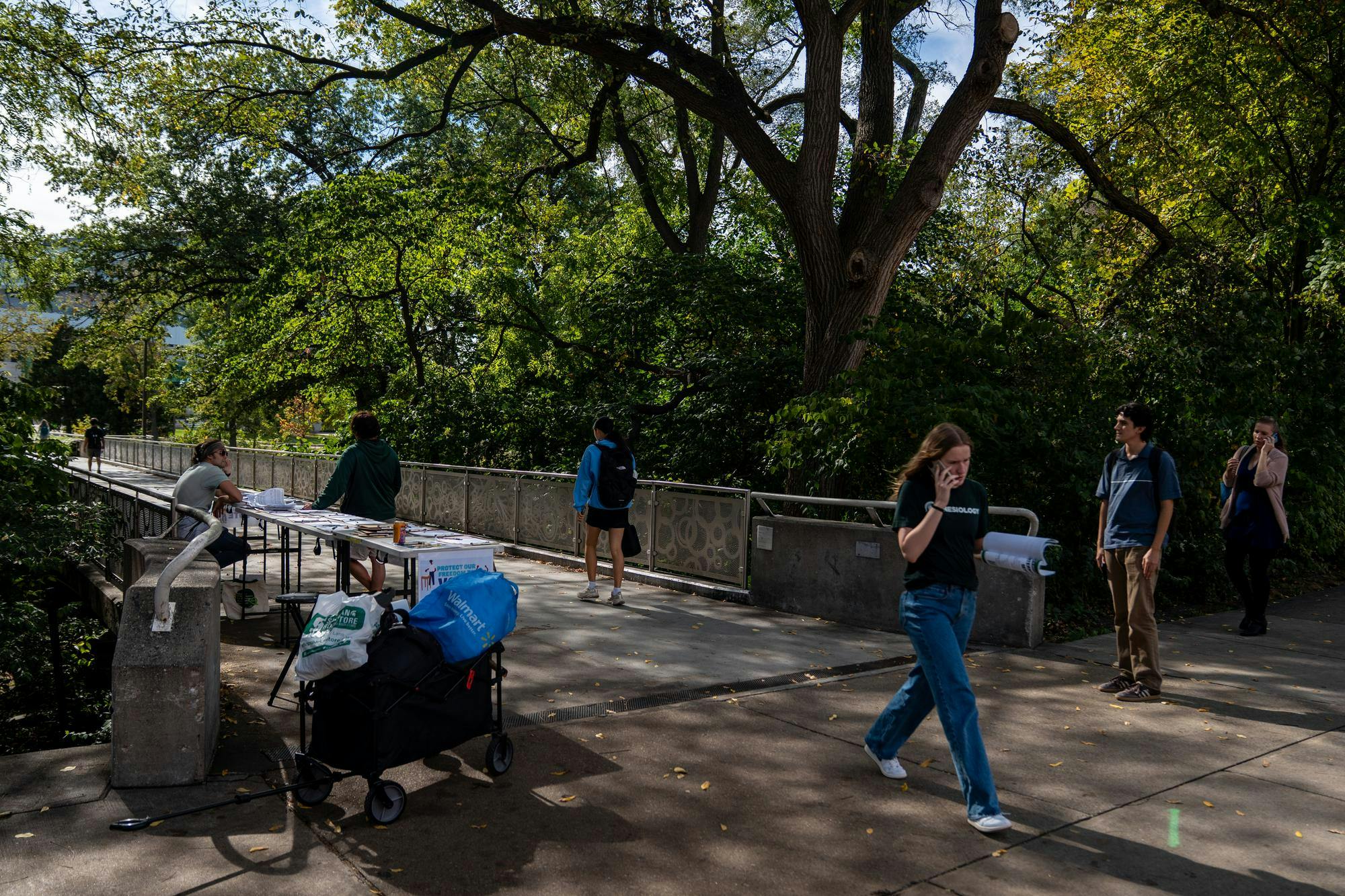
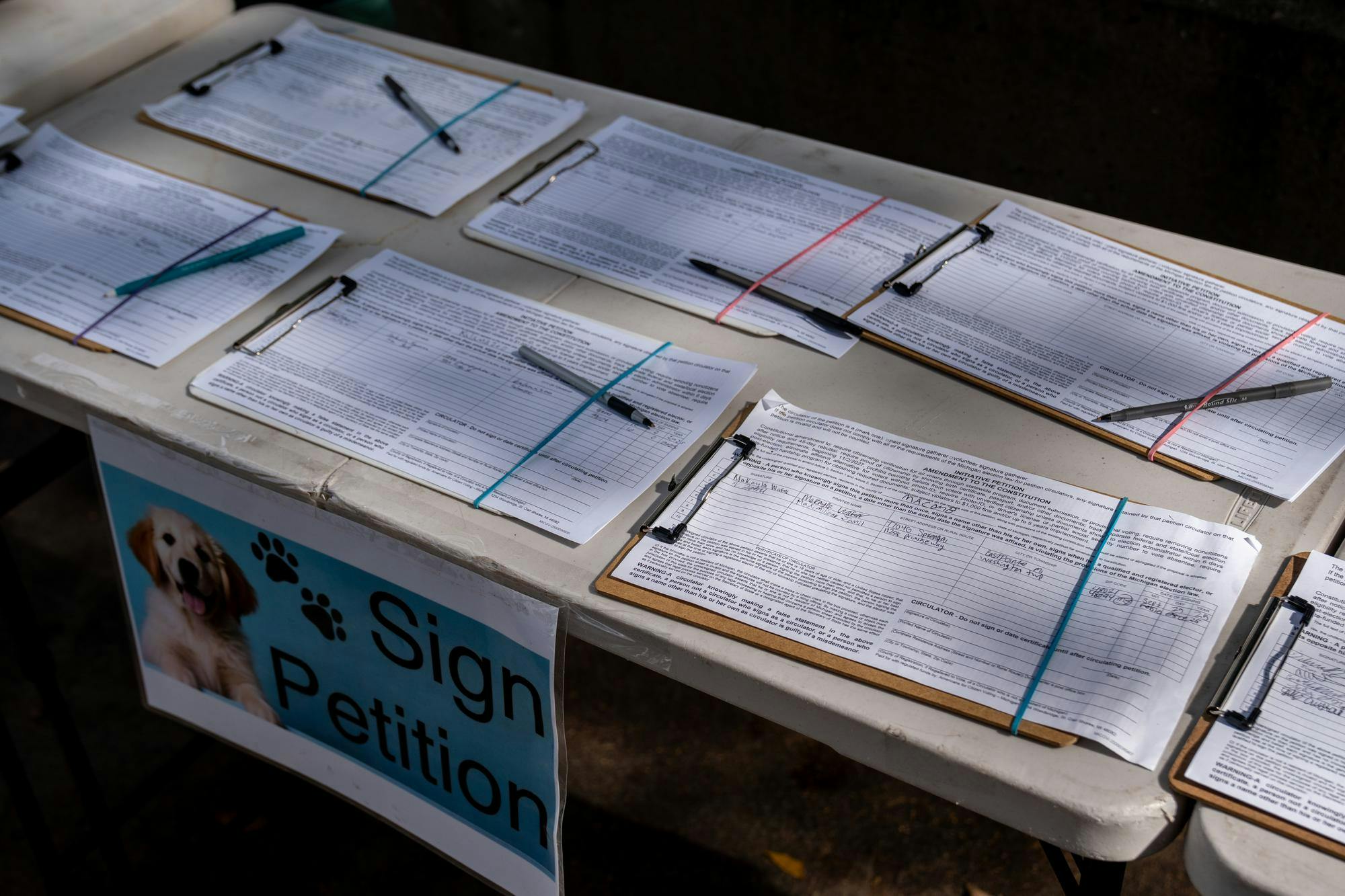
Petitioners gather at MSU's Library Bridge in East Lansing, Michigan on Thursday, Oct. 2, 2025.
Omar Brinjikji was in a good mood as he walked by the library on a recent, unusually warm Wednesday afternoon.
The neuroscience sophomore was on the way back from his abruptly cancelled physiology lecture when he noticed a stream of students ahead of him stopping by a table set up on the bridge connecting the library to south campus.
As Brinjikji approached the table, he noticed it was covered in clipboards filled with thick paper stacks, while small posters featuring a golden retriever puppy compelling passersby to "sign petition" hung from its sides.
A circulator swiftly handed Brinjikji a petition, told him that by signing he’d be supporting a ballot initiative to make voting easier for first-time voters and asked him to sign, before moving on to another curious student.
Only after signing the petition, Brinjikji told The State News a few hours later, did he realize he may have been misled.
In reality, Brinjikji had signed a ballot initiative meant to require all voters to show a photo identification in order to cast a ballot, verify that only U.S. citizens are registered to vote and mandate that the Michigan Department of State regularly review and purge voter rolls of people whose citizenship status cannot be verified. Brinjikji said the circulator he spoke with mentioned none of these details.
Requiring photo identification for voting has been a long-standing debate in state and national politics, with conservatives saying those requirements are essential for protecting election integrity and liberals arguing that they would create an unfair barrier to voting (this measure would provide free ID cards for those facing hardships). Brinjikji knows which side of the debate he falls on.
"I definitely would not have signed my name on it had I known that was a requirement," he said.
Circulators of the petition have descended upon Michigan State University in recent weeks, setting up shop along heavily trafficked footpaths, tabling outside dormitories and even intercepting students elsewhere while riding e-bikes. The vast majority of these circulators are contractors who are paid for each signature they collect by a third-party petitioning company, which itself is paid by the organization actually behind the petition.
Critics of that system say paying circulators by the signature encourages people to say whatever they must in order to get people to sign, even if that requires lying or misleading people. That argument has found its way to the Michigan Legislature, which is weighing whether it will ban that compensation structure, though it faces opposition from Republicans who say it wouldn’t eliminate the incentive for dishonesty.
It's a long-running debate. Nearly every election in the past decade has included reports of petitionersstretchingthetruth in order to gain signatures.
"You could be someone who's just hired by a company, you know, working for a third-party organization you don't really know or care about. You're just trying to get as many signatures as you can to get paid as much as you can," said Eric Walcott, a senior specialist with MSU Extensions who advises local governments.
The ballot initiative was created by the group Americans for Citizen Voting – Michigan. A spokesperson for Campaign Petition Management, the group paid to distribute the petition, did not respond to requests for comment.
However, Paul Jacob, chairman of Americans for Citizen Voting, said in an interview that he would not accept any circulator lying about the contents of his petition, and emphasized that any circulator who was caught doing so would be fired.
"This is about the easiest signature to get, because people want to sign this petition," Jacob said. "So if anyone is saying anything that’s not accurate, they will be fired."
'I work for myself'
For Americans for Citizen Voting to have their proposal added to the statewide ballot next November, they need to amass 446,198 signatures before July. That task isn’t impossible — three ballot proposals were included in the 2022 general election — but requires, seemingly by design, a coordinated group of motivated circulators.
The work can be done by volunteers, but oftentimes political advocacy groups will turn to petition circulating firms who can quickly mobilize hundreds of independent contractors to stand outside grocery stores, walk down city streets and table on college campuses. Jacob declined to say what split of his petition circulators were volunteers or paid contractors, though he said they collectively number "probably a couple hundred people."
The work isn’t glamorous. One recent post on a popular petition circulator Facebook group complained that they wouldn’t work for any campaign that did not offer housing, while others warned against certain organizers who are known to pay late. One circulator on campus told The State News she had been heckled by students at another university.
Support student media!
Please consider donating to The State News and help fund the future of journalism.
Two circulators with Americans for Citizen Voting said they earn three dollars per valid signature. The knowledge of that paltry rate can inspire certain passerbys to sign a petition even if they disagree with its premise, a circulator named Vic who declined to provide his last name said.
"Some people are going to sign regardless of what it’s like," Vic said. "Maybe they’ve been in your shoes before, maybe they had a similar job, and they know it ain’t easy."
By virtue of college student signatures being a finite resource, signature gathering is inherently a zero-sum game with little room for cooperation, even if circulators are petitioning for the same organization. One circulator named Britney (who also declined to provide her last name) said she was unfamiliar with anyone else petitioning on campus.
"I work with this dude named Eric, and he has a whole bunch of people that work with him, but we all work on our own," Britney said. "I have no idea who works for Eric. I have not a single clue what one petitioner’s name is. I work for myself."
Showmanship or dishonesty?
When Britney was standing outside the library’s south entrance on a recent Tuesday, she was still working on her 'hook.'
While getting people to sign a voter ID petition in a deeply conservative district would be no problem, Britney said, getting students on a predominantly liberal campus to even consider signing required creativity — though she said she’s never lied to people.
In one version of her hook, she asked students if they’d like to sign on to a petition which would create a hardship program for voters trying to obtain photo identification, before explaining how the petition would make photo identification mandatory.
“This is my third time here, so I’m still getting used to how the students are responding, and I’m still trying out different hooks to see," Britney said. "But the ones here are actually a lot nicer. If I start off with 'Hey, I have a voter ID petition,' they’ll still listen."
The hook doesn’t need to be verbal only, either. The puppy posters on the bridge, paired with signs that read "protect our freedom to vote," succeeded in capturing at least some people’s attention — like Brinjikji, the neuroscience sophomore, who said that the dogs "kind of drew me in."
Although Brinjikji says that he was not told the truth about what the Americans for Citizen Voting petition was calling for, Vic — one of the circulators working on the bridge — insisted that he is never dishonest with people because "I know what it’s like being lied to."
In a conversation with another petitioner working the table, Vic candidly provided an insight on the level of awareness some people have over what they’re signing: “I can’t even tell you how many people — they’ll sign not even knowing what it is.”
Preventing fraud
Michigan, unlike states like Ohio and Oregon, has no restriction on misrepresenting the contents of a ballot initiative. That means regulating what circulators say and do not say is largely in the hands of the petition circulating firms.
Jacob, of the Americans for Citizen Voting, said his organization has no tolerance for circulators who mislead the public, pointing to a recent instance where he fired a circulator in Detroit who was recorded misrepresenting the petition.
"You know, that's not how the world works. It's not okay to say whatever,” Jacob said. "You have to say the truth and you know, we've had one instance called to our attention and have fired the person immediately."
State Sen. Jeremy Moss (D-Bloomfield Township) has long believed that self-regulation is not enough, however, to prevent circulators from lying. Moss has repeatedly proposed prohibiting firms from paying circulators per signature collected and requiring them to make clear what the petition would do.
"If I know, as a signature gatherer, I’m getting paid the same amount whether I collect one thousand signatures or 50 signatures, there’s no incentive for me to say something false about a proposal and try to get a signature,” Walcott said.
Those proposals have not been voted on yet this session, though the per-signature-payment ban did pass along party lines last year despite Republican opposition. State Sen. Ruth Johnson (R-Groveland Township) said at the time that the bill would prevent petition circulators from being fairly compensated, and that "if there’s individuals who are committing fraud, then those individuals should be penalized, not everyone."
Research professor emeritus at the University of Michigan Michael Traugott said another factor that could complicate efforts to address dishonesty is the simple fact that the state requires nearly half a million signatures before a proposal can get on the ballot.
"It’s very difficult to get volunteers to put in the time required for signature gathering, and that’s why this business of paid signature gatherers developed,” Traugott said. "But there is no way, really, to regulate it legally.”
Discussion
Share and discuss “Petition pushers mislead students” on social media.