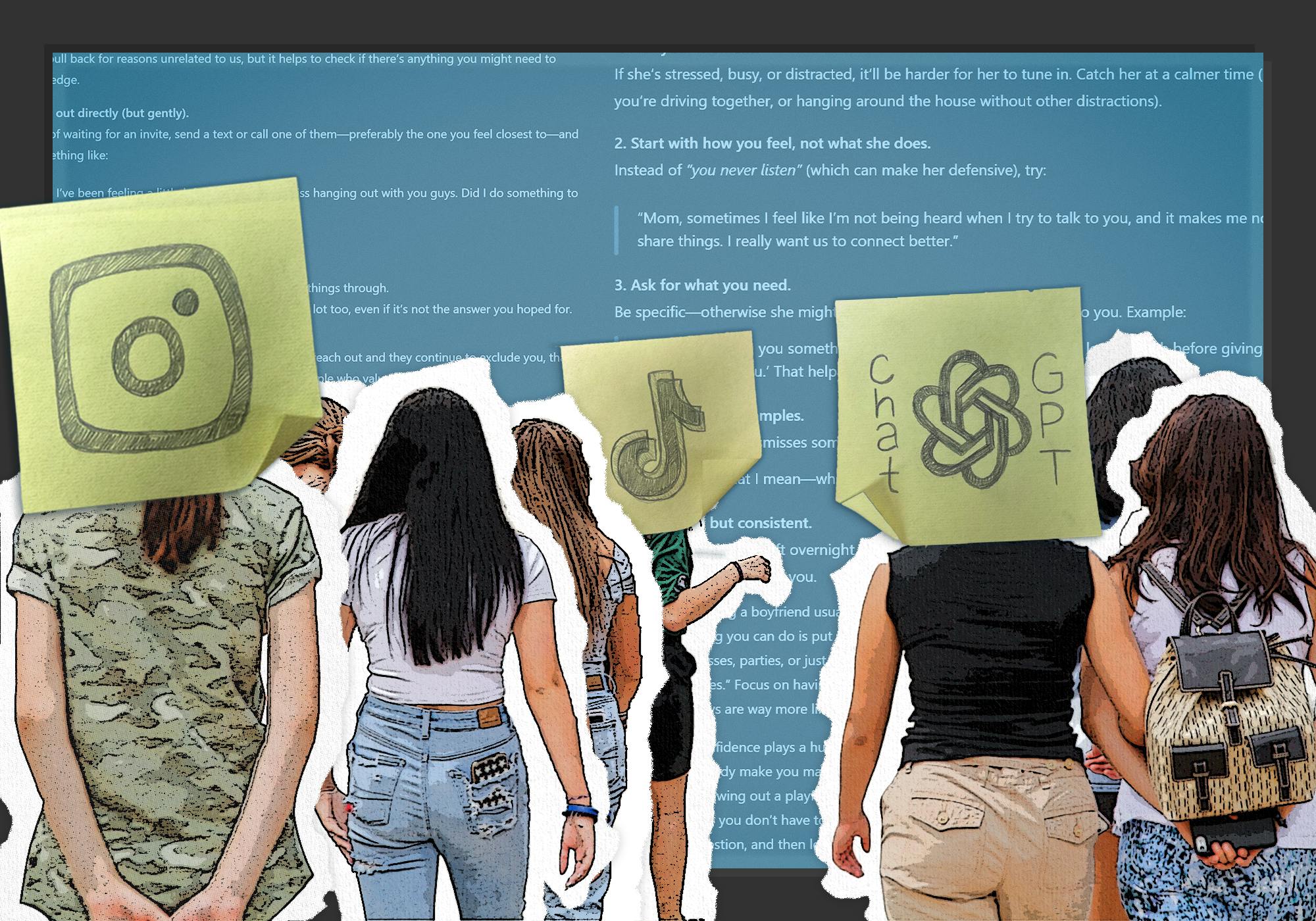
When information science junior DeAngleo Bennett thinks about AI, he doesn’t think it seems real. "It doesn't come off humane," Bennett said. "It feels like words of affirmation just thrown at you."
His thoughts reflect a shared feeling among students – one where AI and even social media are deeply embedded in daily life, reshaping how they learn and present themselves in the digital world.
For anthropology freshman Alexis Bell, she said she spends "a lot of time on social media."
"The main way that I text a lot of my friends is through Instagram," Bell said. "Instagram, Snapchat, and TikTok, I think, are my main three."
Gwendolyn Seidman, associate professor of psychology at MSU, researches cognition in close relationships and motivations for social media use. She describes social media as creating a sort of “social dilemma.”
"You might not want to be on social media, but then your friend says, 'Why didn’t you like my post?' That kind of pressure keeps people engaged even when they don’t want to be," Seidman said.
Bennett stopped regularly posting on social media when he became a student at MSU because he felt he relied too heavily on it to define his lifestyle. “It just felt awkward," Bennett said.
His experience is the same for anthropology and criminal justice sophomore Nevaeh Greenleaf who "doesn’t post, just watches."
Seidman said there are two forms of social media use: active and passive. These forms of use can relate to personality types, but it’s hard to tell, as, "The whole active and passive distinction might be too simple. There are actually different ways to be 'active' on social media, and they relate to different goals, like self-promotion versus connection."
"Passive use, just scrolling or looking at content, is generally associated with lower well-being or mood," Seidman said. "Active use is more complex. Some of it is self-presentational, posting about yourself, photos, updates. But some active use is more social, commenting or liking other people’s content," Seidman said.
With content consumption in mind, the American Psychological Association reports that teens spend nearly five hours a day on social media, one hour more than the students interviewed reported having.
"I’d guess like four hours," sophomore Calder Buehler said. Buehler checked his screen time and found that he averaged about three hours per day.
Seidman discusses how seeing others’ filtered lives and feeling like you’re falling behind is one of the most potentially harmful things about social media.
"Most people filter, literally and figuratively, what they post. And even though we know that, it still affects how we feel about ourselves," Seidman said.
Greenleaf thinks that people "definitely" try to seem more "aesthetic" on social media, but, in person, they’re "real" and "normal" people. "They have flaws and stuff, but they dont show it there," Greenleaf said.
Bell feels the same, sharing Greenleaf’s sentiment of "definitely. I think people seem more confident on social media because they don't necessarily have anyone challenging them,” Bell added.
AI
Bell said she only used AI "one time," and that was "about two years ago." She has never used it since. "I don't like the use of AI at all. I just think that it's a way that people can get out of doing work, and it just rewards people's laziness," she said.
Beuhler agreed with Bell, "I think 90% of the time, it's out of laziness."
"It can be convenient to have something that's like a little notepad just to get your information," Bennett said. "But if you rely on it too much, you're gonna start feeling like AI is your best friend when it could realistically be harmful to you."
Support student media!
Please consider donating to The State News and help fund the future of journalism.
However, Assistant Professor of Computer Science and Engineering at MSU, Mohammad Ghassemi, said he "kind of" thinks of AI as a "tutor in your pocket."
"Like all tutors, they’re very helpful, but also like all tutors, it’s important to know they don’t know everything," he added.
Ghassemi uses AI himself and discusses the benefits of using it as a “learning tool,” and not something to give you all the answers.
"Sometimes even as an expert, it’s not easy to understand scientific papers," Ghassemi said. "It’s really helpful to put an article into an LLM and ask, 'What does this equation mean?' or 'Can you explain this in code or plain English?'"
Bennett said he would use AI for this reason – a coding or math problem he couldn’t understand, a sentiment shared by every student interviewed.
If students don’t understand something a professor says, they can "generate specific examples from abstract statements professors make," Ghassemi said.
He warns, though, that if AI does all the work, retention can be an issue. "Language models have made it possible to flip on 'god mode' or 'easy mode' for your homework."
Ghassemi said his favorite type of learning, however, is dialogic – learning that occurs through genuine conversation. Even though AI can be helpful if used properly, Ghassemi suggests "real dialogue" as a fun and helpful substitute.
"Start a discussion circle. It doesn’t need to be official," he said. "Just pick a topic that’s quasi-related to your field and debate it together. You might learn more than you do in class."
Discussion
Share and discuss “MSU students weigh the benefits, drawbacks of social media, AI” on social media.