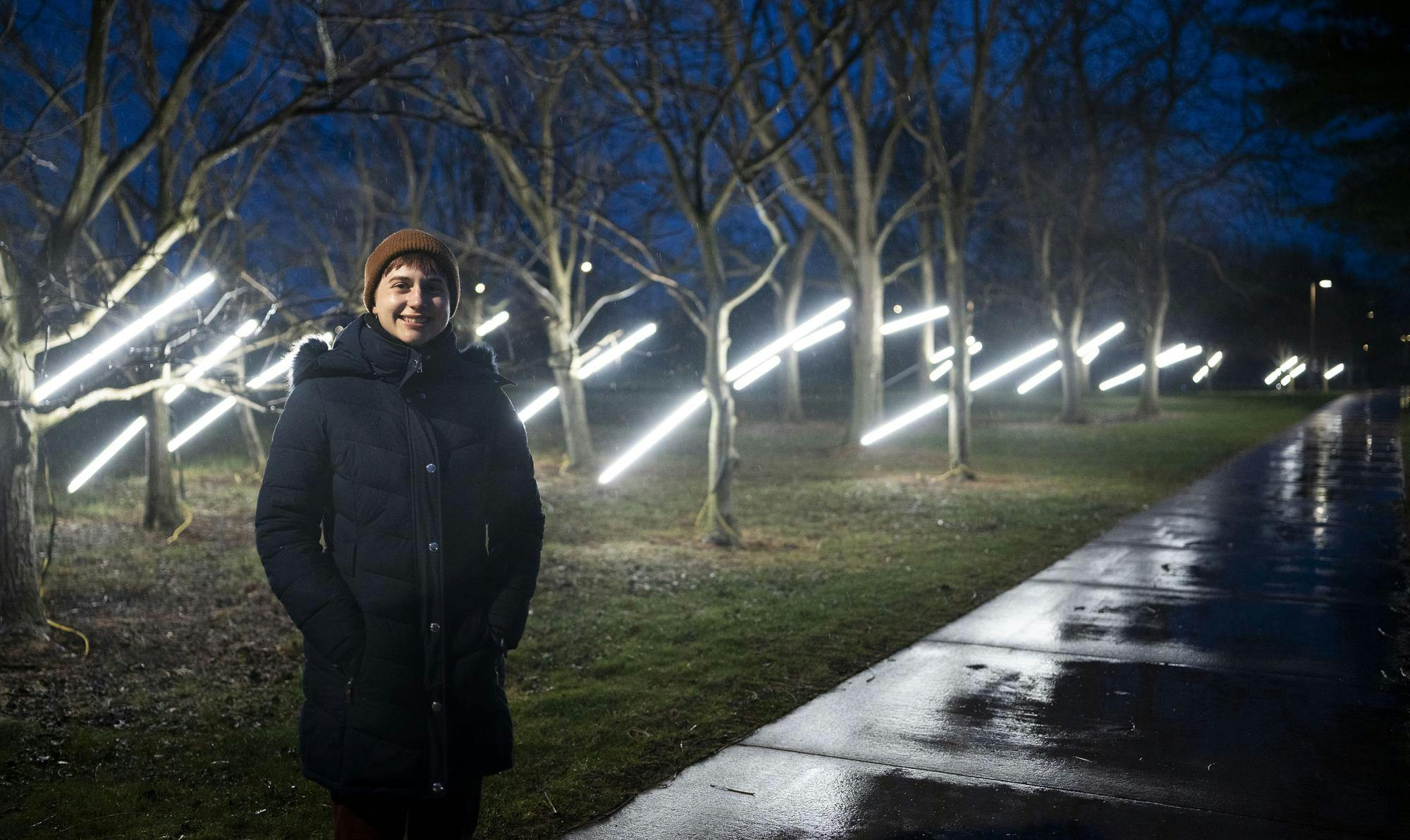
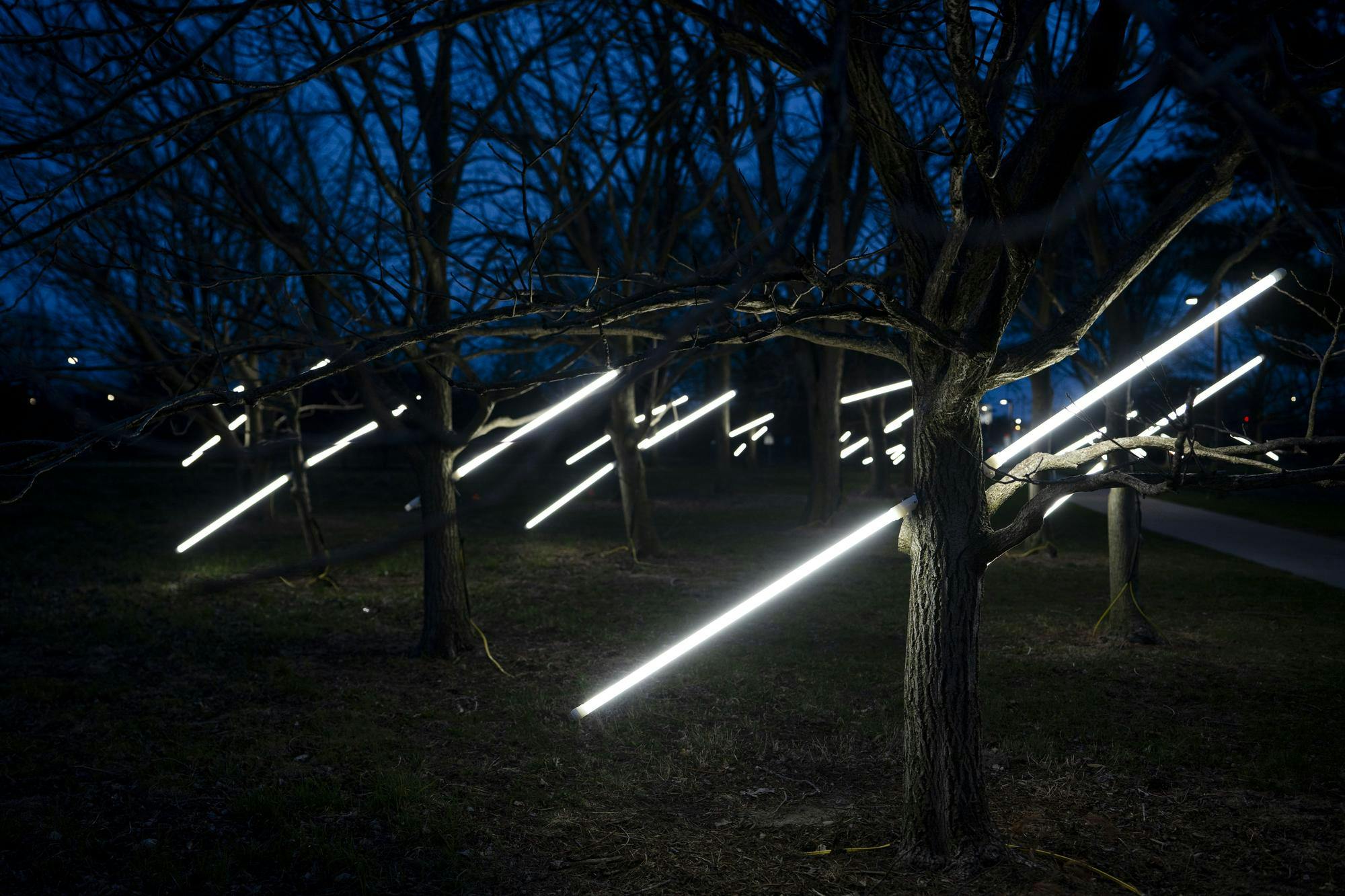
MSU graduate student Hailey Becker stands at her art installation outside of Holden Hall on April 9, 2025. Becker's installation featured beams of light coming out of trees scheduled to be cut down for upcoming construction. She hoped this project will bring awareness to ecological grief. According to her artist statement, “the act of piercing the tree with light is a death ritual in which the community is given an opportunity to pay their respects to the trees, mitigating the shock of their imminent removal.”
On MSU’s campus, the first sign of new construction is the sudden removal of trees.
With constant renovations and new buildings going up, the removal of trees is inevitable. While some may see it as a progress, for others there is a feeling of heavy loss. To graduate student Hailey Becker, it's ecological grief.
"The arborists are trying to do their job, but that sudden loss causes chronic grief, especially on a college campus," Becker said. "The landscape changes so quickly, but we as students have an attachment to it as a home. It makes those impacts more severe."
Currently, Becker is working toward both her Master of Fine Arts degree and a PhD in forestry. She decided that the perfect way to conduct her research on ecological grief through the tangent of her two disciplines. Culminating in an interactive exhibit dubbed "Where the Light Gets In," she has been collecting data and bringing awareness to these grieving processes.
Located on the northeast corner of Trowbridge and Harrison, the exhibit sits on the plot of land identified for the recently approved 2050 Land Use Plan. The 43 trees in the exhibit are scheduled to be cut down to create space for new academic buildings, student housing, a hotel and parking spaces.
Becker hopes that by commemorating these trees their removal won’t be as sudden, and people will be able to grieve the loss in a productive way.
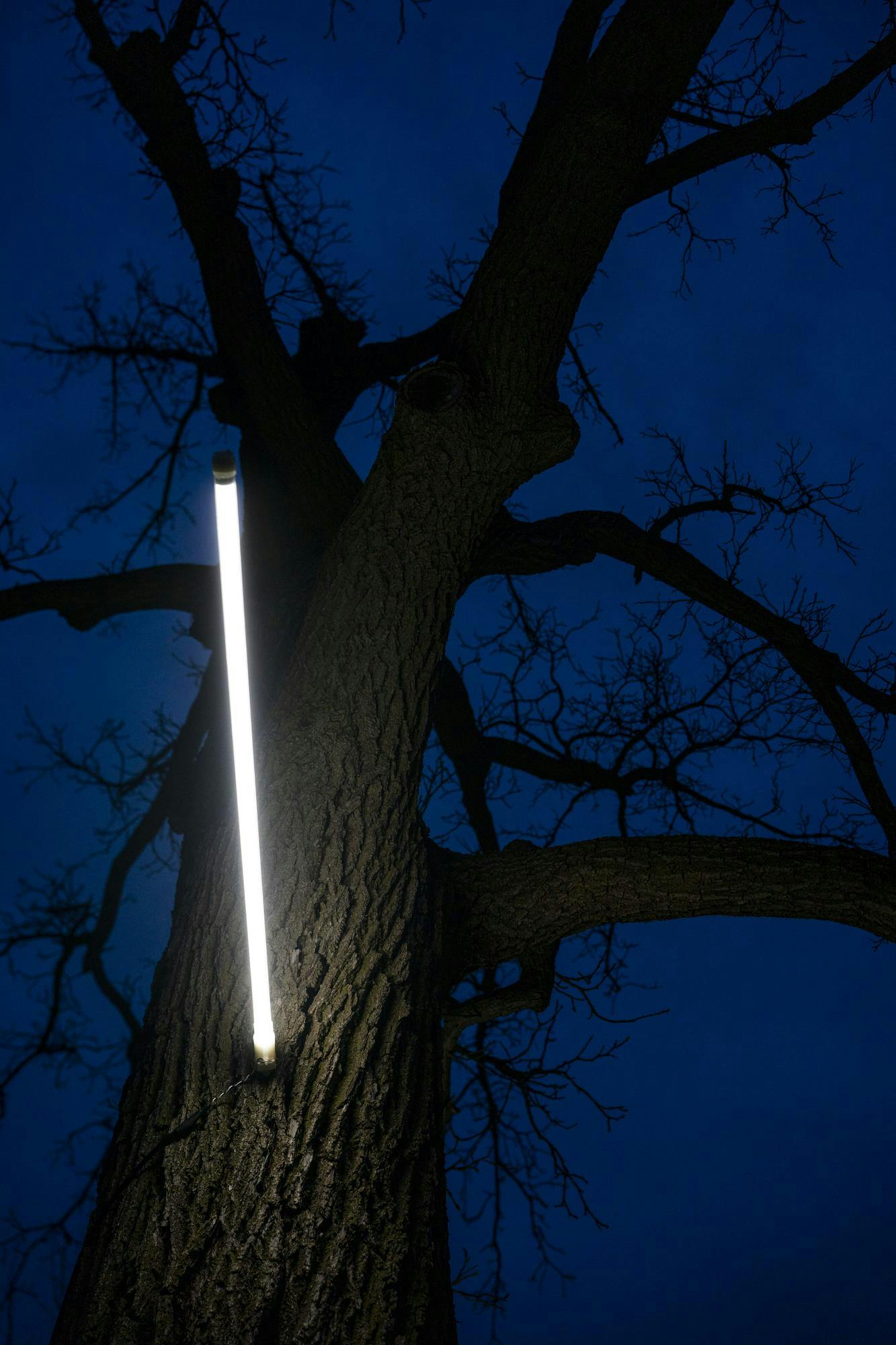
Inspired by lyrics from musician Leonard Cohen, the protruding beams of light emerging from the trees emulate a spear, piercing through the tree's heart. Becker hopes for this to be seen as a death ritual, giving the community the opportunity to pay their respects.
"This kind of art is really meant to shake up your day and allow you to look around a little bit differently," Becker said.
Becker's goal is to gather research on the impacts of ecological grief and how people process it, especially with growing feelings of guilt due to climate change. Visitors of the exhibit are asked to respond to a survey, which Becker uses as data for her research.
"This art installation can act as both an intervention and a therapy," she said.
For some MSU students, the exhibit is how they learned about the upcoming construction.
"I was sad to hear that a lot of these trees were gonna be taken out and converted into another building," fisheries and wildlife senior Eric Heidelberg said. "My first two years (at MSU) I lived in South Neighborhood. I liked walking in the trails."
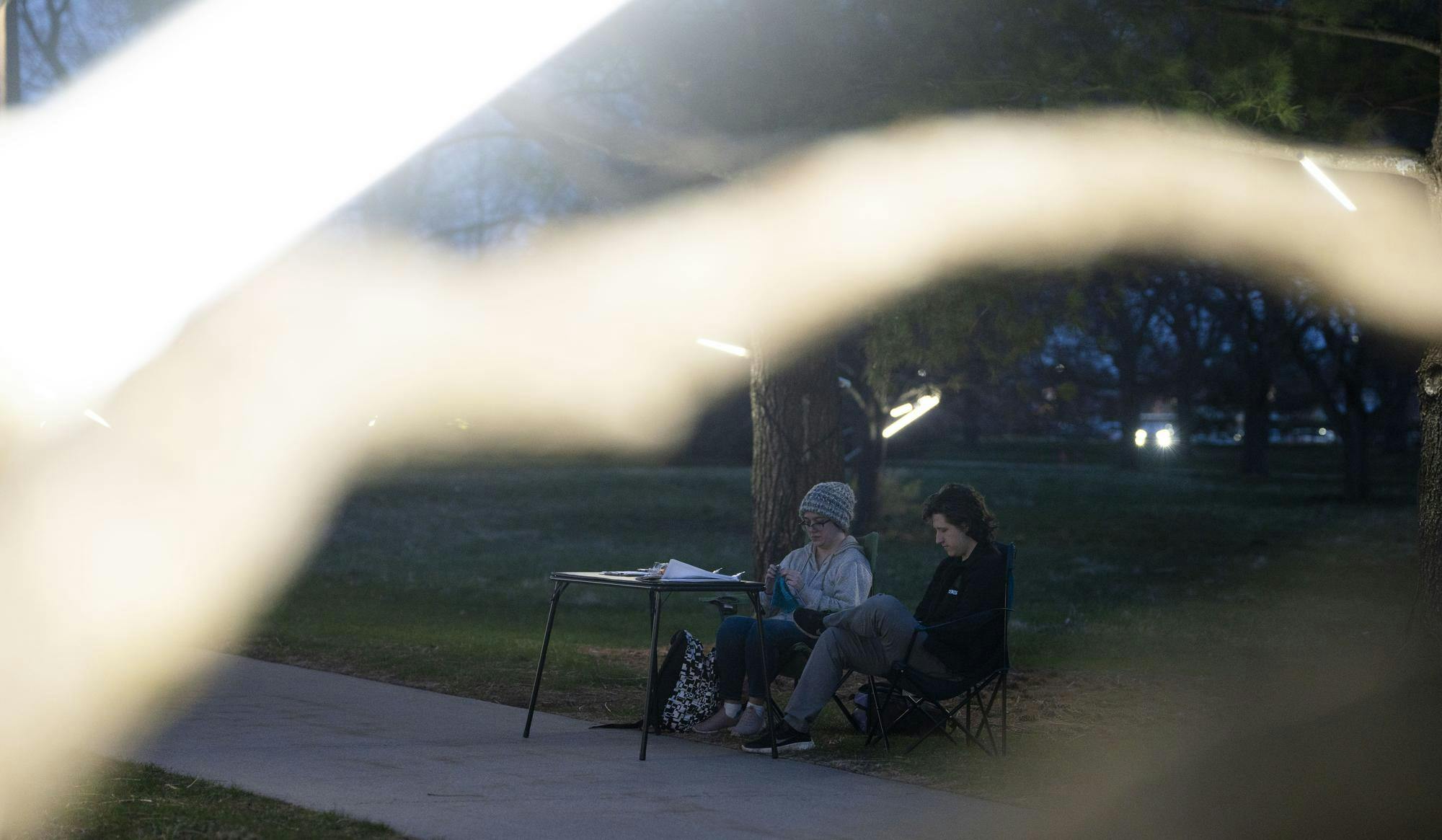
Heidelberg got involved with Becker's research after working as an undergraduate research assistant for her advisor, Dr. Emily Silver. His job is to sit outside at the exhibit and ask viewers if they’ve been impacted by ecological loss. Heidelberg assists in the facilitation and collection of survey data, including following up with respondents one week after their initial responses.
Although Becker's research focuses on the feeling of loss or grief from the removal of green spaces, she also acknowledges the necessity for it.
The 2050 Land Use Plan includes building sustainably. This often means using building materials like wood, which leads inherently leads to cutting down more trees.
"Coming to terms with that, especially because we feel guilty about our role in climate change, is not going to be easy," Becker said. "We want to see if there's a way that we can mitigate some of those feelings of loss in order for us to step into a more sustainable future."
For professor of ecology, evolution and behavior program and director of the campus arboretum Alan Prather, promoting sustainability while fostering the growth of the university is one of his main roles.
As an arborist, Prather has a hand in the decisions of which trees get cut down. With over 20,000 trees on campus, these decisions are not made lightly.
Support student media!
Please consider donating to The State News and help fund the future of journalism.
"There's no wrong feelings about cutting down trees," he said. "There can be a lot of grief involved, especially if it's an old tree or a beautiful tree. That doesn't mean that we're able to save every tree in every place. We can't stop construction. It would be a shame if we stopped building on campus."
Prather's role as an arborist often results in cutting down invasive species of trees and planting new trees to "future proof" campus.
"We're starting to plant trees that grow further south in East Lansing so as the climate warms up, we'll have trees that are able to withstand the new temperature and climate regime," he said.
Promoting the campus arboretum has been a driving force for Prather’s involvement in the project.
"I love the way that it makes us think about cutting trees down, not just the cost to the beauty of campus and the cost to the environment, but actually the cost to ourselves," Prather said. "I think that confronting that head on is pretty brave, and I'm really excited about it."
Prather hopes that this project will make people step back and remember all of the things MSU does to keep campus beautiful.
"As Spartans, that's something we share, and we're really lucky," he said.
For Becker, she hopes that this interdisciplinary display will spark a larger dialogue, which she believes are the first steps to creating change.
"I want it to be a true collaboration, where you have scientists getting exhibition credits and artists getting publications and peer review journals," she said. "They lift each other up. The real change in the world is done when people are able to communicate with each other."
Discussion
Share and discuss “MSU graduate student's art installation honors trees marked for removal” on social media.