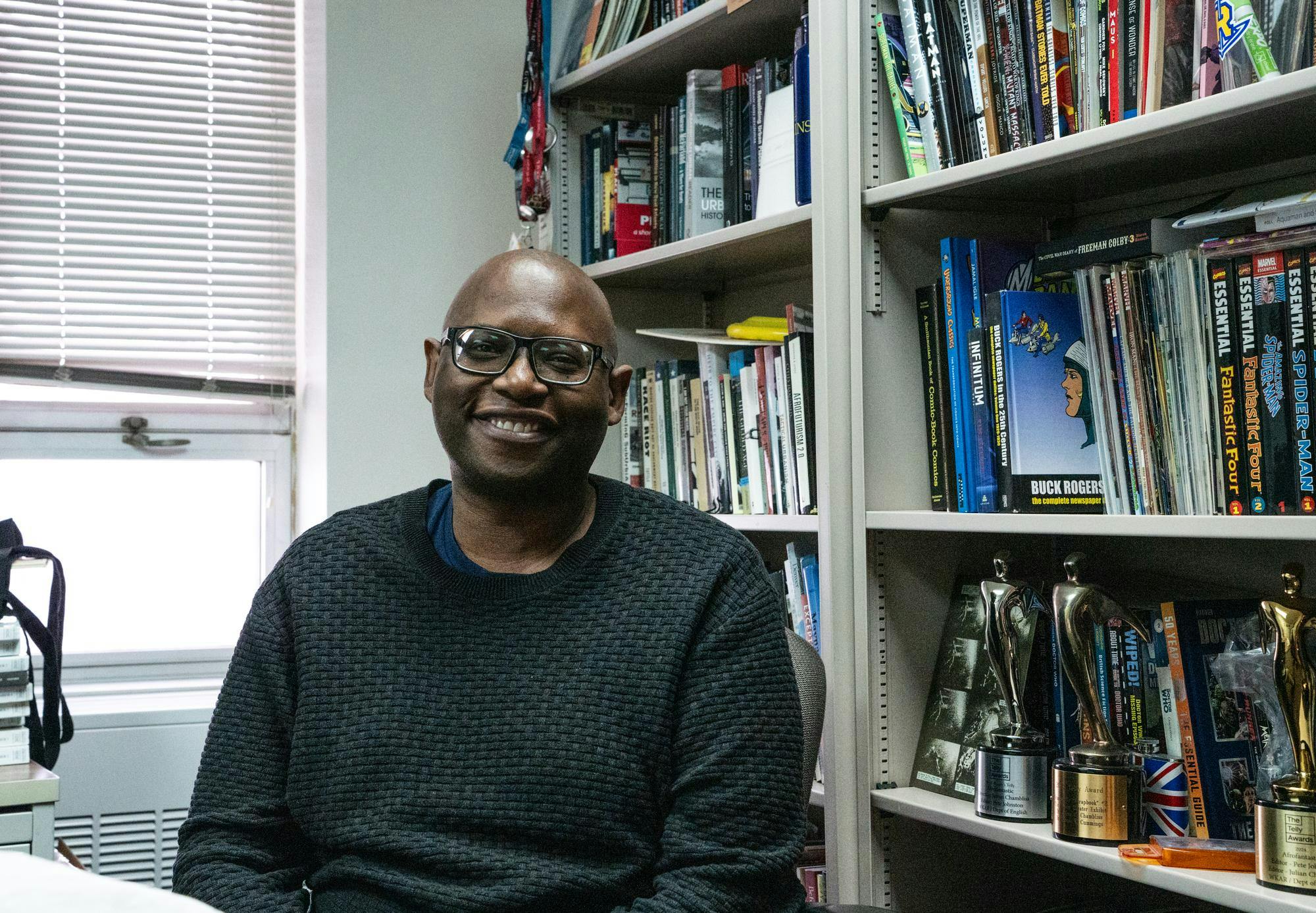
From there, Chambliss used comics as a means to further explore research he had done in graduate school regarding modern American history.
"It really became a way for me to talk about things that were in my original dissertation, which was about the formation of the United States and the early 20th century, late 19th," Chambliss said. "In a lot of ways, comics are a manifestation of sort of transformations of the late 19th and early 20th century. So a graphic literature sort of documents, archives those transformations."
Since beginning his work with comics, Chambliss has become an expert in the field. His current work at MSU includes teaching about comics. And in 2019, he published a book titled, "Assembling the Marvel Cinematic Universe: Essays on the Social, Cultural, and Geopolitical Domain."
But it would be inaccurate to say comics are his only focus here at MSU. He also works in the digital humanities, which he said involves "using computers, computer tools (and) digital tools to explore humane questions." As an interdisciplinary professor, Chambliss' "humane questions" tend to relate to Black speculative practice and Afrofuturism, which he also teaches about.
His multifaceted work has led him down paths in numerous mediums: digitizing MSU's comic collection, a recently published textbook, an exhibit at the MSU Museum, piecing together archives from historically Black towns, and mentoring his students who are similarly fascinated with comics and the role they play in Black culture and storytelling.
Chambliss arrived at MSU in 2018, when he was hired to MSU’s English department as part of the Consortium for Critical Diversity and Digital Age Research. It was as if the job description was written for him.
"The English department had a description that talked about someone who could do digital humanities and who could do comics," he said. " ... Once I saw the description, I was like, I feel like I kind of have to apply for this job."
Chambliss is currently working alongside others at MSU to digitize the university's comic collection. Over the past few years, they have been adding comic data to WikiData, the data repository for Wikipedia. Every entry into Wikipedia has a record associated with it, and every link on a Wikipedia entry also represents a record. When data is added to WikiData, that creates another record that can be used.
"The more information that's in WikiData, the more that you can see patterns, because you can connect the record that you added to other kinds of records, right?" Chambliss said. "So you're basically adding to a repository that allows you to ask very particular kinds of questions."
Part of the logic behind this work, Chambliss said, is to create more opportunities for people to create more nuanced stories about comics because they will have more digital resources available to them.
Second year Ph.D. student Brittany Akins has worked alongside Chambliss on this project. Chambliss was the first to introduce her to digital humanities, and she said it has been interesting to see the two components of the field converge.
"It's really fun to see the places that we can use tech, specifically in humanities spaces, where people would normally consider them in opposition," Akins said. "It's very cool to see the possibilities that we can achieve when we do work like this."
When Akins came to MSU, she was assigned as a teaching assistant for one of Chambliss' undergraduate courses. It was then that Chambliss introduced to her a comic called "Blue Hand Mojo," which she said was like "a coming to Jesus moment."
"I was like, 'oh my God,' like something just clicked," Akins said. "The angel started singing, and everything just made sense."
Her TA role under Chambliss also led Akins to the research she is now doing for her Ph.D., which explores Black horror films, comics and prose fiction. She plans to discuss decolonization and working through trauma in Black horror as a genre, while also exploring how Southern Gothic and Caribbean folklore are in dialogue with each other.
Chambliss is the co-chair of her research committee.
"He has all this really cool knowledge and all these connections to people in the industry, whether it's comics or the Black speculative," Akins said. "He's been giving me so much information, and I have so much theory to read because of him in comics and in the Black speculative space."
Third year Ph.D. student Harry Foster had a similar experience.
Support student media!
Please consider donating to The State News and help fund the future of journalism.
Chambliss was one of the main reasons Foster decided to pursue his Ph.D. at MSU in the first place. After doing his undergraduate at Columbia University, MSU was not on his list until he met and spoke with Chambliss. Since then, Chambliss has played a significant role as a mentor in Foster’s education and chair of his research committee.
"We're both giant nerds," Foster said, "so sometimes our conversations digress into talking about comic books and superheroes and things like that, but like we're both also really deeply interested in themes of race and gender, especially Black masculinity, and especially in thinking about race and gender in conjunction with power."
As shown through both Foster's and Chambliss’ research, it is not as if the two conversations are separate.
"Sometimes the nerd conversations get very political, and sometimes the political conversations get really nerdy," Foster said. "They're deeply intertwined, because comics historically have been very, very political."
Speaking to Chambliss about comics is "almost like speaking the same language," Foster said. These conversations have been "essential" in helping Foster determine his research project.
Foster’s thesis will focus on a fictional figure called "Black Badman" and the character's evolution through pop culture and time. The character is a sort of Robin Hood and has appeared in various comic books and films. Black Badman, Foster said, is a unique American invention and didn’t exist prior to African enslavement and the slave trade.
"He is a product of enslaved Africans adapting to their new lives in America after emancipation, and so my research project is sort of tracing his evolution … and his development in pop culture and through different genres as a way of trying to understand how he continued or is no longer relevant as a form of emulative behavior for the Black community, as a heroic model," Foster said.
Outside of his work with comics, Chambliss uses digital humanities in his work relating to Afrofuturism and Black community development.
Afrofuturism, as defined by Chambliss, is the intersection between speculation and liberation born of the efforts of people of African diaspora who are working in opposition to oppression.
"It sort of talks about the ways that Black people are acting in the affirmative towards the future, and so that that process really requires Black people to imagine beyond the confines whatever contemporary sort of oppression they're facing," he said.
Right now, Chambliss is doing work with historic Black towns like Eatonville, Florida, and theorizing about the role of Black towns as Afrofuturist spaces. Chambliss explained that Black town-building began after the Civil War and Reconstruction as a way for Black people to create spaces that were "nurturing institutional support" and allowed them to "project themselves and their children into the future."
He described these spaces as "engines of speculation that will allow the few generations to prosper, to endure, to do more."
"I'm often trying to recover stories about Black spaces, or sort of marginalized groups, people who are sort of hidden in the record," Chambliss said. "So I am working in the archives and trying to piece together and reveal sort of archival narratives about people, about places, about things."
His essays from this research will be coming out this year.
Chambliss' work in Afrofuturism also extends to his teaching. One of his classes, called "Afrofantastic: Race, Power, and Gender in the Black Imaginary," allows students to explore Black speculative practice and Afrofuturism. His success with this course led to the recent publication of his textbook, "Mapping Afrofuturism: Understanding Black Speculative Practice."
The book was written from the content of the class and acts as a guide for others who seek to teach or learn about the course.
And on top of everything, Chambliss is also a curator at the MSU Museum. His most recent exhibit, “Techno: The Rise of Detroit’s Machine Music,” will be at the museum until April 30.
"I'm usually doing something Afrofuturist," Chambliss said. "You just sort of have to catch me, and I'll be doing something."
Discussion
Share and discuss “MSU professor uses comics, digital humanities to explore Afrofuturist stories” on social media.