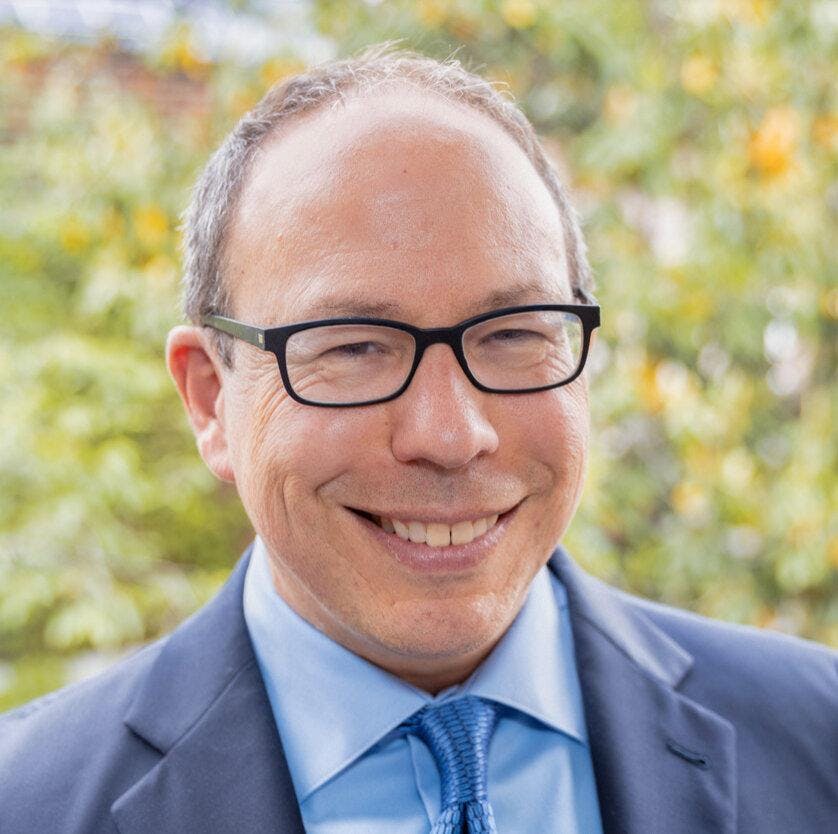
A Michigan State University law professor who called the 2020 election "crooked" will serve as general counsel of the Federal Communications Commission, the agency’s chairman confirmed on social media last week.
Adam Candeub teaches several introductory courses in MSU’s School of Law and is the director of its Intellectual Property, Information and Communications Law program. During President Donald Trump’s first term, he held positions at the Department of Justice and the National Telecommunications and Information Authority.
Candeub caused a stir on campus last summer after he wrote a chapter of Project 2025, a think tank’s 922-page blueprint for conservative takeover of the federal government written in anticipation of another Republican presidency.
Candeub has been open about his support for Trump and his willingness to serve under another Trump administration. But private emails obtained by The State News through a public records request cast light on the extent of his alignment with the president.
In response to a colleague who shared an article arguing the Jan. 6, 2021 capitol riots constitutionally disqualified Trump from serving a second term, Candeub wrote, "There was no insurrection. There was a political demonstration to protest a crooked election that got out of control."
In August 2023, Trump was indicted in an election fraud case in Georgia. In response to an MSU communications staffer passing along a media request for an interview on the subject, Candeub wrote that he’d be "happy to tell any interested person that the indictment is bullshit," according to the emails. It doesn’t appear as though Candeub was ever interviewed.
That December, Candeub shared a news article about a group of Republicans who prayed over Trump at a campaign stop in Iowa. In the subject line, he wrote, "G-d bless Iowa!"
Candeub told The State News that media interviews with FCC employees must be coordinated through the agency. The FCC did not respond to repeated requests for an interview with Candeub.
Questions over the independence of the FCC
Candeub’s appointment is a reminder of the Trump administration’s increasing influence on the FCC since Inauguration Day.
Under the direction of Chairman Brendan Carr, who appointed Candeub to his position, the FCC has ended its promotion of DEI, launched an investigation into NPR and ordered the release of the full transcript of a 60 Minutes interview with Kamala Harris after Trump claimed CBS deceptively edited it to make her look better.
Every administration exerts its own political influence on the FCC. But the agency should ultimately be an arm of Congress, not of the president, says former FCC Chief Economist Johannes Bauer.
It takes strong leadership to resist presidential pressure to "impose an agenda driven by vengeful and other narrow motives on the FCC," Bauer said.
Candeub appears to have the president’s interests in mind, though it's yet to be seen how that will affect his work. He told Politico in August 2024 that he’s "always been supportive of the president and his agenda" and that he’d be "honored to play whatever role" he could in another Trump administration.
For Trump and his allies, supporting the president could mean getting rid of the FCC’s status as an independent agency.
Kevin Roberts, president of the think tank behind Project 2025, told the New York Times that contributors to the project were committed to giving the president more power over independent agencies.
"The notion of independent federal agencies or federal employees who don’t answer to the president violates the very foundation of our democratic republic," Roberts told the Times.
Trump himself has also promised to bring independent agencies "back under Presidential authority," specifically naming the FCC and Federal Trade Commission.
Rob Frieden, an academy and emeritus professor of telecommunications and law at Penn State, said that he’s concerned about the independence of the FCC under Candeub and Carr.
"Just now, the court of public opinion and Executive Branch officials appear to favor aggressive investigations and sanctions of individuals and organizations, not licensed and regulated by the FCC," Friedman wrote in an email to The State News. "I worry that the FCC will ignore the clear First Amendment rights of journalists, broadcasters, Internet platform operators, and social networks."
Support student media!
Please consider donating to The State News and help fund the future of journalism.
Candeub’s plans for the FCC
At the FCC, where he previously served as an attorney adviser, Candeub is expected to take an aggressive approach to regulating Big Tech.
Candeub has "fought fearlessly against Big Tech censorship," FCC chairman Carr told Semafor.
He's a critic of Section 230 of the Communications Decency Act, which protects internet platforms from liability for the posts of its users.
In 2018, Candueb represented a white nationalist who was banned from Twitter in a lawsuit against the platform, which was later dismissed.
In 2020, amidst a debate over whether social media censored conservative views online, Candeub helped write a petition to the FCC that called for less legal protection for content moderation. Though his efforts fell through once Joe Biden took office, Candeub told Politico that he hoped Trump would revive the request.
Candeub has also argued for increased protections for children online, telling Politico that it’s "terrible that Big Tech forms contracts with our kids in those stupid terms of service and they don't get parental consent."
Candeub’s trouble at MSU
As a professor, he has been known for his edgy wit and "non-PC language."
But last summer, Candeub’s reputation became intertwined with his contribution to Project 2025.
A post on Reddit pointing out the connection garnered hundreds of interactions. The most recent review on his Rate My Professor profile is a condemnation of his work.
In September 2024, MSU’s Student Bar Association overwhelmingly passed a resolution denouncing Candeub’s involvement in Project 2025 and urging him "to disavow many of the harmful ideals espoused in the plan."
The resolution was written without knowing whether the propositions in Project 2025 would ever be implemented, or if Trump would even become president, said Torence Witherspoon, a senior in the college of law and president of the Student Bar Association.
But now, as Trump gives numerous contributors to the project influential positions in the government and begins to implement some of its proposals, Witherspoon says that "the concerns that we stated in that resolution remain today."
Discussion
Share and discuss “MSU professor who called 2020 election ‘crooked’ to be top FCC lawyer” on social media.