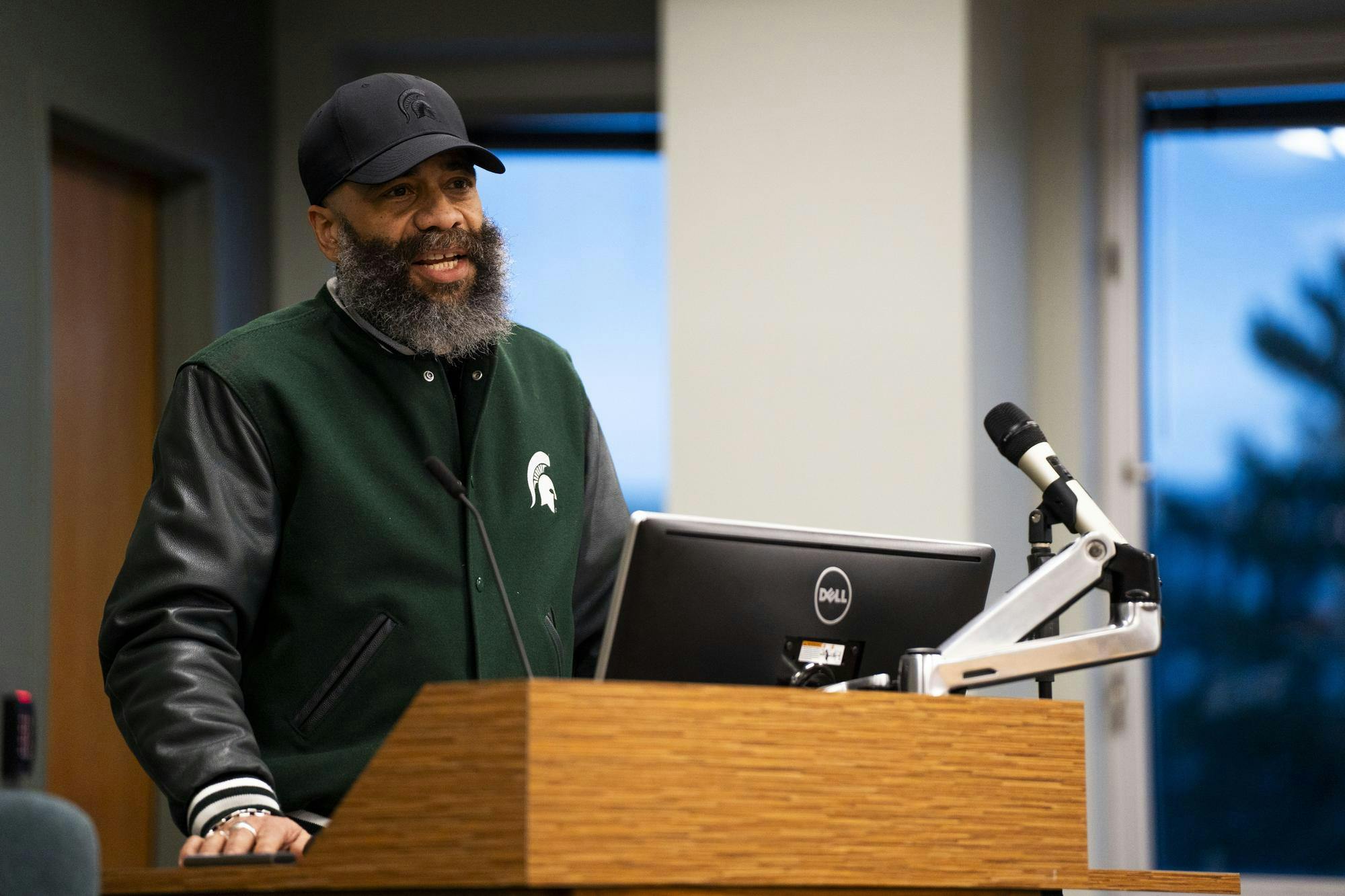
Michigan State history professor and author Pero G. Dagbovie discusses his new book, "Forever in the Path," at the MSU Library on Feb. 24, 2025. In his book, Dagbovie retells MSU's Black history using over a century of university archive materials.
Dean of MSU’s graduate school Dr. Pero Dagbovie hosted a discussion for his book "Forever in the Path: The Black Experience at Michigan State University" on Feb. 24. The book, which was released on Feb. 1, details the histories and contributions of Black students at the university, beginning with the first known Black students to be enrolled in the mid 1890s.
"Very little has been written today about this aspect of MSU’s history," Dean of MSU Libraries Neil Romanosky said. "Dr. Dagbovie’s ’Forever in the Path’ is the first to provide a comprehensive overview of the Black experience at MSU from the late 19th to the late 20th centuries."
Romanosky highlighted the effort that Dagbovie put into creating his book, noting the deep archival work that had to be done when exploring the stories of early Black students. Dagbovie said that uncovering information on those who attended MSU in the late 1800s and early 1900s required multiple sources, such as census records, newspapers and yearbooks.
"I just searched for people who were rendered voiceless by archives," Dagbovie said. "People are sometimes rendered voiceless because the people collecting materials might not be thinking about them."
Throughout the book’s 41 chapters, Dagbovie covers a wide array of important Black students who reshaped the culture of the university. Many major steps towards equality on campus, Dagbovie explained, started with pushes from students, such as Franklin Duffy in the 1940s.
"There’s this notion that (former MSU president John Hannah) was benevolent and desegregated the dorms," Dagbovie said. "That’s just not how that stuff went down. Franklin Duffy contacted the NAACP, got Black senators involved, and said, ‘if I don’t get the room I want, we’re going to take this to the senate floor and Michigan State will lose its funding.’"
The 1960s proved to be a monumental decade in Black student enrollment and involvement at MSU. In 1960 there were only a little more than a hundred Black students enrolled at MSU, Dagbovie said. The Detroit Project, which began in 1967, worked to recruit more Black students to attend the university, with a total of 700 Black students on campus that fall.
Dagbovie explained that, while impactful, the Detroit Project was not the only cause for that number to increase. Events such as the assassination of Martin Luther King Jr. in April of 1968 inspired Black activists across the nation to demand more of their universities.
"In the fall of 1968 the incoming Black student body doubled, and there were about one thousand total Black students on campus," Dagbovie said. "There were more than 2,500 African American Spartans by the early 1970s."
Dagbovie’s detailed storytelling and descriptions made it easy for members of the community, like MSU Press Director Elizabeth Demers, to connect with the stories depicted in "Forever in the Path."
"This book feels very personal to me," Demers said. "I grew up on the east side of Lansing. When Dr. Dagbovie describes the ties between Lansing’s African American community and the university, I know the neighborhoods he speaks of. This book enriched my memories of being a student here, and it will inform my path as a member of the community going forward."
Dagbovie did not simply recount important names and events that readers should know about when researching the history of Black involvement at MSU. Instead, he worked to detail their lives and circumstances so that the readers can fully understand their impact.
"Focusing on many personalities, important events, incidents and turning points, this book is a blend of intellectual history, social history, educational history and institutional history," Dagbovie said. "It’s part of the African American biographical tradition. At its core, it’s a collection of biographies, seeking to understand the past and why they made those choices."
Dagbovie explained the importance of viewing history through a lens that might seem unfamiliar, as it can be eye opening to a side that may not receive as much recognition and can help members of the community see their campus from a new perspective.
"When African Americans are focused on, or at a minimum, removed from the margins, we see a noticeably different Michigan State University history than the one we are accustomed to," Dagbovie said. "We see the potential of what John Hannah called a 'multiversity,' and of what Clifton Wharton dubbed a 'pluralistic university.'"
"Forever in the Path" highlights both the successes and the struggles that Black students at MSU have faced since its founding. Dagbovie explained that acknowledging both sides is crucial in telling those stories.
Support student media!
Please consider donating to The State News and help fund the future of journalism.
"When making sense of the Black historical experience at Michigan State, we should also remember to maintain that delicate balance between notions of victimization, inequity and oppression, and of course, resistance, struggle and perseverance," Dagbovie said.
Discussion
Share and discuss “Dr. Pero Dagbovie discusses the history of Black students at MSU ” on social media.