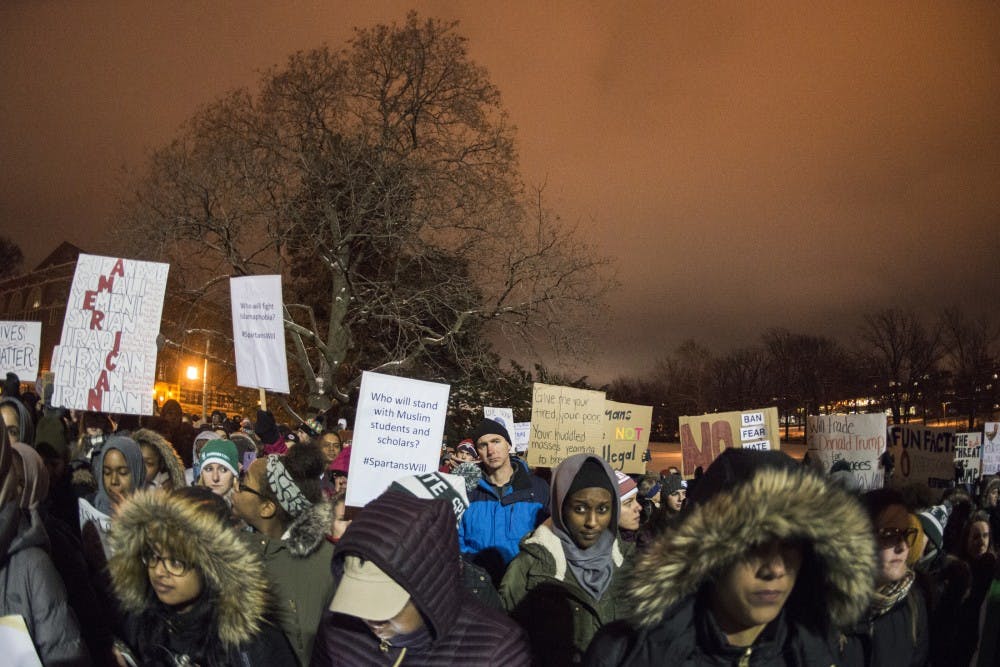
Protesters raise their posters on Jan. 31, 2017 at The Rock. The Michigan State Muslim Students' Association hosted a "No Ban, No Wall: Spartans for Sanctuary and Solidarity" as a response to President Trump's executive order on immigrants and refugees.
International students from any of the seven countries affected by President Donald Trump’s executive order are advised to not leave the country until the situation changes, MSU College of Law professor and Immigration Law Clinic member David Thronson said. Since the order is only a little more than a week old, Thronson said its ultimate ramifications are not yet clear.
“I would be surprised if there’s not some change to this,” Thronson said. “Now, whether that’s good change or bad change, I don’t know. How it would impact one individual student’s particular circumstances, I don’t know. So there will be a need for people to really make individualized, informed choices as to what their options are, what their situation is, financially, family, their course of study, how this all works out.”
For now, there is a 90-day restriction on entry for citizens of Iran, Iraq, Libya, Somalia, Sudan, Syria and Yemen. Thronson said that length of time could be expanded or restricted in the future. U.S. citizens are not affected, and Thronson said a Department of Homeland Security statement issued this week indicated that legal permanent residents of the U.S. who are citizens of one of the seven named countries will be allowed re-entry into the U.S., barring any incriminating evidence against them.
Thronson said there are two main challenges the executive order will face in court. The first challenge is that the order oversteps the powers of the executive branch. Thronson said both Constitutional rights to due process and statutes that set out certain rights for those seeking entry could possibly be infringed upon by this order.
“There are things that are hard to undo by executive order, and so there will be litigation over time testing those limits,” Thronson said. “The idea that the executive has broad power over immigration, that’s not controversial. There is a lot of power the executive has. It’s going to be around the edges of where did this overreach, and where might it not have?”
The second challenge is based on the establishments clause of the First Amendment, which guarantees that the U.S. government will never establish an official national religion. Thronson said some litigators have challenged the order on the basis that it is unfairly lenient toward Christians or discriminatory toward Muslims.
“One of the arguments is that this order preferences Christians. It does so without saying the word Christian, but that’s clearly the intent,” Thronson said. “People who were involved in the drafting and formation and formulation of this have very bluntly said that’s what they were trying to do. So there’s language in there about preferencing claims for asylum. For example, claims for refugee status from people from minority religions within these seven countries, which are majority Muslim, which is essentially saying non-Muslims only. Muslims need not apply. That preferences some religions.”
Thronson said litigation against this order could take years to complete. Initial rulings could take months, and there might then be months or years of appeals. Ultimately, if things do not change in the interim, Thronson said this case is likely to be decided by the Supreme Court.
Since no one knows whether the limitations on entry will be rescinded after 90 days or extended, Thronson said that international students affected by the order will have to remain vigilant for new details about it.
“People are going to have to devote some energy on keeping up with what’s going on,” Thronson said. “It’s a time to listen a lot, to pay attention and it’s a time, I think in particular, for all of us who don’t have to worry about our visa status and don’t have to worry about coming and going to speak up, and talk about how important it is that we keep students with us here, and how important it is to have an international presence in our universities and our communities. We are the ones in a position to make that story heard and to make sure that people who have less voice ... aren’t put in the onus of speaking out for themselves, when others can help give voice to their situation with less risk and stand up and do the right thing.”