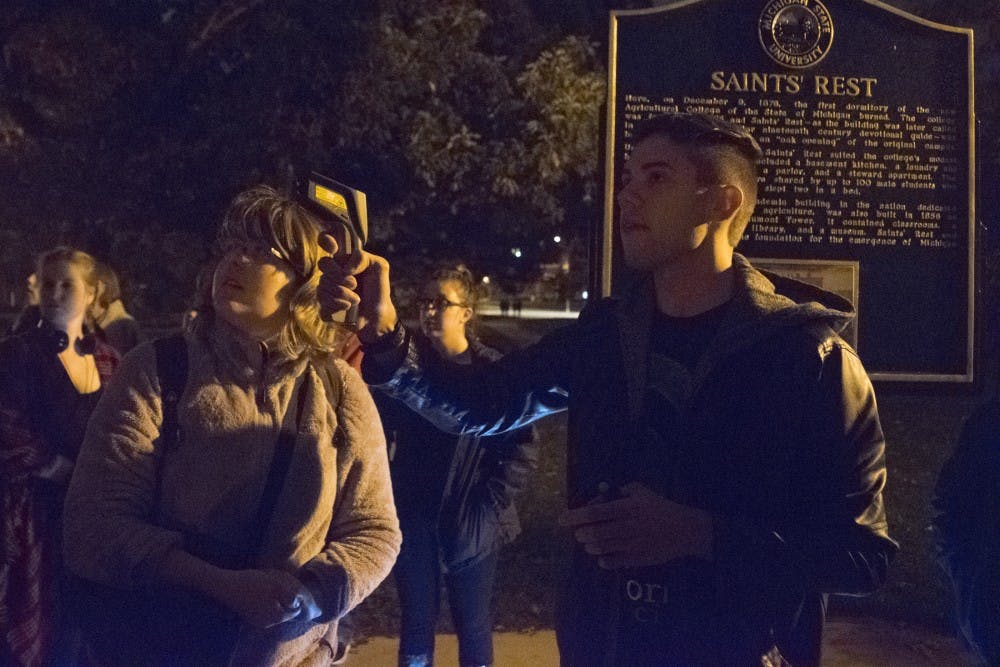
Rumors of haunted occurrences on MSU's campus came to life on Thursday night when the MSU Campus Archaeology program and the MSU Paranormal Society teamed up to put on the third annual Apparitions and Archaeology Haunted Campus Tour.
The tour featured six stops: Beaumont Tower, Sleepy Hollow, Saints’ Rest, 1900 Fountain, Morrill Hall Memorial and Mary Mayo Hall.
At each stop, members of each campus group talked about some archaeological and paranormal history regarding each site.
Beaumont Tower
Beaumont Tower was built on the site of the first building that was built at MSU, which was called College Hall, Campus Archaeology Program Director Lynne Goldstein said.
In a recent excavation by the MSU archaeologists, they were able to uncover part of the original College Hall structure.
“When they put that sidewalk in, which was just a few years ago, we found a corner of College Hall still there,” Goldstein said.
In terms of any hauntings of Beaumont Tower, Paranormal Society member Dan Mueller said they have gotten readings on their “K2 Meters," which detect electromagnetic activity, of ghosts in the area of Beaumont Tower.
Additionally, Goldstein said students have claimed to see a man in stovepipe hat, as well as couples dressed in 1920’s clothing and holding hands, walking around the tower at night.
Sleepy Hollow
Sleepy Hollow used to be part of the Beal Botanical Garden, anthropology graduate student and member of the Campus Archaeology Program Jeff Painter said.
“When (the university was) building Abbot Hall in the 1880’s, when they were digging the basement for the hall, they actually just took all that dirt and trash from construction and threw it all in Sleepy Hollow,” he said.
Because of that, Painter said the Archaeologists have found some old artifacts in Sleepy Hollow.
Environmental studies and sustainability junior and Paranormal Society member Tara Eavy said some people feel the sight might be haunted.
“While there are no documented ghosts or apparitions in this area, people often comment on feeling a haunted feeling and spooky atmosphere," Eavy said. "Due to it being a low spot in the landscape, it often retains fog more than other areas on campus."
Saints’ Rest
Saints’ Rest is the site of the university’s first dormitory building, which burned down in 1876.
Doctoral student and Campus Archaeologist Lisa Bright said after the building burned down, everything that remained was put in the basement of the building.
“While some workmen were repairing the basement, Saints’ Rest burned to the ground," Bright said. "At the time, no one knew why, what had happened, they just took everything from the building and pushed it into the basement and covered it over."
Support student media!
Please consider donating to The State News and help fund the future of journalism.
In 2005, members of the Campus Archaeology Program excavated some of the area where Saints’ rest once was and discovered part of an exterior wall of the building’s basement, along with two inside rooms and several artifacts of the building, Bright said.
International relations senior and president of the Paranormal Society Jared Gajos said students have seen 19th century students walking around the area, possibly looking for their old hall.
1900 Fountain
The 1900 Fountain was a gift from the class of 1900. It was made to be a fountain for horses to use on one side and people on the other.
Anthropology graduate student Mari Isa said it was strange for the gift to be something that catered to horses as not long after this, automobiles took over transportation.
As the fountain was a place people were known to stop off for water at, some people say they see ghostly figures dressed in 19th century clothing stopping by the fountain and nearby tree, which was struck by lightning earlier this year, anthropology senior and Campus Archaeology Program member Jasmine Smith said.
Morrill Hall Memorial
The Morrill Hall memorial marks the location of Morrill Hall, which was the first women’s building on campus and was constructed in 1899, graduate student and Campus Archaeology Program member Susan Kooiman said.
All that is left of the building is the plaza, which is found near the memorial and features benches made from stone that was part of Morrill Hall.
Astrophysics freshman and Paranormal Society member Anna Blow said that students used to ghosts in the hallways of Morrill Hall.
“After it stopped being a dorm and became an educational building, there were accounts of people saying they would see ghosts of professors walking around the hallways at night trying to find their classrooms,” Blow said.
Mary Mayo Hall
Mary Mayo Hall was constructed in the 1940’s, but prior to this there was faculty housing in the same area, professor Amy Michael said. There is only one remaining faculty house, which is called Cowles House.
Recent excavations have found some of the original foundations of the faculty houses, which once stood in the area of Mayo Hall, graduate student and Campus Archaeology Program member Autumn Beyer said.
“Mary Mayo is one of the most haunted buildings on campus," anthropology sophomore and Paranormal Society member Ryan Maue said. "A lot of stuff has happened here. Usually late at night, on the first floor, people have seen Mary Mayo herself walking around.”
Discussion
Share and discuss “Apparitions and archaeology haunted campus tour showcases six stops” on social media.