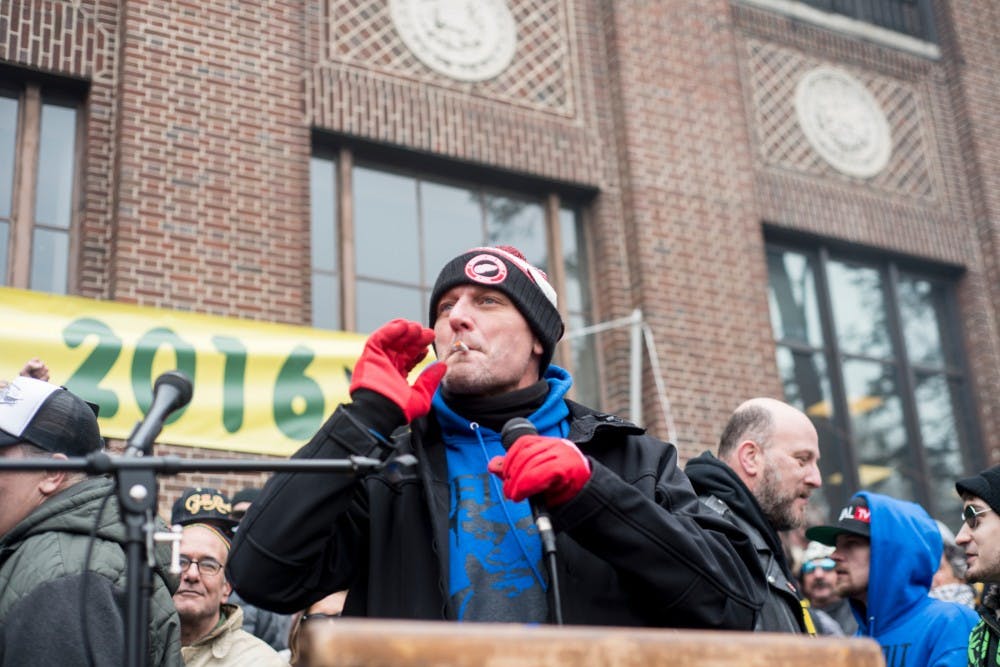
Retired Detroit Red Wings forward Darren McCarty guest speaks on April 2, 2016 at The Diag in Ann Arbor, Mich. McCarty spoke about how medical marijuana has helped his battle with alcoholism.
For Angie, an MSU student who attended the 45th Annual Ann Arbor Hash Bash on Saturday at the University of Michigan Diag, using marijuana is an important part of relaxation and social life.
“It brings people together,” Angie, who asked only to be identified by her first name, said. “It’s something people can connect on and relate to, no matter what you’re going through.”
Thousands of cannabis users and legalization supporters gathered for Hash Bash. The event featured a series of speakers who described the positives of the drug.
In the state of Michigan, cannabis is currently illegal for recreational use, but those with medical marijuana cards are legally allowed to possess certain amounts of the substance. The Michigan Medical Marihuana Act, or MMMA, was enacted in 2008, and it has remained in effect ever since.
The goal of medical marijuana dispensaries is to provide a safe space for the transfer of marijuana to patients who are unable to grow their own marijuana. Early in 2011, the City of Lansing created a law establishing a licensure process and regulations on dispensaries.
Later that year, before any licenses were issued, the Michigan Supreme Court cast doubt on the legality of dispensaries. In its decision on State of Michigan v. McQueen, the Court found the MMMA did not authorize the sale of marijuana on a patient-to-patient basis. The ruling has been used in many cities as precedent for shutting down dispensaries.
None of the planned licenses in Lansing were ever issued because of the McQueen decision, and some dispensaries shut down on their own after the decision, but there are some dispensaries still operating in the, Lansing City Council member Carol Wood said.
The owner of one south-side Lansing dispensary, "Matt", who asked to be identified by a pseudonym, said there are more than 60 dispensaries within city limits. Matt said he worries about customer safety at some dispensaries because of the lack of strict regulation.
The council has been searching for ways to re-establish regulatory control over dispensaries, Wood said. One city attorney presented a draft ordinance to the council on Thursday, which would force dispensaries to move out of the main downtown districts of Lansing and into less developed districts.
Still, dispensaries are forced to operate in constant fear of being raided. At any time, the City of Lansing could decide to enforce the state Supreme Court ruling and close down any dispensaries they choose to target.
Addison, an MSU student who works at a Lansing dispensary, said the shaky legal status of the marijuana business creates an unsafe environment for users.
“I think if we’re out in the open, people can be more educated about it,” Addison, who asked for only his first name to be used, said. “When it’s this hidden thing, the education doesn’t come with it. When people use it, it becomes a rebellious thing ... people go all-out. I think, if it was accepted, people wouldn’t feel the need to do that.”
Many Hash Bash speakers told stories about their experiences with medical cannabis. One man said his 7-year-old son used a cannabis-based medication to fight multiple diseases. Another speaker explained that while she suffered from epilepsy, she had not experienced a seizure since she started smoking regularly.
One MI Legalize volunteer expressed concern that the state is starting to roll back the privileges granted by the MMMA.
"Authorities are pushing back on medical and trying to close it up again. We’re fighting against that, because I do know that it works medicinally."MI Legalize volunteer at Hash Bash
“Authorities are pushing back on medical and trying to close it up again,” the volunteer said. “We’re fighting against that, because I do know that it works medicinally.”
Alyssa Edwards, a Lansing Community College student who works at a dispensary in Lansing, said medical marijuana use is vital to many of her patients.
“We’re saving lives every day,” Edwards said. “There’s multiple people who come in with cancer, epilepsy, veterans with PTSD, who need what we have but don’t have access to it.”
Legislators in Michigan and other states have been more open to medical marijuana use than to recreational use. Medical cannabis is legal in 23 states, while recreational use of the drug is legal in just four.
Support student media!
Please consider donating to The State News and help fund the future of journalism.
Recreational cannabis use is a big part of Hash Bash. The U-M police do not arrest attendees for marijuana possession on the Diag during the two hour long festival, which motivates many to head to Ann Arbor. Some wear costumes, including socks, shirts and hats decorated with marijuana leaves.
Matt questioned whether the informal fun of Hash Bash helps the cause of marijuana legalization. He said the legalization movement needs to have a professional face if it wants to win the support of government officials and non-users.
“Unfortunately, the movement that’s going on today down in Ann Arbor hurts us more than it helps us," Matt said. "It’s good for the community to come together and bond, and whatever, but afterwards, you put on your suit and tie and go about it the right way. That’s cool, that’s recreational, my hat goes off to it, I love and support it, but at the same time it’s not going to get the job done.”
"It’s good for the community to come together and bond, and whatever, but afterwards, you put on your suit and tie and go about it the right way. That’s cool, that’s recreational, my hat goes off to it, I love and support it, but at the same time it’s not going to get the job done."Anonymous owner of a south-side Lansing dispensary
The MI Legalize organization, which aims to peacefully promote the legalization of marijuana, got more than more than 1,000 Hash Bash visitors to sign a legalization petition, one volunteer estimated.
MI Legalize's argument for legalization emphasizes the infrastructural improvements which would come from legal taxation of the drug. Matt said he believes that is the type of appeal that will lead to support from legislators and the general public.
“MI Legalize, they’re talking about fixing the roads,” Matt said. “They’re talking about putting money into the school system. If you do that, by all means, come in and do business. ...You have to give back. That’s what every other business does. That’s what taxes are.”
Discussion
Share and discuss “In midst of Hash Bash, students and dispensary workers reflect on legalization” on social media.