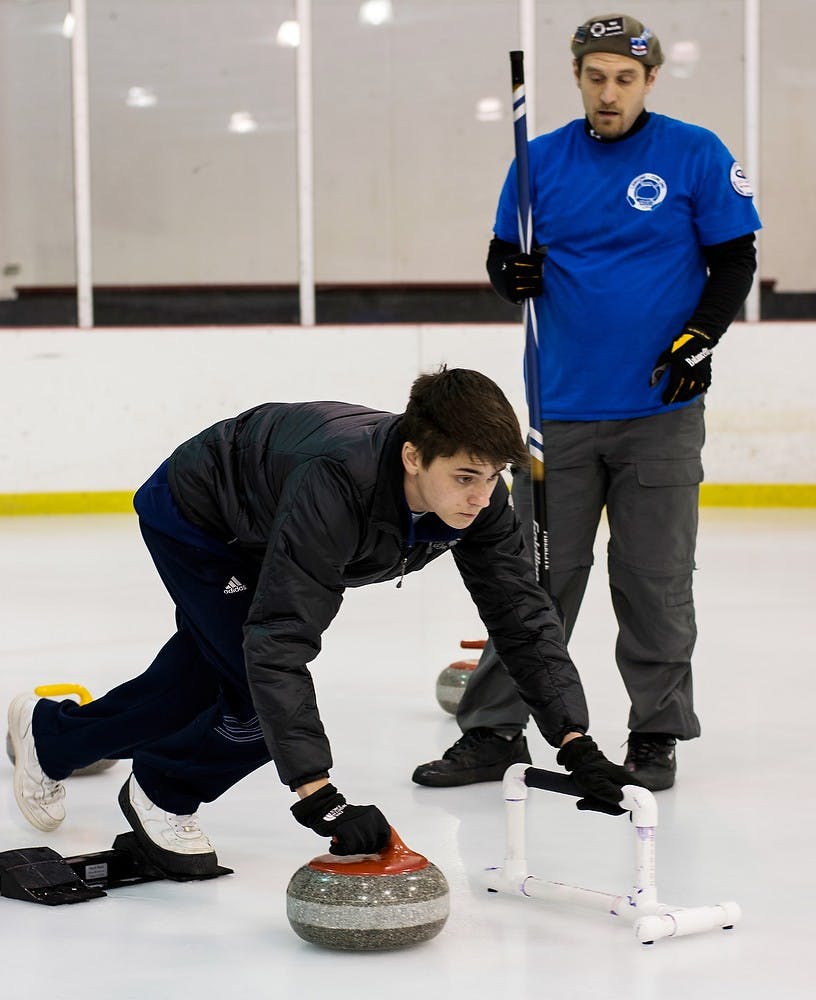
With the buzz of the Winter Olympics wrapping up and the sport gaining more notice, the Lansing Curling Club held a free “Olympic Learn To Curl Celebration” on Sunday.
The ice arena almost was filled to capacity with participants wanting to experience the sport of curling after watching Canada win both the men’s and women’s gold medals in the Sochi Games.
The sport does not get much attention outside of Olympic years, so Sunday was optimal timing for the event, as visibility has noticeably increased thanks to increased television air time.
“Timing is key,” said Gerrit Smith, a curling club board member. “Every four years, curling gets a big boost. Everybody watches in the Olympics and goes ‘Oh, that’s pretty easy to do,’ and they come out here and it’s a little more challenging than they think.”
Past club president Andy Mayville said the group was created shortly after the 2010 Vancouver Winter Olympics to bring attention to the sport in this part of the U.S.
The goal of curling is to earn points by placing stones close to a target area without having the stones knocked away by the opposing team. The team that scores the most points wins.
“It combines chess, horse shoes and shuffle boards, and it combines that on ice,” Mayville said. “There’s a lot of strategy to this sport.”
Getting acquainted with the sport and the equipment is the first step, though, club secretary Lisa Hamm said.
“We wanted to have an opportunity for everyone who’s seen it for the past two weeks and gotten really excited, and finally done a Google search and realized ‘Oh, there is curling in Lansing,’ to get a chance to come out and step out in the ice and find out just how much fun it is,” Hamm said.
Most people think each person only has one job in curling, but Smith said everybody does everything. Each person throws two stones, and everybody does a little bit of everything for the other tasks.
“This is kind of the cool thing: If you’re not good at one aspect, maybe you’re a good sweeper, or you’re the strategist — so you can be the skip and things like that,” Smith said.
Ultimately, he said the goal is “to have the hammer,” which means to throw the last stone. Placing the stone to the team’s advantage earns the team two points.
“You’re trying to think in advance (about) ‘How can I get my one point if I’m going first or two or more if I’m going second at the hammer?’” Smith said.
For the event, participants tried to master setting up on the hack — the takeoff point — pushing their foot off from there, and gliding on the lunge position to “throw” the rock, or slide it up the ice toward the target area.
One of the attendees, Matthew Maki — a first-time curler and resident of Jackson, Mich. — said he did not expect the number of people that showed up, noting the crowd was quite large.
“Curling isn’t exactly something we all grew up doing around here, but a lot of people seemed to be interested in it,” Maki said. “I think balance is definitely the toughest part, you sort of forget that you’re on a slippery surface, and just to maintain it, that’s hard.”
Mayville said after the rock is thrown, sweeping clears the path for the stone to go wherever it will earn the team the most points.
“It polishes the ice in front of the stone and it creates a layer of water,” he said. “What that does is it makes the stone go faster and straighter, so in essence, when you sweep, you’re steering the stone and controlling its speed.”
Although curling might look like an easy sport, the event showed people there how difficult it is to get used to the movements and the techniques involved.
“It’s an easy sport to learn, but it’s a difficult sport to master,” Mayville said.
Support student media!
Please consider donating to The State News and help fund the future of journalism.
Discussion
Share and discuss “Curling gains notice” on social media.