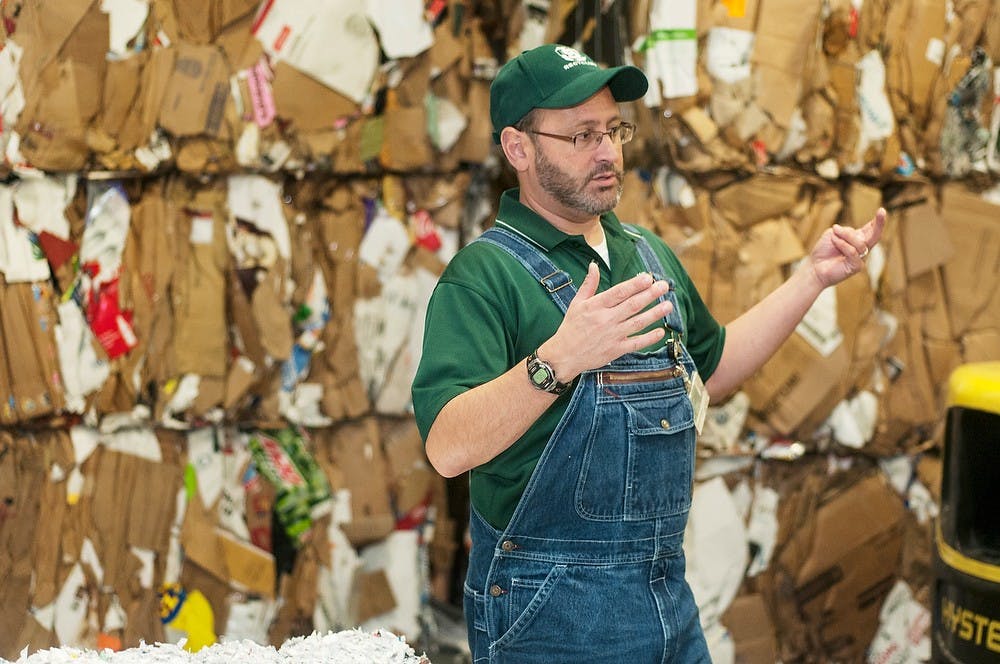
As part of Campus Sustainability Week, the MSU Recycling Center hosted an open house that featured a composting and organic food presentation to teach students and staff more about organic farming.
The open house served as an opportunity for students to learn about the positives of composting and the differences between organic and non-organic food options.
The presentation at the event was delivered by horticulture professor John Biernbaum, who teaches five courses in student organic farming, composting and crop production.
Biernbaum said worm composting plays an important role in organic farming because the worms help refertilize the soil.
At the event, Biernbaum also went into detail regarding the reasoning behind the price differences amongst organic and non-organic foods.
“I ask them, ‘why is the price so low for non-organic food?’” Biernbaum said. “They’re not just charging more because it’s organic food, and it’s limited. The goal is to have affordable food, but farmers still need to make a living.”
Biernbaum also said organic farming is a more evolved option compared to industrial farming, and it’s more sustainable.
Lauren Olson, project coordinator at the Office of Campus Sustainability, added that there are hidden fees many aren’t aware of when purchasing industrial agriculture goods.
“There’s a high cost that goes into industrial agriculture that’s not being included into what you’re paying for your food,” Olson said.
Outside of the presentation, David Smith, MSU’s waste reduction coordinator and coordinator of the event, was on hand Monday afternoon to help students and staff learn more about the Recycling Center’s main goals.
“The recycling center and surplus store is responsible for the end use of all items of campus,” Smith said. “We look at everything that comes into our facility. If we can’t resell the items, we reuse them.”
The Recycling Center embodies environmental sustainability through its design with many perks. The building consists of recycled carpet, volatile organic compound paint and tables made of recycled glass and metal. The center also uses solar panels on the roof and rainwater to power washers and wash out toilets.
The many environmental friendly options at the center have helped reduce water waste. 57 percent of waste was diverted in 2011, according to a poster featured at the event.
The center will continue to host events similar to the open house throughout the week to promote campus sustainability, including an Energy Transition Town Hall and Recycled Floral Arrangement Workshop on Tuesday.
Support student media!
Please consider donating to The State News and help fund the future of journalism.
Discussion
Share and discuss “Recycling Center to host numerous events this week” on social media.