MSU dining hall customers are continuing to improve producing less food waste annually, and this year no different.
Clean Plates at State, the food waste reduction and sustainability initiative of Culinary Services, has seen a reduction in food waste at the dining halls from last year to this year.
“We wanted to figure out how to be more sustainable and responsible,” Residential and Hospitality Services Sustainability Officer Carla Iansiti said. “Reducing food waste helps keep the cost of food down.”
According to Eat at State, the program consists of waste audits done in the spring semester at the various dining halls on campus, analyzing customer behavior and the amount of food waste. The audit utilizes electronic scales that weigh each customer’s plate subtracting a tare allowance for each type of plate across campus. Not every dining hall saw a decline in food waste per customer, however overall, the average amount of food waste fell from 3.9 ounces per customer in 2012 to 3.7 ounces in 2013.
“We are trying to coordinate a complete plate, by identifying portion control versus serving size,” Iansiti said.
As the largest cafeteria on campus, Brody Square has initiatives to reduce waste and contribute to sustainability for Culinary Services.
“Waste management and recycling are key to being sustainable,” Brody Square Sous Chef Joe Murphy said.
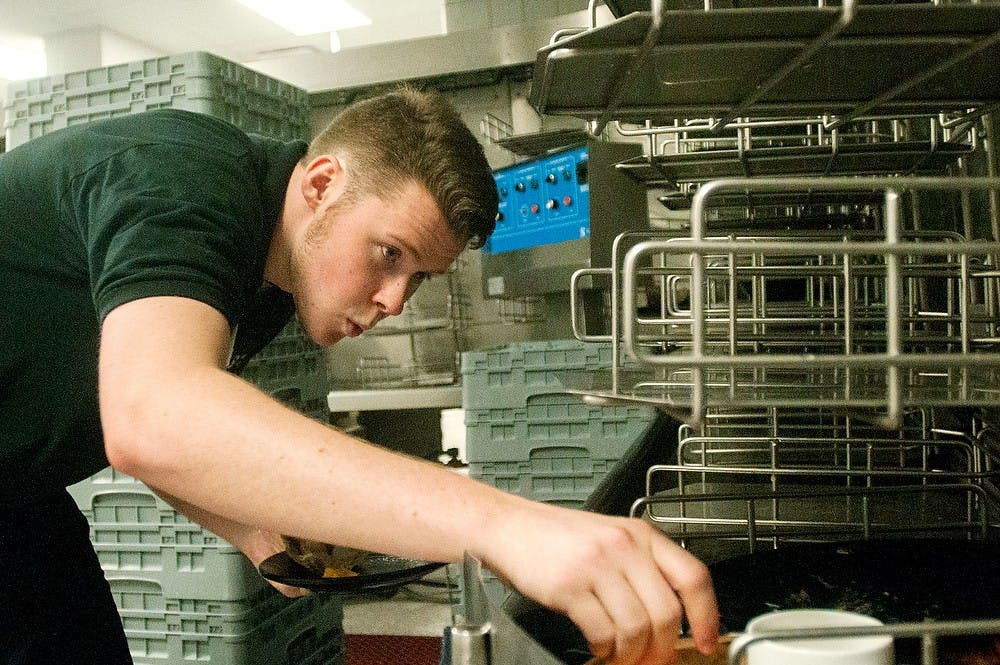
Murphy pointed out that it is a challenge to feed so many people and to clean up after them, but having the right hardware helps to cope with the challenge.
“The pulper, part of the post-consumer waste management system we have, here is similar to what you see on a battleship, or a nuclear submarine,” Murphy said. “It’s essentially a huge garbage disposal, it helps us keep our waste down. We only produce two trash bags of waste a day.”
Murphy also indicated that portion control also helps cut down on waste, and identifying portions versus serving size, citing that limiting the portions is essential to reducing food waste.
“We have determined that smaller plates and smaller portions help,” Murphy said. “If you’d like more (food), please come back or ask for it. We want to work with the customer. We try to have a direct point of contact with each and every customer.”
Lauren Opeka, an advertising junior, indicated that she has noticed there is a change in the perception of food waste.
“There is almost a pressure to clean your plate,” Opeka said. “When you go up to put your tray and plates away you feel bad having food on it.”
While equipment and portion control contribute to sustainability, customer attitudes and awareness are central to cutting down food waste, Iansiti said.
“There is definitely more educational awareness,” Iansiti said. “Students are becoming more aware and knowledgeable.”
Support student media!
Please consider donating to The State News and help fund the future of journalism.
Discussion
Share and discuss “Clean Plates at State initiative continues to see less food waste” on social media.