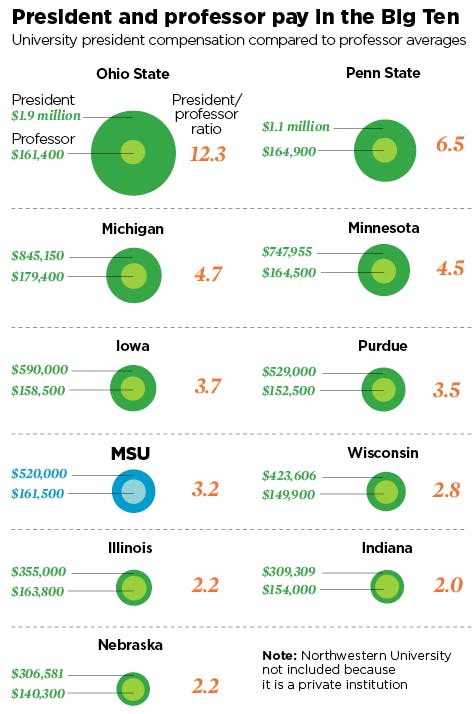
The Chronicle of Higher Education released a report Sunday detailing the professor and president pay for universities. Faculty Senate Chairman and Steering Committee Chairman John Powell, Associate Provost and Associate Vice President for Academic Human Resources Theodore Curry and University Spokesperson Kent Cassella provide insight on the results of the report from faculty, recruiting and administrative standpoints.
Q & A with Powell
How do you think MSU’s competitiveness among other Big Ten schools is affected by the amount professors are paid?
Powell: Compensation is always a consideration when one applies for a job. Obviously, we want to get the highest quality people we can. When it comes to faculty and recruitment, usually young faculty look at the university and salary as important. But they also look at the college in their research domain and what would be (most beneficial) to accomplish their agendas for their careers. They’re looking for a lifetime fit. Compensation is a very important part of it, but I don’t think it is always a driving force. I think we’re still very competitive because of the quality of programs we have on campus, the programs and the diversity we have to help the faculty develop.
Has there been any struggle for the faculty to receive compensation in the last decade? If so, what relevance or struggles do you see today?
Obviously compensation is tied to the economic environment of the state of Michigan. When the state of Michigan is in the economic troubles we’ve gone through in the past 3 years, salaries are affected. The economic impact of the country has a big economic impact on the salary structures of the university. Are we concerned? Sure, but so is everyone else in the country. It is a matter of working through the issues and doing the best we can in the confines of the structures that dictate our position.
Q & A with Curry
How do you think MSU’s competitiveness among other Big Ten school’s is affected by the amount professors are paid?
Curry: We strive to be in the middle of the Big Ten in terms of total compensation. In part, as a result of the budget over the last few years, we’ve slipped a bit. But I don’t believe it has affected our ability to recruit the high quality faculty we have and continue to recruit to MSU.
When you look at hiring faculty, we have to hire faculty at or near the market, or they wouldn’t come to MSU. If our salaries were out of line, it is doubtful the other factors would allow us to attract the high quality faculty we are attracting. For example, if you take our industrious psychology program or our nuclear physics program, which are ranked No. 1, there are certainly people who would accept a little bit less to come to a No. 1 ranked program. Still, if our salary is out of line, it is unlikely you can overcome that simply because of the reputation of the program.
What effect would you say salary and compensation have on bringing new faculty into MSU and maintaining MSU’s competitive position in the Big Ten?
It is a concern but there is no reason to believe it is adversely affecting our ability to attract a high quality staff. Salary certainly is a factor when deciding on a position. But I think people look at total compensation, which includes salary, includes benefits, includes the colleagues they’ll be working with and includes the kind of research and scholarship in which they can engage. They look at the community they will be coming into, and increasingly they look at issues such as partner hiring or a partner acclimation programs — there are a host of factors that get looked at. Salary certainly is an important one, but it isn’t the only one.
Does faculty compensation affect the university in any other ways?
The bigger effect is our ability to retain high quality faculty, in that some of your more mobile faculty — and these are people who are mobile because of their accomplishments — there is the potential they could be recruited to other institutions. I believe we get affected more at those levels than we do at initially hiring new faculty.
Q & A with Cassella
How does the university president’s compensation affect the competitiveness of MSU among Big Ten universities?
Cassella: (Lou Anna K. Simon’s) annual salary is approximately in the midrange of all Big Ten presidents. That keeps us as a benchmark because we are competitive among our Big Ten peers.
The (MSU) Board of Trustees has tried to increase her compensation.
President Simon hasn’t had a salary increase since December of 2007 … She continues to decline any increase in her salary. She and her husband Roy Simon (director of telecommunications and transportation) have a long history of giving back to MSU. Their annual giving has totaled more than half a million dollars since she’s become president. … I think that speaks volumes.
Support student media!
Please consider donating to The State News and help fund the future of journalism.
Discussion
Share and discuss “Face Time with MSU Officials ” on social media.