Mark Hollis believes he’s an educator — and with good reason.
With hundreds of student-athletes at MSU each year, the athletics director heads a program responsible for the growth of those students academically, socially and athletically.
Mark Hollis believes he’s an educator — and with good reason.
With hundreds of student-athletes at MSU each year, the athletics director heads a program responsible for the growth of those students academically, socially and athletically.
“When an individual becomes a Spartan, I think it’s our responsibility to educate on the front end and to make corrections in the classroom or the social environment,” Hollis said.
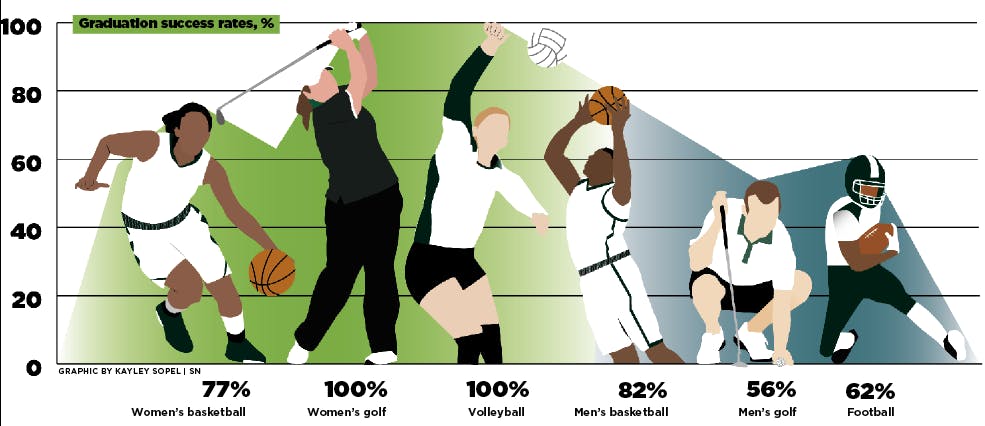
Despite some variation in assessing athlete academic success, Hollis and his colleagues say the department is succeeding at the best rate MSU has ever seen. Numbers reported last week by the NCAA show an 83 percent Graduation Success Rate, or GSR, for scholarship student-athletes, a number above the national average.
The GSR is a way of computing graduation rates for athletic departments for about 200 student-athletes with scholarships. Because the scholarship-athlete population is smaller than the general student population, and because the GSR accounts for athletes leaving school early, the metric isn’t comparable to the Federal Graduation Rate used to measure overall. Using the FGR metric, MSU’s student-athletes are graduating at a rate of 70 percent, compared to 77 percent for the overall student body.
Continuously improving
Despite the athletics department’s highest numbers ever, Hollis isn’t going to settle for the current numbers.
He’d like to see improvements in numbers from programs such as football and men’s golf, which were at 62 percent and 56 percent GSR, respectively.
“It’s like anything else, there’s always room for improvement,” Hollis said. “Football is one area where we want improvement. They’re kind of in the bulk of the Big Ten, but we have had consistent improvement over the past five years … consistent improvement is going to get you where you want to be.”
Despite the few seemingly struggling programs, MSU still exceeds the new standards recently approved by the NCAA. The NCAA recently reformed eligibility requirements to include a 2.3 GPA — up from a 2.0 — and an Athletic Progress Rate, or APR, of above a 930 — up from 900 — for a program’s postseason eligibility. APR is a standard used to track the current retention and eligibility of student-athletes. All of MSU’s athletic teams stand above the 930 mark based on 2009-10 numbers, and MSU holds an institutional number of about 975, said Associate Athletics Director for Student Services and Director of Student-Athlete Support Services Jim Pignataro.
Although the sweeping changes by the NCAA have brought academics to the forefront, Pignataro said MSU won’t make any drastic changes to what’s already in place.
“From Michigan State’s perspective, we’re actually making no adjustments,” he said. “We understand how the numbers are calculated. We feel we have elite programming.”
To help improve the student-athlete learning experience, MSU created the first academic center for Division I athletes in 1998 with the Clara Bell Smith Center. The center includes tutorial program, academic mentors, learning specialists and a rigorous tracking system, Pignataro said.
“That makes us a little unique,” he said. “Michigan State has been committed to providing really elite resources to our student athletes.”
But MSU officials still keep the academics of athletes within the athletic department, and there are groups, such as The Drake Group, who advocate for greater transparency in student-athlete academics.
Former president of The Drake Group Kadence Otto said the group is happy with the NCAA reforms, but much more can be done. Otto also is a professor at Western Carolina University.
“We would like to have certain institutional structural changes such that the graduation rate would increase, but more importantly the general education of an athlete would improve,” she said.
The students
Although stereotypes of lazy and apathetic student-athletes exist, they’re much like the rest of the student body, Pignataro said.
More than 100 majors are represented within the athletics department, and cumulatively the students hold a 3.0272 grade point average, he said.
Former men’s soccer player Colin Givens said he definitely noticed a negative attitude from the general student body. Givens left MSU last January to pursue a professional career and is trying to finish his degree following an injury setback. As a student-athlete, he found professors who were both lenient and strict against his hectic day-to-day practice and game schedule, and often had to work harder, burning the candle at both ends.
But he also said there is some justification of the negative stereotypes. As a student without the added focus of playing soccer, Givens said it’s easier to focus on studying in class.
Support student media! Please consider donating to The State News and help fund the future of journalism.
“I would say 90 percent of student-athletes that I know put their sports first, that’s why we’re here,” Givens said. “I wouldn’t be at Michigan State if it wasn’t for soccer, so therefore I had to focus on what got me here.”
Hollis said he believes student-athletes are held at a different level than the general student body, but for a reason.
“It’s a privilege to compete in interscholastic athletics, and whether you’re talking about graduation rates or behavior, you should be accountable,” he said.
Both Hollis and Pignataro said athletes are aware of the importance of degrees and more are coming back to finish their degrees following any athletic careers.
“I have one-on-one conversations with many athletes to get them to come back to finish,” Hollis said.
Following a seven-year NFL career with four teams, former MSU football player TJ Duckett is back at MSU for an indefinite education.
“Knowledge, wisdom, everything is very important to me,” he said. “It’s a 10-year commitment that I made, and I want to live up to my word and be true to myself.”
For more on this story, check out the Academics and Administration blog.