During their middle school days, Nangea and Kuya went through the typical day without anything to eat.
As they reached high school, they were introduced to an education system where the rules were strictly enforced. If a student disrupted class, it meant expulsion.
“Life has been very challenging in the village,” Nangea said. “In Kenyan schools, you have limited opportunity — it’s like survival of the fittest.”
It was through these struggles that they found the courage and drive to do something great — a mission that has led them to pursue degrees at MSU to help lead their country out of economic despair during changing political times.
A changing vision
Since Kenya gained independence from Britain in 1963, a constitutional reform has been a major topic of discussion since the centralized government was poorly constructed and created many problems throughout the country.
Nearly two years ago, the people of Kenya decided it finally was time for change.
In spring 2010, the Kenyan government passed a new constitution, which Nangea said paved the way for the country’s division into counties. The citizens’ vision for change finally became a reality.
“Hopefully it will improve the overall standard of living for the average person,” said Morompi Ole Ronkei, Nangea’s uncle and a relative of Kuya, who lives in Kenya.
Although constitutional reforms still are in the process of implementation, the country has been divided into 47 counties, which operate separately from the central government and each are headed by their own governor as a way to provide a checks and balance system for the government.
Nangea and Kuya said they hope to contribute to the future success of their country by bringing home outside knowledge they gain at MSU and applying it to the areas in which Kenya needs improvement.
“I feel like it’s a great opportunity for Kenya to develop,” Kuya said.
Although many citizens in Kenya believe this new constitution ultimately will bring prosperity to the country, Ole Ronkei said it might not meet people’s expectations.
“I fear that we might be expecting too much from this new constitution,” Ole Ronkei said. “There is a lot of hope on that piece of paper.”
Since development within Kenya is now controlled at the county level, Ole Ronkei said the major challenge will be finding a sufficient number of qualified people to take leadership roles.
“We are scrambling to put our young people through college in hopes that they become the brains that will run out country,” Ole Ronkei said.
Stepping up
The process of applying and getting admitted to MSU was another challenge for Nangea and Kuya.
When Peter Briggs, now director of the Office for International Students and Scholars, was teaching at the University of Oregon, he built a relationship with his student Ole Ronkei.
As one of the handful of Kenyan citizens of his generation to receive a formal education, Ole Ronkei had plans to improve Kenya’s economy through helping young adults find similar opportunities.
Support student media!
Please consider donating to The State News and help fund the future of journalism.
“I am always looking for opportunities for young people in my country to do better,” Ole Ronkei said. “You could say it’s my life mission.”
After catching word of Brigg’s current job at MSU, Ole Ronkei saw the opportunity to network. He contacted Briggs and set up a meeting with the Office of Admissions to see if there were potential opportunities for Nangea and Kuya, who had just graduated from high school in 2009.
The boys, excited by the opportunity, set out to complete their MSU applications. After travelling the long 35 miles on multiple occasions to access the nearest computer to their village, they completed their applications and waited — which seemed like forever — they received an email from MSU.
They were in.
“I convinced the Office of Admissions that they would be transforming humanity by admitting my two Maasai boys,” Ole Ronkei.
In Nangea and Kuya’s community, education is regarded as a foreign concept and is not necessary for survival.
But both knew at an early age it was something that they wanted to pursue.
Being the first generation of their families to receive a formal education pushed them to try even harder for success.
“Kenya reached a point where people started seeing the importance of going to school,” Nangea said. “We need more people with quality higher education.”
Although MSU is covering their tuition costs, Nangea and Kuya still had to come up with money for room and board.
They set out on foot, going door to door in their Kenyan community, asking for money.
“The good thing about Maasai people is they’re not very hard to convince,” Nangea said. “They don’t debate education.”
Culture shock
When they finally stepped foot on MSU’s campus this August, Nangea couldn’t believe he was actually here.
“It was a dream come true,” Nangea said. “We struggled a lot to get here — it’s a new life.”
Although they’ve only been at MSU for one semester, Nangea and Kuya said they already have learned a lot through their experience.
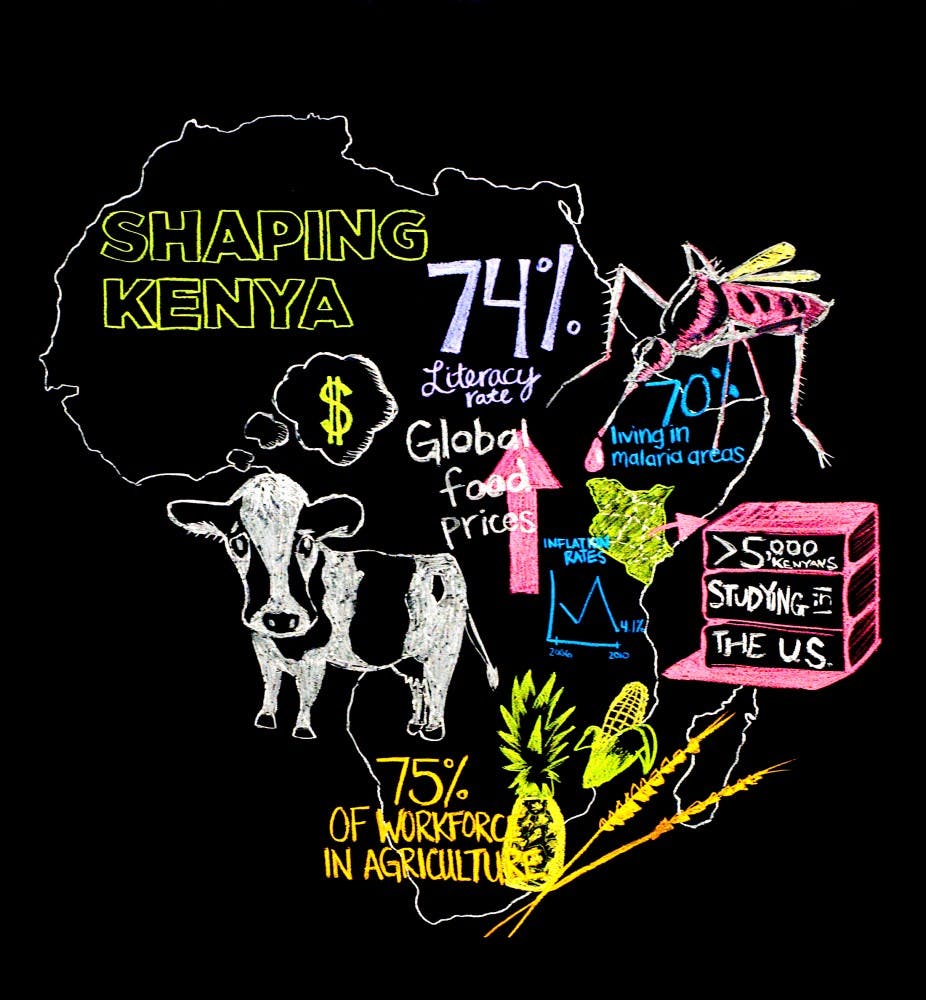
Since Kenya is an agriculturally based economy, Nangea, now an agribusiness management freshman, said he would like to use his education to help solve the food security problem back home.
“At first, it was like culture shock,” Nangea said. “The good thing is, whenever we accept a challenge, we become humble.”
With his new class schedule, a job in Hubbard Hall’s cafeteria and a volunteer position at East Lansing High School, Nangea said he is starting to feel comfortable in his new home.
“So few people get the opportunity to go to college in our village … Most people herd cows — that’s life” Nangea said. “I wanted something different.”
Kuya, now a physiology freshman, said he has big plans for his professional future.
After completing his undergraduate degree, Kuya said he hopes to move on to medical school and receive a doctoral degree, just like Ole Ronkei.
“Malaria is a major problem in Africa,” he said. “I want to help save the lives of people who suffer from the disease.”
Although Kuya is doing well in his classes so far, he said he feels an immense amount of pressure from MSU and his community back home to succeed since they are the reason he ultimately is able to pursue his life goals.
“Sometimes you feel like everybody is watching you,” Kuya said. “Everybody is expecting something great from you.”
Ties with MSU
With 33 students from Kenya currently studying at MSU, their presence — although small in comparison to the student population — helps create a strong sense of diversity on campus, said MSU President Lou Anna K. Simon.
“We hope students who come from anywhere on the globe will take advantage of the cultural richness found on Michigan State’s campus,” Simon said. “We’re in a globally connected society.”
MSU’s connections to Africa extend far beyond campus, said Deogratias Ngonyani, an associate professor in linguistics.
The university is involved in various activities in Africa including multiple research projects and study abroad programs with more than 10 African countries.
Academic research and hands-on experience is necessary to fully understand another culture, he said.
“The world is like a village; we all interact in one way or another,” Ngonyani said. “An understanding of Africa will give people a better understanding of how the world works.”
Briggs’ said his office serves as the backbone of the students’ support system at MSU, and the chance to help the Kenyan region is an exciting opportunity.
“It will be very powerful as they’ve seen different lifestyles in the wealth we have here and value systems — they are going to be forever straddling worlds,” he said.
“I think they are in a position where they really appreciate what they’ve got.”
As for Nangea and Kuya, Ole Ronkei has high hopes they will return with the skills to help make a difference in their home country.
“I have a lot of hope for those two young boys,” Ole Ronkei said. “I honestly see them becoming national leaders in Kenya.”
Discussion
Share and discuss “Shaping Kenya” on social media.