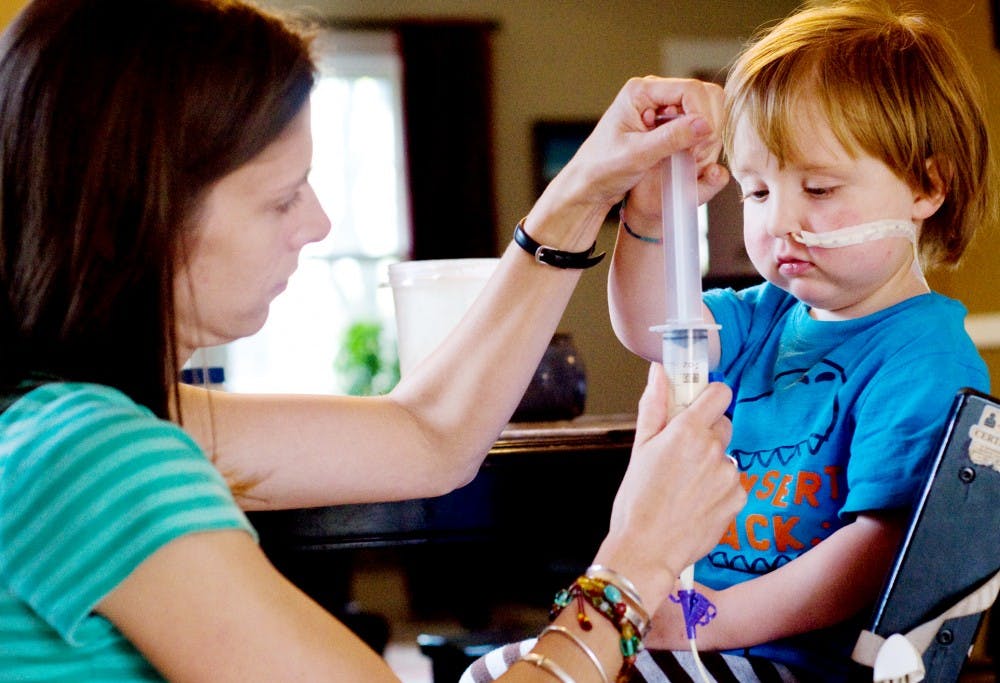
On Tuesday morning, Abigail Waller rushed her 3-year-old son to Lansing’s Sparrow Hospital to check if his feeding tube loosened in the night.
Sipping tea and waiting for their return, John Waller was unfazed.
For John, it was one of many trips the couple has made since their son Charlie was diagnosed in April with diffuse intrinsic pontine glioma, or DIPG — a rare and inoperable cancer that grows in the brainstem.
Typically, children with DIPG live about a year after their diagnosis.
With few options for treatment John and Abigail decided to try a ketogenic diet, where Charlie is fed mostly fatty foods.
This deprives the tumor of nutrients it needs to grow and might shrink the tumor. The diet was proven effective in mice but has not yet been proven successful in humans.
Despite the uncertainty of Charlie’s diet, his parents can’t turn away from a treatment that could save their son’s life, John said.
But measuring every drop of water and each gram of food is wearing on them.
“I feel that we should continue, but I don’t think I feel comfortable continuing,” Abigail said. “I feel huge amounts of anxiety not knowing how to feed my child, and when I do feed him, it’s pepperoni, butter, oil, mayonnaise and cream cheese.”
Living with uncertainty
Without more evidence of the impact the diet will have on the tumor, the family is moving forward blindly, John said.
Charlie turns his nose to most of the food in the diet, and making each meal is often a two-person job.
With fewer carbohydrates, his chubby cheeks have thinned.
“He’s going to lose weight — that’s inevitable of this diet,” said Charles Sweeley, a university distinguished professor emeritus who first recommended the diet to the Waller’s. “(It) doesn’t mean he’s in danger, though.”
Sweeley is working with a group of MSU professors and Sparrow doctors to research the effects of the diet on adult cancer patients.
Physically, the diet has been proven safe, Sweeley said.
But Charlie’s parents said it can be draining.
Unlike other cancers, the DIPG cells are spread like grains of sand throughout Charlie’s brainstem, making it difficult to see minute reductions or growths in the tumor, Sweeley said.
“The difficulty is we can easily assess what’s on the negative column, but have no way of assessing what’s on the positive column,” John said. “You can’t make a rational, informative decision.”
Support student media!
Please consider donating to The State News and help fund the future of journalism.
If the diet proves effective, it could be used to help children diagnosed with DIPG around the world, Sweeley said. Still, the effects haven’t been proven in children yet.
“It gives them something to have some hope for, and …it might even work,” Sweeley said in a previous interview. “It may not do anything other than stall the growth of it and prolong Charlie’s life. On the other hand, it might be more profound than that.”
Although the chance of success helps the Wallers move forward, the possibility that it will be fruitless keeps their hopes in check, Abigail said.
“You can’t help but think (the doctors and specialists are) doing this to appease us,” she said.
A normal life
For the family, the start of school means a chance to regain the normalcy they lost the day doctors told them their son would die in weeks without radiation therapy.
John began teaching at the university Wednesday, and Charlie’s 7-year-old sister Esther begins school next week.
Charlie’s mother took a leave of absence from her job.
Although other professors took over John’s classes in the spring after the diagnosis, he taught an online class this summer and is looking forward to teaching more. The brief time he spent with his students was uplifting, he said.
Members of the department have been invested in the Waller’s wellbeing since Charlie’s diagnosis.
Associate history professor David Bailey drove to meet the Wallers in the hospital and bought Charlie’s third birthday cake.
If John is overwhelmed by work and taking care of Charlie, other professors in the history department are ready to teach his classes, Bailey said.
“The department itself has been changed by this, too,” he said.
In late September, Charlie’s parents plan to enroll him in a special education program at Pinecrest Elementary School, 1811 Pinecrest Drive, to help him develop stronger language and motor skills among other children dealing with impairments.
“I think it will be good for him to be around children with special needs,” Abigail said. “That’s his normal.”
Although Charlie is excited to ride buses and go to school like his older sister has, Esther fears leaving her family to go to class, her parents said.
She suffers from separation anxiety and asked her father to work from home this summer to spend time as a family, Abigail said.
“(She’s) a young child wanting to figure out how to control this world you can’t control,” she said.
Still, after a few weeks of school Esther and the family should be more relaxed, Abigail said.
“I think there’s enough normalcy that we don’t feel we’re in a very painful dilemma at the moment,” John said.
The days ahead
The family plans to keep Charlie on the ketogenic diet for about two more months to see if it has been effective in shrinking the tumor.
In the coming months, his parents will assess whether or not the $20,000 they fundraised this summer will be enough to pay for medical expenses. The funds are quickly dwindling.
The money has helped them think of creative ways to help ease the pain and stress they deal with, John said.
John and Abigail have considered buying an iPad so Charlie can better communicate when he begins classes. He struggles to vocalize his discomfort, but using pictures might be easier for him, they said.
“We’ll be thinking of things like that, which we wouldn’t if we didn’t have that money,” he said.
Although the dietary supplement Charlie eats through the feeding tube has been covered by their insurance, they’re unsure if they’ll need to pay for it in the future.
Future medical expenses could cost hundreds of dollars.
But for now, they’re focused on enjoying their time together and not succumbing to the sadness that threatens to overpower them.
“I cannot have any more badness come out of this — it could continue to have a ripple effect forever,” Abigail said.
_For more information or ways to help, visit www.friendsofcharlie.com
Discussion
Share and discuss “A chance for Charlie” on social media.