Karen Klomparens feels that the demands of today’s job market clearly differ from years past.
To her, today’s market reflects the growing need for a well-educated “knowledge economy.”
Karen Klomparens feels that the demands of today’s job market clearly differ from years past.
To her, today’s market reflects the growing need for a well-educated “knowledge economy.”
Unlike 50 or 60 years ago, more than ever before fields require higher qualifications and more education, which is something Klomparens — the dean of MSU’s Graduate School — said has pushed greater numbers of students toward advanced degrees.
“I think because our knowledge has gone up in areas … you just simply have to know more to be a useful employee,” she said.
Klomparens isn’t alone among educational experts, and recent trends indicate as much.
In the U.S., nearly two times as many people hold an advanced degree — either a master’s, professional, or doctorate degree — now than in 1990.
Fall enrollment of graduate and first-professional students also has increased 57 percent over the same time period, according to a report by the National Center for Education Statistics, or NCES, and in 2009, more than 17 million people carried an advanced degree in the U.S.
In the same year, enrollment of new students in graduate schools increased 5.5 percent, a 1 percent jump over the year prior.
Even with a sudden flood of well-qualified individuals into the job market, an MSU advanced degree still remains highly valuable to some.
“MSU has a noted reputation at the graduate level for excellent programs,” said Stefan Fletcher, president of the school’s Council of Graduate Students. “MSU has several programs that are ranked first in the nation, and MSU is rapidly rising when it comes to the business school, the law school, the science and technology field. That’s where the kind of economy of tomorrow is headed.”
Rising benchmarks
With the nearly twenty-year rise in advanced degree graduates still on-going, Fletcher believes the job outlook and expectations for many graduate students could change as well.
“It definitely, I think, makes it more competitive,” he said. “The quality of the institution you go to and the quality of the program you go to become major factors.”
In every significant area, from bachelor’s degrees on up, the percentages of both men and women with a degree are climbing.
Almost a million more people have doctorate degrees now than in 1990, and about the same proportion of people have an advanced degree now that had a bachelor’s degree or higher in 1960, something that could be reflective of increasingly stringent demands made by employers.
A report issued by the Commission on the Future of Graduate Education indicates that, by 2018, the number of jobs requiring an advanced degree will jump by about 2.5 million. For doctorate degrees alone, the number of jobs demanding those qualifications is expected to spike about 17 percent.
Some experts fear this trend could continue, making an advanced degree a necessity even for jobs that oftentimes used to require somewhat normal qualifications.
“There’s mixed parts of advanced degrees,” said Eric Hanushek, a senior economist at the Hoover Institution at Stanford University. “Part of it is a number of people are trying to distinguish themselves from other graduates.”
Looking inward
Several university programs still carry the school’s graduate mission onward, even as more candidates enter the job market with advanced degrees.
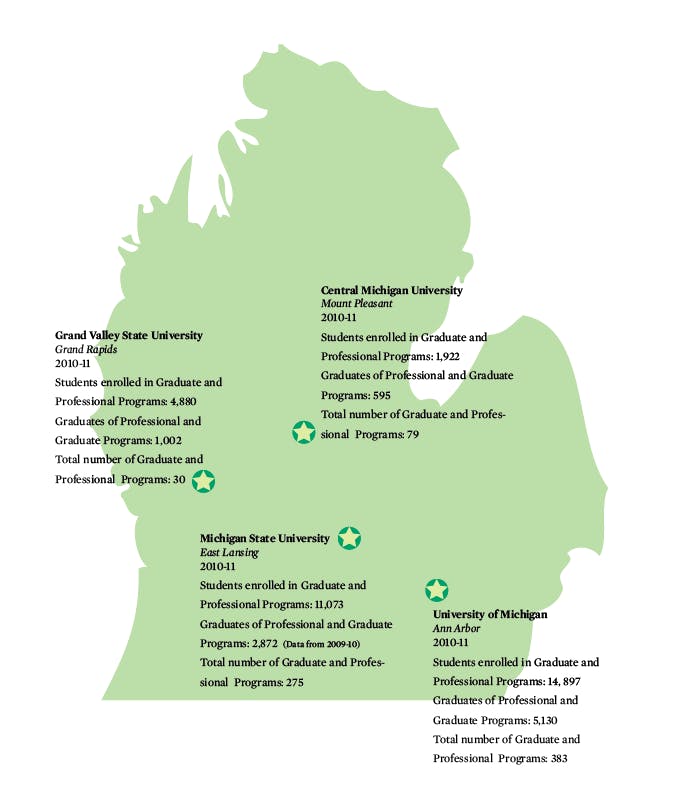
MSU’s nuclear physics graduate program, and the institution’s elementary education and secondary education graduate programs were ranked tops in the country in 2010 and 2011 respectively, according to rankings from U.S. News and World Report.
Those strong showings contradict the fact that only slightly more students have been studying toward doctorate or master’s degrees in recent years at MSU, after an uptick in the late 90s.
Support student media! Please consider donating to The State News and help fund the future of journalism.
At MSU, only 4.6 percent of all degrees awarded in 2009-10 were doctoral degrees, and 17.5 percent of all degrees were master’s degrees.
With fewer drastic upward changes than the national average, graduate school officials say they’re working harder to retain more students and prevent dropouts.
Governmental assistance is part of that package, but Val Meyers, the associate director in MSU’s Office of Financial Aid, said graduate financial aid most often comes in the form of federal government loans, some of which have come under fire as President Barack Obama and U.S. finance officials have slashed excesses from the budget deficit.
Efforts to force the country’s debt ceiling upward centered around cost-cutting measures, some of which targeted federal financial aid programs, including subsidized student loans. Those will be chopped from assistance packages starting next July.
“There are other resources outside of federal aid that graduate students use, but they’re things like teaching assistantships or research (assistantships),” Meyers said. “Those are work-type aid programs, but they’re not federal aid.”
Meyers said oftentimes, many graduate students rely on things such as teaching assistantships for major funding, but even those opportunities — particularly for international graduate students — aren’t as readily available as they once were.
“My rule of thumb has always been the number of international graduate students is always directly related to the number of assistantships (available),” said Peter Briggs, MSU’s director of the Office for International Students and Scholars. “If we aren’t in a budget-cutting mode … then the number stays strong.”
Although enrollment of international graduate students at MSU hasn’t spiked dramatically, many advanced-degree holders continue to reside in the U.S. after graduation, a move experts say drives the labor market.
“Even though there has been an increase in the number of folks with advanced degrees, we haven’t seen a collapse of their wages,” economics professor Charles Ballard said in an email.
That upward surge has, Ballard said, led to a large increase in the earnings gap between workers with varying levels of education.
Some advanced-degree graduates, on the other hand, are forced to leave the U.S. because of immigration restrictions, rules that Ballard said underscore a greater problem in the country’s policies.
“We provide top-notch education for foreigners, and then we send some of them back to their home countries so they can very effectively compete against us,” Ballard said in the email.
Crowded competition
Even as qualifications for certain jobs ramp up, statistics indicate students working toward advanced degrees continually flock to the same fields.
In 2007-08, about 31 percent of master’s degree students were enrolled in master of education or master of arts in teaching programs while about 19 percent of that same group were enrolled in master of business administration programs, accounting for about half of all students enrolled in master’s degree programs, according to the NCES report.
Reasons for the surge in interest in both education and business run rampant and could, experts say, stem from numerous factors.
Klomparens said most of the time, students enroll in advanced programs “because they don’t have a choice,” citing changes to many fields — including teaching — that once often required only a bachelor’s degree.
At the master’s level, Klomparens thinks the demand for more qualified workers only will increase, once again citing the ever-growing knowledge economy of tomorrow.
“The requirement is a master’s degree (for some jobs),” she said. “That’s not dilution at all. Everybody who still wants to stay in that field has got to get that degree. If you don’t have that degree, you’re done.”