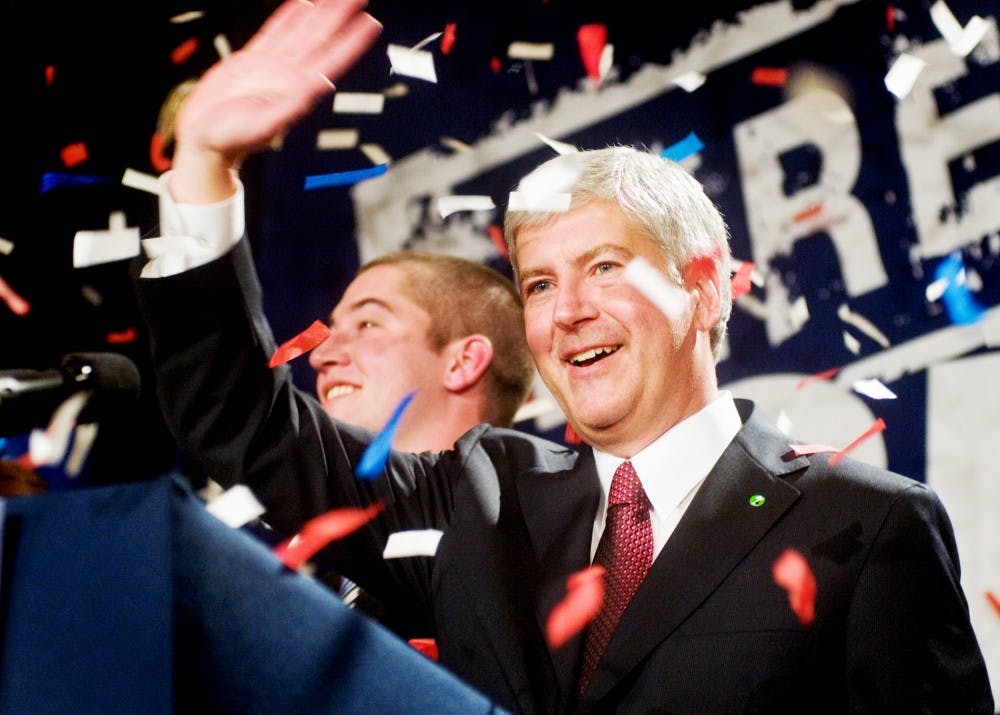
The moves Gov. Rick Snyder made in his first six months in office to cut university funding and impose pension taxes have some Michigan residents worried if Snyder’s plan for reinvention really will bring about the state’s success.
July 1 marked 182 days since the governor took office. In this time, Snyder promised to make major strides in reinventing Michigan, and Bill Ballenger, editor of the political newsletter Inside Michigan Politics, said the governor accomplished tasks at breathtaking speeds.
“He has made much greater strides in getting achieved what he wants than his predecessors at this (point in their incumbency),” he said.
One significant accomplishment made by the governor was the early passing of the state’s budget, said House Minority Leader Richard Hammel, D-Mt. Morris Twp. Snyder achieved his goal of passing the budget for the upcoming fiscal year by May 31. This budget eliminated Michigan’s $1.5 billion deficit but cut funding for the state’s universities by 15 percent in the process.
This decrease in funding for education was a disappointment for many Michigan residents, including Hammel and criminal justice junior Phoebe White.
White said the decrease in funding for universities caused tuition at MSU to increase, making the cost of higher education too much for many students.
“Education should have the most funding because we need students, and we need education and people with good ideas to help the city and the state,” she said.
Snyder also restructured the state’s tax system, eliminating the Michigan Business Tax and replacing it with a 6 percent corporate income tax as well as passing a law that allows the taxing of many residents’ retirement income.
But the public has not responded well to the changes Snyder made. In his firm’s most recent poll, Bernie Porn, president of Lansing polling firm EPIC-MRA, said voters gave the governor a 60 percent overall negative job rating in reaction to his budget cuts and tax reform.
Ballenger said the public must remember Snyder only has been in office for six months.
“He’s kept a lot of the promises he made,” he said. “Not all of them, but he hasn’t had time to keep all of them.”
With time, Ballenger said Snyder’s education cuts also could be mitigated.
“It’s possible if the economy improves — and it already has shown signs of life — maybe the Legislature can go and decide early next year we can restore the cuts we made to K-12 education or higher education.”
Snyder spokesman Ken Silfven said there is no doubt Snyder’s changes eventually will turn Michigan around.
“They were the foundation for the ultimate goal, which is creating an environment to put families back to work,” he said.
To help achieve that goal, natural resource recreation and tourism senior Anne Wardle said the governor could do more to make sure people know all the state has to offer.
“We’re going strong with the Pure Michigan campaign, but (we need to) just make sure we’re pulling in travelers from out of state and not just promoting tourism in Michigan to Michiganders,” she said.
Although he doesn’t agree with the way the governor is going about the state’s reinvention, history senior Michael Press said he applauds Snyder’s work to create new, advanced jobs.
“We’re never going to get back to that golden era of being the Motor City,” he said. “I like (moving toward) the direction of technology (and) green jobs. I think there’s going to be a lot of roles for green jobs.”
Hammel said he would like for Snyder to engage the Legislature — including Democratic party leadership — more.
Support student media!
Please consider donating to The State News and help fund the future of journalism.
“I know for a fact that he’s very passionate and very committed to this state — there’s no doubt in my mind. (But) I think a more bipartisan spirit would be more helpful when it comes to working through issues,” he said.
Silfven said the governor and lawmakers will be very busy the rest of the summer and this fall. Discussions currently are being held about future policy plans concerning health and wellness, transportation and infrastructure, local government reform and education reform, as well as workforce and talent development. The governor also will continue his efforts to get legislative approval for the building of a second bridge from Detroit to Canada.
“We’re not letting up,” Silfven said. “It’s been a very productive six months, but we’re going to keep going full throttle.”
Discussion
Share and discuss “Gov. performance analyzed on day 182” on social media.