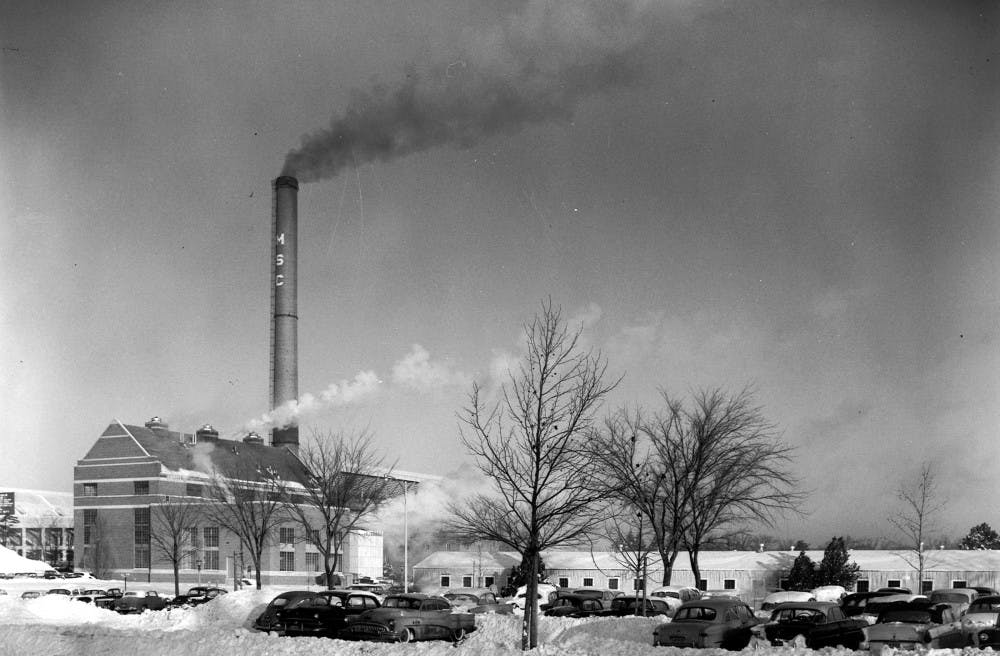
Perhaps the most visible thing to Fideler and others of that part of MSU’s past is the smokestack bearing those initials that stands at the Shaw Lane Power Plant, just south of Spartan Stadium.
Last week, university officials announced their decision to dismantle the smokestack beginning this summer. The Shaw Lane Power Plant will remain intact, and the white bricks that form those initials will be saved, according to university officials.
The structure has stood for more than 60 years and was prominent during Fideler’s time as a student.
“It just really spoke to the legacy of the school,” he said. “It’s part of the history.”
From the ground up
Although the Shaw Lane Power Plant can be seen almost anywhere on campus, it wasn’t the first power plant with a smokestack at MSU.
That distinction belongs to the North Campus Power Plant, which sat at the current site of the Administration Building beginning in 1921. The plant’s smokestack originally said MAC, reflecting the school’s name at that time.
When it became apparent the university would need another plant to meet its growing energy needs, officials selected the Shaw Lane plant’s current site and named the plant for MSU’s 11th president, Robert S. Shaw. The site was chosen for its close proximity to the then-nearby railroad, which ran along the building’s west side. That selection also allowed the north campus plant to be demolished later.
In early 1948, blueprints for the new power plant became a reality. Originally one of the few structures on campus situated south of the Red Cedar River, the initials that featured prominently on the smokestack soon were out of date. On Dec. 12, 1948, Michigan State College was accepted into the Big Ten, and the institution promptly changed its name to MSU.
The 239-foot-tall tower wasn’t part of the original plan though, university engineer Bob Nestle said.
“It was actually a change order on the power plant project,” he said. “When that power plant was first built, there wasn’t any chimney there.”
University officials quickly realized the need for such an addition, though.
“(The plant’s operations) caused so much smoke and cinders across campus that the smokestack was built shortly after,” Nestle said. “That’s why you see that metal breaching on the roof of the power plant.”
With the plant and smokestack up and running, the site served as the school’s main power source from 1948-75. As early as 1963 though, plans were being made to phase out the building’s operations eventually, and in 1965, construction began on what is now the T.B. Simon Power Plant, which began operating at full capacity in that same year.
That left the Shaw Lane Power Plant out of commission in 1975 and put its future in doubt.
A decision to make
Following the shutdown of the facility, it remained an electrical substation for buildings that hadn’t transferred power over to the new plant yet.
“There was at least some effort expended to keep it in an operational mode,” Nestle said.
“It became fairly apparent after awhile that it was not needed.”
As early as 2000, then-Provost Lou Anna K. Simon and other MSU officials alluded to doubts surrounding the smokestack, according to an article from The State News.
Serious talks did not begin until 2010, when the university began weighing the fate of the structure.
That process included the formation of a website in February that allowed alumni, students and faculty members to offer their input on the future of the smokestack, said Scott Westerman, executive director of the MSU Alumni Association, or MSUAA.
Support student media!
Please consider donating to The State News and help fund the future of journalism.
“I encouraged people on social media to go over there and tell us what their thoughts were so we could get a gage of what folks were thinking about,” he said.
The reaction
News of the smokestack’s impending demolition elicited a wide variety of emotions from alumni and students alike.
MSU alumna Robin Spearin is among those disappointed in the university’s decision.
“I think that it was a big part of the skyline — it’s like taking down Beaumont Tower,” she said. “The fact that it had MSC on it was really cool, it was kind of our symbol of the university.”
Spearin remembers the structure vividly from her time at MSU.
“I remember using it as a compass for getting around campus,” she said. “When I think about MSU, I think about trees, Beaumont (Tower), the (Spartan) Stadium, and the smokestack.”
Others were equally downcast but understanding of the university’s decision.
“It’s disappointing — that’s kind of a neat little landmark,” said Steve Parker, an MSU alumnus. “It really came down to dollars and cents (though).”
Some current MSU students were less sentimental.
“If it doesn’t really do anything, just tear it down,” biological science junior Rob Berkheiser said.
“It hasn’t been doing anything for 30 years — honestly, I don’t think it’s a huge deal.”
The change in the landscape will make a significant difference in the campus skyline, said Ed Busch, a processing archivist with the university.
“It’s such a landmark (because) it’s always been there,” he said. “I think it’s going to be noticeable that it’s gone — initially it’s going to be a shock.”
The future
Nestle said the actual process of dismantling the smokestack is undetermined at this time, but there are several potential methods that might be used.
“We don’t know the details, and we will not dictate to the contractors exactly how they take it down,” he said. “It may depend on what equipment they have.”
Nestle added the actual cost will be known once bidding offers come in from companies, but he anticipates the project will cost about $850,000, whereas repairing the smokestack would cost about $1.4 million, with yearly maintenance costs.
Although the white bricks will be saved, the actual use for those bricks hasn’t been determined.
“I don’t think anybody at this point knows exactly what’s going to be done with them,” Nestle said.
“Certainly, preserving those bricks leaves those options wide open.”
Regardless of what happens with those materials, Westerman feels MSU is moving forward.
“The alumni are much more interested in what we’re doing to make MSU better,” he said. “If you compare that … to the smokestack, very quickly people move past that issue — people understand that it’s a beloved icon that needs to come down.”
Discussion
Share and discuss “Saying goodbye” on social media.