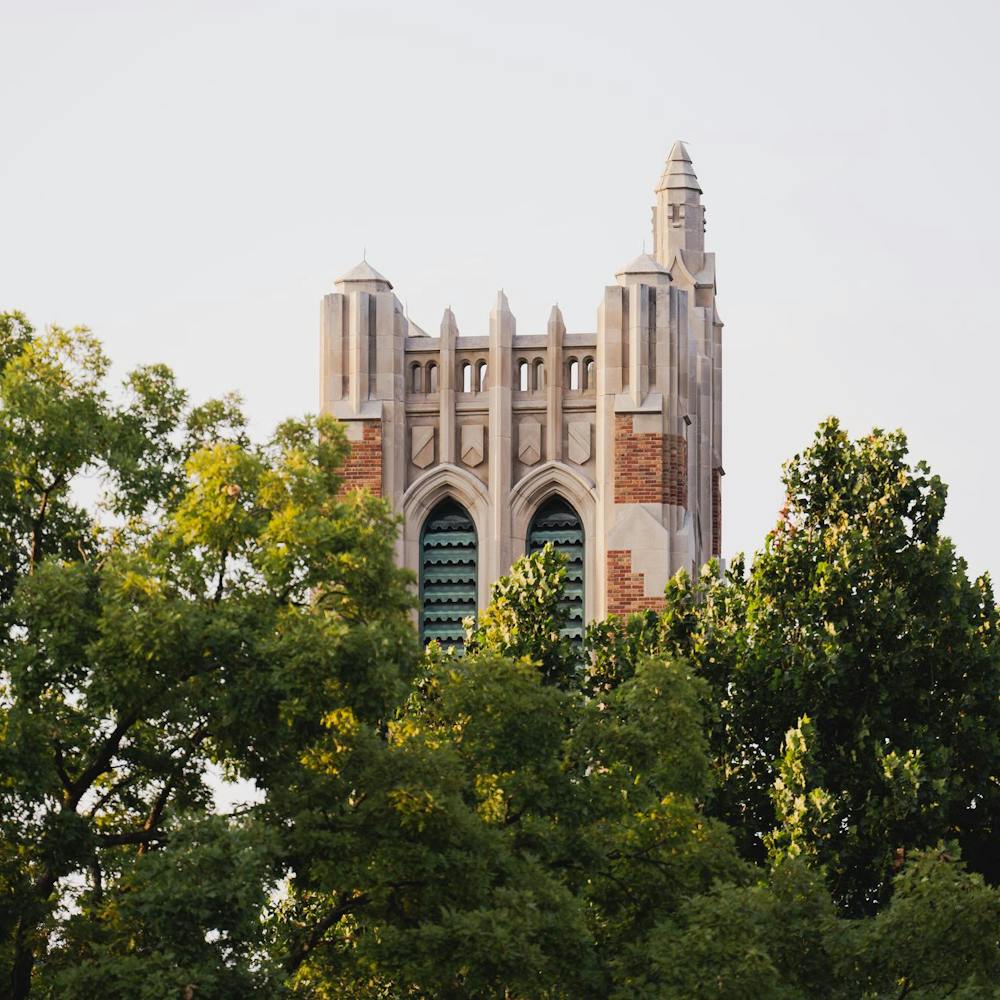
Pie-throwing students, jeans with tails and a university president who knew every faculty member by name have all cruised across the green grass of the MSU campus in the past 50 years.
Norman Abeles and Mordechai Kreinin are two professors who have been along for the ride - teaching thousands of students, grading countless exams and even witnessing three Rose Bowl victories - proving that a half decade of teaching yields more than an in-depth view into economics and psychology.
And don't expect them to slow down anytime soon.
Welcome home
"About 3 feet," Abeles said, as he stretched his arms across his desk, showing the size of computers at MSU in the '50s.
They were slow, needed air conditioning and some even had punch cards.
Abeles, a psychology professor, was here when campus had 17,000 students and 1,500 faculty.
Former President John A. Hannah (1941-69) would meet faculty in the Union, shake all their hands and remember their names, Abeles saide.
"That was his signature mark in that point in time," he said.
"He knew what to emphasize," he said. "He built (MSU) to a take-off point - he got us to this position."
Abeles said people spoke well of the university's psychology program, and it seemed like a good place to work.
"It was just about the right size," he said.
When Abeles and Kreinin started teaching, the university was known as Michigan State University of Agriculture and Applied Science. By 1964, the name was changed to Michigan State University.
"The sign of the times"
Students went through an unusual stage in the '60s and '70s, Kreinin said.
Pie throwing.
"I had a big lecture at Wells Hall, and out of the back of my eye, someone threw a pie at me," he said laughing.
He ducked, the pie landed on the chair and the student ran out the front door.
Although that wasn't the only case of pie throwing, he said it was better than the stage where students ran naked through class - especially during the sexual revolution of the time.
"We went through some weird periods," he said. "It was the sign of the times."
In the '50s, Abeles said, ladies wore dresses and guys sported jackets to class.
Tone jeans and jeans with tails were other fads Kreinin witnessed throughout the years.
"But the students were more conservative back then," he said.
That is, until the '60s, Abeles said, when an unusual trend of tan raincoats came along.
"But that died out quickly," he said.
An actor in the classroom
Kreinin, born and raised in Israel, received a bachelor's in economics at the University of Tel-Aviv, in Tel-Aviv, Israel.
He moved to Michigan to get a master's in economics at University of Michigan.
Because he went to U-M - he said a policy did not allow him to teach there - so he made the 65 mile journey to teach at MSU.
When he first started, his undergraduate classes had no more than 100 students and graduate had no more than 30.
Now with up to 600 student lectures, Kreinin has worked out some methods to keep them in control.
"When you teach large classes, you have to be a little bit of an actor," he said.
He sings and tells stories, and if the students are especially shy - he gives them a penny for each question they ask.
"The students say, 'If you gave us a quarter, we'd ask more,'" he said.
Kreinin currently teaches one semester in the fall, and then takes the rest of the year to travel and research. He has taught 10 lectures around the world and has been a university distinguished professor since 1990.
In fall 2006, a student in one of his classes approached Kreinin and told him his parents met in his class.
He didn't believe it.
"Pretty soon, they're going to come up to me and say their grandparents met in my class," he said.
"Lots of weddings come out of those big classes."
He would know - he met his wife in one at U-M.
6 a.m. classes? No way.
Abeles doesn't get very good attendance at his 8 a.m. classes - especially on Mondays, Wednesdays and Fridays.
He has no pity on those who have to wake up early - when Abeles attended University of Texas, classes were held at 6 a.m. to avoid the heat.
"They have never done that here, nor should they," he said laughing.
Abeles moved to the United States from Vienna, Austria, before World War II.
He received his bachelor's in psychology at New York University, before moving to Texas to complete his master's.
Abeles met and married his wife in Texas, and they had two children.
He first entered MSU as an instructor in the Counseling Center.
He was director of the MSU Psychological Clinic and a member of Academic Governance system, among other things, during his time at MSU. He now teaches graduate students in psychology.
He also does extensive research on aging, mood and memory, and the relationship between anxiety and depression in older adults.
Abeles served as president of the American Psychological Association in 1997. His keynote speaker was Elie Wiesel, an American-Jewish novelist, political activist and Holocaust survivor.
One of his fondest memories of MSU was when Wiesel was MSU's 1999 spring convocation speaker.
Exercise the mind and body
Behind Fee Hall are eight tennis courts.
"It's the right spot for me," Kreinin said.
He regularly does water aerobics, plays bridge and works out at the gym, but tennis is what he enjoys most, he said.
For 30 years, Kreinin played paddleball, a sport similar to handball, and the trophies lining the top shelf of his office confirm that. But after a hip replacement nine years ago, Kreinin was reduced from paddleball to tennis, he said.
He has learned to love the sport.
When there's a tennis tournament in town, he watches it.
And when there's one out of town? Well, he watches those, too.
"I go to the U.S. Open every year," he said.
Similarly, Abeles still exercises every day. He said if he could describe himself in one word, it would have to be energetic.
"You have to be active, interested and concerned about the world around you," he said.
It's all about here and now
As far as the future goes, Kreinin isn't worried about it.
"Who knows? I may just drop dead in the classroom," he said, with a laugh. "I'm too young to be thinking about my legacy."
Abeles agreed. He said 50 years is not enough to see real change.
"You wait - there will be people here for 60, 70 or 80 years someday."
Will they be some of them? Tune in again in 10 years to find out.
Colleen Maxwell can be reached at maxwel79@msu.edu.