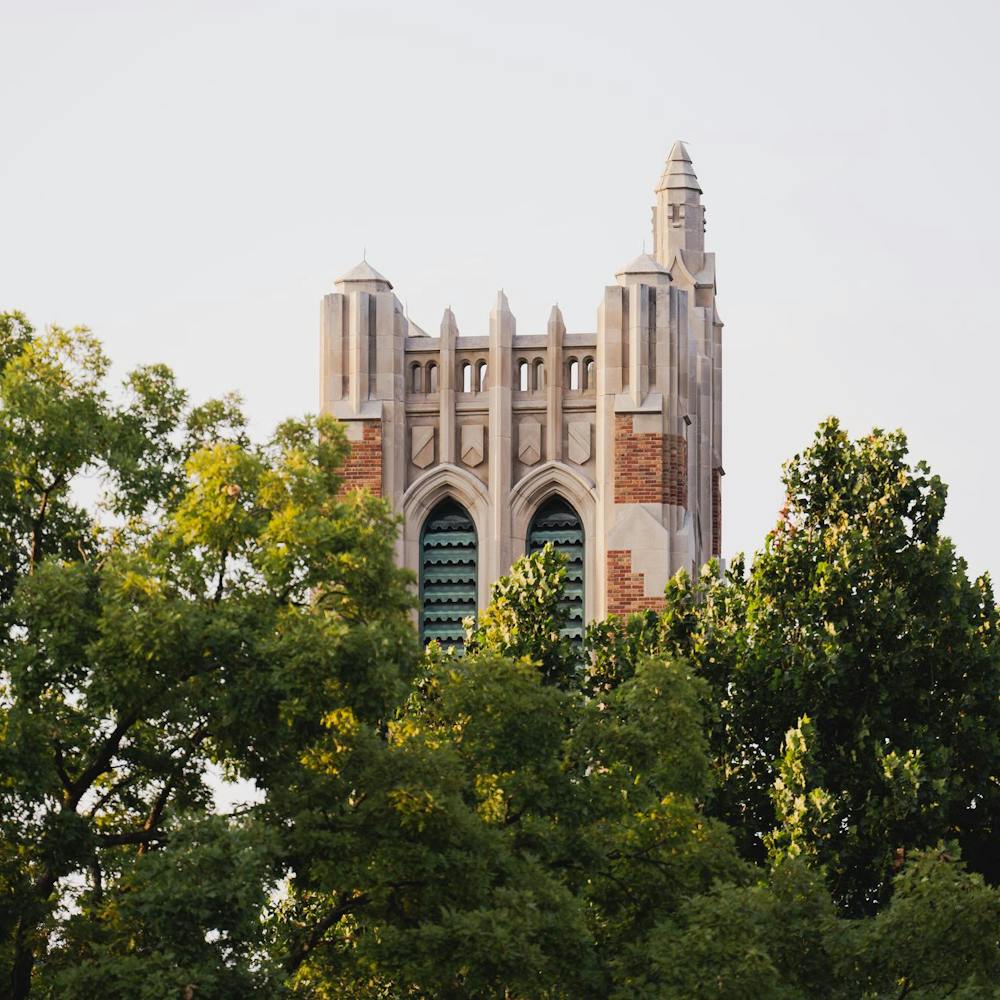
MSU English senior Frank Gottschalk disappeared 10 years ago today.
The 25-year-old took his brother's car without permission and left his Mason home for good that cold February night. Whether he wanted his trip to be permanent is still under investigation by the Ingham County Sheriff's Department. "There was no evidence of foul play, but I wasn't investigating the case," Ingham County Sheriff's Department Det. Billy Mitchell said. The detectives who worked on the case have all since retired, he said. The only clues the department disclosed following the 1997 disappearance include Gottschalk's brother's abandoned vehicle, which was found at the corner of Grand River Avenue and Cedar Street in Lansing, along with two of Gottschalk's bags filled with his belongings on the Shiawassee Street bridge, also in Lansing. Gottschalk's wallet, black leather jacket, watch and Detroit Lions coat were missing from the bags, Gottschalk's mother, Adeline, told The State News in 1997."This is totally out of his realm," she said then. "We were very close and he always calls. It was my birthday on March 5, and he didn't call."
This case follows a trend of missing or drowned college-age men throughout the Midwest in the past 10 years.
Gottschalk's parents could not be reached for comment.
A high school classmate told police he spotted Gottschalk at a submarine shop on Okemos Road on Feb. 22, 1997. The only other lead came in Feb. 10, 2004, when Gottschalk's father called the department with some news, Mitchell said.
"He had gotten a call from Capitol One Visa advising him that Franklin had applied for a credit card and used the dad's name as a reference," he said. "We received a response from Capitol One's security people on Feb. 12 stating they had looked into the application and found no sign of a Franklin Gottschalk."
Police combed the Grand River that flows under the bridge where they found Gottschalk's belongings following his disappearance, but came up empty-handed.
Brian Wilson, a 1996 MSU alumnus who worked with Gottschalk at University Development, said although he didn't know him too well, he liked him.
"He was an interesting person," he said. "He was just one of those quirky kind of people that was clearly never in the 'in' crowd, never the cool kid in school. But I thought he was funny and I really liked the kid."
Adeline Gottschalk told The State News in 1997 that Frank had gone through a rough patch prior to his disappearance. He had planned on graduating from MSU the semester before he went missing, but learned he was three credits short from a degree — the latest blow in a line of "bad luck," she said.
Gottschalk's disappearance came during a semester that played host to a handful of student suicides, during which many students were "freaked out," Wilson said. But Adeline Gottschalk said she thought violence may have contributed to her son's disappearance.
"I don't believe he is voluntarily missing," she told The State News in 1998. "We have not heard anything — not a word."
Connecting the dots
Since Gottschalk's disappearance, two non-MSU students — Kettering University student Ryan Getz and Delta College student Eric Blair — were found drowned in the Red Cedar River.
Getz, 21, was found April 20, 1998, more than four months after he was declared missing New Year's Eve. The former MSU student had lived in Cedar Village apartments and was visiting friends and drinking before he turned up missing.
Blair, 18, was found in the river Oct. 23, 2001, four days after he had been reported missing near Waters Edge Apartments, also while visiting friends.
Although Gottschalk's circumstances differ from the cases of Getz and Blair, all three incidences have been lumped into evidence supporting the urban legend of Interstate 94. The conspiracy theory calls attention to at least 27 deaths or disappearances of college-age males, mostly white, along the I-94 corridor — beginning west in St. Cloud, Minn., and flowing east, ending right here in East Lansing.
Some suspect a serial killer prowling the area. Most cases involve a night of drinking, with the victim straying from friends.
"It was just hard to believe that they would get separated from their friend in every instance," said Leann Long, editor in chief of The Forensic Examiner, a peer-reviewed journal of forensic science. Long wrote an in-depth report on the conspiracy for the Fall 2006 edition.
She said through her research, she couldn't conclude why such a high density of college-age men have ended up drowned or missing.
"Men are more adventurous, so they're the ones to think that they won't drown — those are the reasons from those who don't think it's a serial murderer," she said.
Lt. Bob Berndt of Wisconsin's La Crosse Police Department said each case is individual, and alcohol has always been a factor in their city's drownings. The city has seen eight drownings of college-age men in the past 10 years, he said.
"All have been students who have had very high blood alcohol concentrations that have gotten into Mississippi River," he said. The lowest blood alcohol level from the victims has been 0.2, while the highest has hit 0.42, he said.
"We have confidence that (the deaths) are from a high level of intoxication," he said. "If you look at this on the whole, all over the Midwest, there's a lot of water, and we have the culture of drinking in the Midwest — Wisconsin is definitely part of that."
Lee Gilbertson, a professor in the criminal justice department of St. Cloud State University in Minnesota, where one male student drowned less than a year ago, is analyzing the disappearances and deaths.
"Naturally, the states that have the highest self-reported rates of binge and chronic drinking have most victims," Gilbertson said.
Gilbertson said he's gone to a number of the drowning or missing person sights to collect the police and autopsy reports.
"There are some cases, and they are not all in one town, where I've said, 'Boy, they sure look like they're linked," he said.
Gilbertson said he hopes to have a report out about his analysis by the end of summer.
"Some of the cases I've looked at, they're probably an accident," he said. "There are some that are clearly not an accident, but they are isolated incidents. I'm pretty sure a crime occurred but nothing ever happened (with the law).
"There are several cases through the United States along I-94 that really leave you scratching your head."