Both the state and the university are recycling the old ways they look at trash.
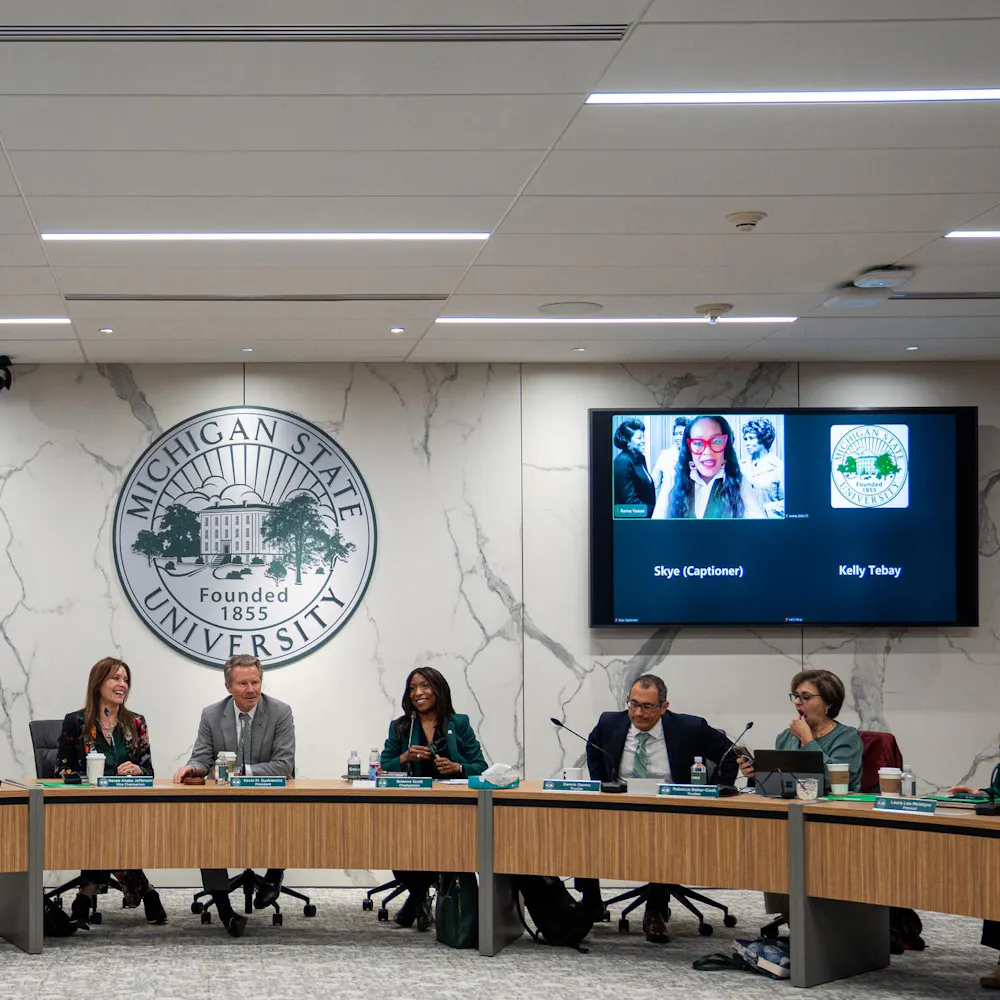
Legislators are working to reduce the amount of garbage Michigan receives from Canada while the MSU Board of Trustees is voting today on the future of a possible expanded recycling center on campus.
"It is everyone's responsibility, not just the university's, to make sure we continue to pick up more trash and recycle," said Roger Cargill, MSU's recycling and waste management operations supervisor. "We live in an environment that can be very wasteful at times, and it is up to everyone to contribute to this effort to make this university cleaner."
In the last year, MSU shipped about 9,000 tons of trash to Granger Waste Management Co.'s Wood Street Landfill in Lansing. Three separate funds pay the trash bill, said Bob Ellerhorst, the director of waste management at the Physical Plant. The academic trash costs the university $740,303, and trash from housing costs $635,000 to ship.
The athletic fund, which deals porting events like basketball and football games, has a running bill that will be added up at the end of the year, Ellerhorst said.
Roughly 1,070 tons of paper products were recycled in the last year. The university ships other recyclables — such as paper, cardboard and scrap metal — across the state and to Ohio.
Recycling containers are located in each residence hall, and officials are working with the waste management department to continue to motivate students to recycle more often, said Angela Brown, the director of housing and food services.
"We are working on a way to expand our recycling efforts," Brown said. "We are picking up more plastic items and bottles now and are hoping to move on to scrap metal, but we just don't have the facilities for that right now."
On Service Road, there is a building where recyclable materials are sorted, but the university doesn't do any on-campus recycling. But MSU could improve its recycling efforts with a new, comprehensive recycling center on Service Road.
The center is estimated to cost about $3.5 million and could be built where the current recycling center is located. Funding for the project is expected to come from surplus and recycling program revenues.
"Most people (trustee members) were very interested in the idea," said Trustee Colleen McNamara. "There are concerns that we don't have one, and I think we are in need of one."
It doesn't matter if there is a new recycling center on campus, said Taylor Smith, a telecommunication, information studies and media sophomore.
"If they put more money into creating another facility, it's not going to make much of a difference," she said. "People who recycle will continue to, and for people who don't, new programs won't matter."
McNamara said with the university having such a recycling-savvy campus, especially among the student population, building a center is the right thing to do.
Chairman David Porteous said students helped the board realize the need for a better facility.
"Now that we know about this recycling center, we can now go through a review and evaluation process and work to see how much this would cost and how this center improves our recycling effort," Porteous said.
MSU is not the only university in the Big Ten to show interest in improving recycling efforts.
The University of Illinois put $1.3 million in the late 1980s toward a new recycling center and updating their transfer station, which helps sort all the recyclable material from the university, said Tim Haas, University of Illinois' recycling and waste management coordinator.
"We deal with close to 14,000 tons a year, and we are recycling close to 49 percent of that material," Haas said. "The state set a bar where 40 percent of garbage has to be recycled back in 1988, but we had been exceeding that long before those regulations."
Blame Canada
A public outcry to halt the truckloads of Canadian trash coming into the state has both major political parties trying to ebb the tide.
Canada will gradually eliminate the amount of solid municipal waste, or city garbage, it imports into the state by 2010, according to an agreement between Michigan legislators and Ontario officials, which was announced by Sens. Debbie Stabenow and Carl Levin, D-Mich., and Rep. John Dingell, D-Dearborn.
U.S. Rep. Mike Rogers, R-Brighton, introduced a bill passed by the House that would allow individual states to regulate the intake of out-of-state solid municipal waste into their landfills. If made into law, Rogers' bill might allow the passage of 2005 Michigan legislation that would ban Canadian trash from the state with the federal government's consent. Rogers' bill is now to the Senate for review.
Neither the agreement with Canadian government officials nor Rogers' Congressional bill cover industrial or commercial waste.
In 2005, 29 percent of all solid waste in state landfills originated outside of Michigan, including Canada and other U.S. states. Only 19 percent, or 12 million cubic yards, of trash deposited in landfills that year was Canadian.
According to a 2005 Michigan Department of Environmental Quality report, Ingham County's Granger Wood Street Landfill takes in trash from other state counties, but not from out-of-state sources.
Although the legislators' announcement isn't binding, some believe it is a more effective solution to a fairly complicated problem.
Deborah Muchmore, vice president of public relation services at Marketing Resource Group, Inc. — whose clientele include the Michigan Waste Industries Association and the city of Toronto — said even if a law is passed, it will likely be quickly disputed in the courts. A complete halt to trash importation isn't a practical possibility because it violates the North American Free Trade Agreement, she said.
"The concern is it may jeopardize the back-and-forth relations we have with Canadians," Muchmore said.
But law getting tripped up by the court system is not a major concern, Rogers' spokeswoman Sylvia Warner said.
"If we were going to be concerned about laws being challenged in court, we would probably never make laws," she said. "That doesn't stop you from filing laws for the good of the people just because someone might sue."
Warner said what is allowed in Canadian solid municipal waste imported into the state can't be adequately regulated and inspected. In some instances, hazardous or medical waste — which is illegal if dumped in a landfill not designated for such waste — has been transferred over the border, she said.
"This is not a local issue for where the landfills are located because this affects every household and commercial business in Michigan," she said. "You have a foreign government dumping its trash in Michigan, and Michigan is unable to stop that or do anything about it."
Efforts in the 1990s to lessen the environmental impact of trash resulted in closing many landfills and upgrading others to be safer and have a larger capacity, Muchmore said.
Landfills nowadays are heavily regulated and expensive to build, she said.
A proposed change in Michigan's dumping charge from 21 cents per ton to $7.50 per ton, which both Michigan residents and out-of-state dumpers would have to pay, would support trash inspections, said Brad van Guilder, community organizer for the Ecology Center in Ann Arbor, a nonprofit organization for environmental advocacy.
Roughly 80 percent of the money gained from imported trash goes back to local governments to improve waste management systems, van Guilder said.
Canada has always been in the forefront of pursuing recycling programs and planned to be reliant on recycling by 2010, Muchmore said. But in the case of Toronto, she said the city needs more time to find a place to store its trash.
The agreement between the Democrats and Canada works because it gives Toronto time to find another way to deposit waste, but it also addresses an issue many residents find "repulsive," Muchmore said.
"Just picture your next door neighbor's trash basket overflowing — say they walk over and put their trash basket in your (dorm) room," she said. "It's essentially the same thing, but on a much larger scale. It's sort of repulsive because it's not yours and you want it gone."
Justin Kroll can be reached at krolljus@msu.edu.
Lindsey Poisson can be reached at poisson4@msu.edu.
State News staff writers Holly Klaft and Kris Turner contributed to this report.