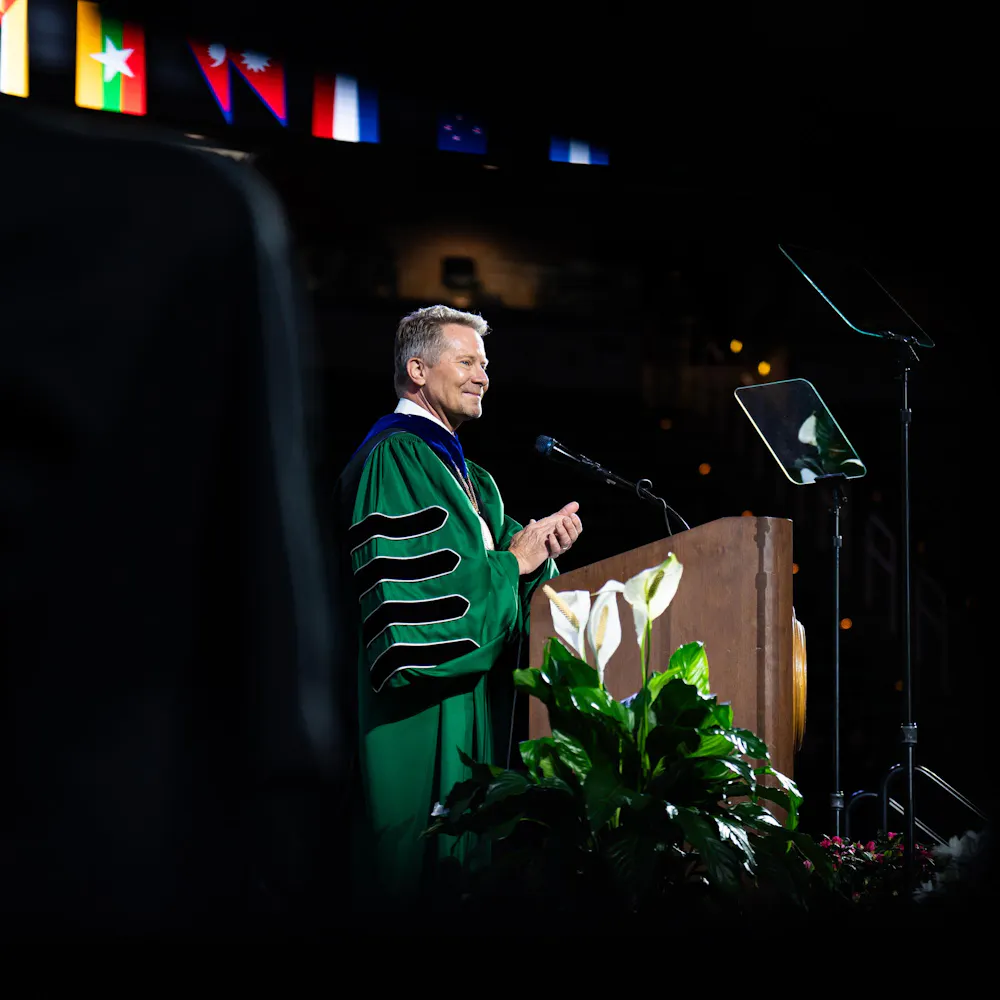
Linguists like Dennis Preston do more than speak a variety of languages.
"People also think that we are the language police and we patrol around making people speak correctly, but we are concerned with what people actually do, not what some think they should do," Preston said.
This MSU professor's research focuses on sociolinguistics — the study of linguistic behavior as influenced by social and cultural factors. He's studying how people's location affects their speech and how people are discriminated against because of the way they talk.
While Preston has done speaking engagements talking about the "Northern Cities Shift," which has changed where vowels are pronounced in sentences and words, he has also done research on linguistic profiling.
And Preston and Nancy Niedzielski, an assistant professor of linguistics at Rice University, have explored the misconceptions about linguistics in their book "Folk Linguistics."
Niedzielski said they wanted to compare what linguist believe to popular beliefs.
"When linguist talk to regular people, we wanted them to know what most people believe already," Niedzielski said. "We also wanted to inform linguist about what is important to non-linguists."
They discovered that there are interesting differences and similarities between popular belief and what linguists have discovered about nature, structure and use of language.
Preston is currently working with three different groups to understand how they learn languages and how where they live affects the way they talk.
Graduate student field workers are recording the language of Polish Americans in Hamtramck, Arab Americans in Dearborn and Mexican Americans in Lansing and Benton Harbor.
"We suspect the Polish Americans in Hamtramck will catch on to the way Michiganders talk but will still have their ethnic pride," Preston said. "A person's identity can be closely connected to their language. Hispanics in Lansing seem to be constructing a special dialect of their own."
Immigrants from the Appalachian area who have settled in such places as Ypsilanti several generations ago have completely lost their earlier speech patterns, although they preserve other cultural features, Preston said.
Linguistics have also found that most blacks do not participate in the linguistic changes.
Research within the industry has shown that ordinary people can detect a black voice with about 80 percent accuracy.
This has led Preston and others to continue to study linguistic profiling, Preston said. In one study, when a speaker called for an apartment using a black dialect, he was told that no apartment was available.
The same speaker called back using a European-American dialect and the apartment suddenly became available.
Niedzielski said she has known Preston for 18 years and he is a fantastic person that you could learn a lot from and have fun all at the same time.
"He has become a colleague and a friend," Niedzielski said. "I will always learn from him no matter how far I go in my career. I have modeled my career after him."
Preston grew up in Louisville, Ky., and went on to earn his doctorate from the University of Wisconsin.
While in college, Preston first fell in love with sounds while acting.
"I always tried to make different sounds and making my voice sound different," he said. "I also had two impressive teachers while in college and I think that they must take part of the blame for my love of linguistics."
Preston did not think he would be a linguist growing up but his family's culture helped spark interest in language and phonetics.
"An entire side of my family is Hungarian. When you are bilingual at a young age it gives you an interest in languages and sounds," he said.